
UGC To Take Over Foreign Degree Equivalency From TU Starting July 17
UGC will take over higher education degree equivalency from TU starting July 17, with new authority over foreign degree recognition, credit transfer and quality assurance.
· 5 min read

KATHMANDU, July 16 — The University Grants Commission (UGC) will begin handling higher education degree equivalency from July 17, taking over the responsibility from Tribhuvan University’s Curriculum Development Centre after a legal amendment shifted the authority to the national higher education regulatory body.
The change means students who earned higher education degrees from foreign universities will now have to follow the UGC process for equivalency instead of applying through TU’s Curriculum Development Centre.
Who Is Taking Over?
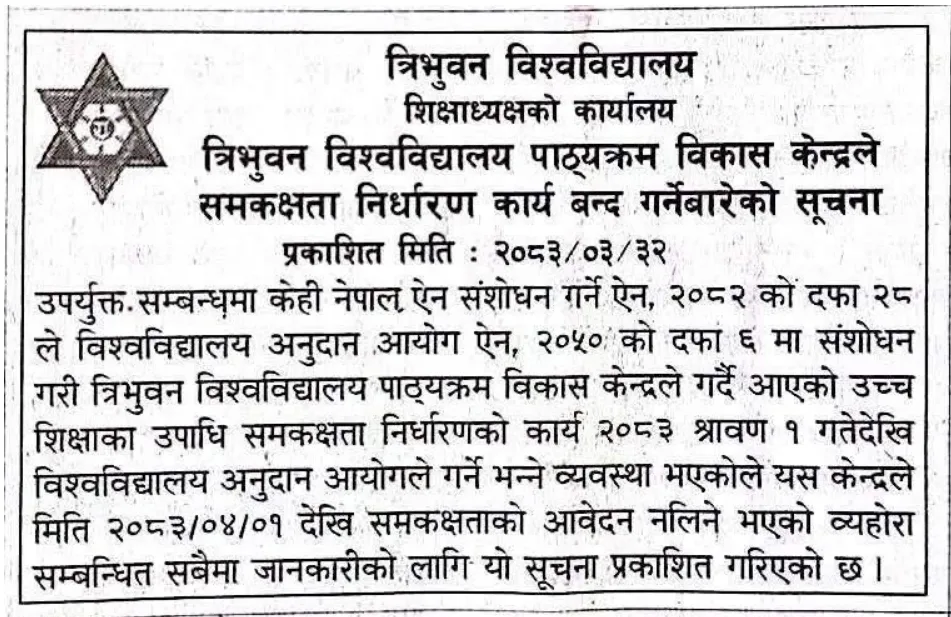
The University Grants Commission has officially taken over the responsibility of determining the equivalency of higher education degrees in Nepal. Following an amendment to Section 6 of the University Grants Commission Act, 2050, through Section 28 of the Some Nepal Acts Amendment Act, 2082, Tribhuvan University's Curriculum Development Centre has stopped accepting new applications for degree equivalency from July 17, 2026.

Previously, TU's Curriculum Development Centre was responsible for evaluating and issuing equivalency certificates, particularly for students who completed their higher education abroad and required official recognition of their qualifications for employment, further studies, or professional licensing in Nepal. Under the new legal provision, these responsibilities have now been transferred to the University Grants Commission.
What Has Changed?
The major change is that TU's Curriculum Development Centre will no longer accept new applications for higher education equivalency from July 17.
The responsibility has now been transferred to the UGC, which will determine whether degrees obtained from foreign universities or equivalent institutions meet Nepal's higher education standards.
The amended law also authorises the UGC to oversee higher education qualification equivalency, credit transfer, quality assurance, and accreditation.
When Will The New System Start?
The new arrangement will come into effect from July 17, 2026.
TU's Curriculum Development Centre issued a notice stating that it will stop accepting new equivalency applications after the legal provision comes into force.
Students who have already received equivalency certificates from TU before the handover will not need to apply again.
Where Should Students Apply Now?
From July 17 onward, students seeking equivalency for foreign higher education degrees will need to apply through the University Grants Commission once its application process is formally announced.
The UGC has not yet published detailed operational guidelines for the new system. It is expected to establish the necessary administrative mechanisms and application procedures for handling equivalency requests.
Officials have also stated that the commission plans to make the process paperless, from application submission to certificate issuance.
Why Was The Authority Shifted?
The transfer follows recommendations made by higher education reform bodies, including the High-Level Education Commission, which proposed that equivalency, credit transfer, and quality assurance should be managed by a national regulatory body rather than by an individual university.
The shift is also expected to reduce the administrative burden on TU's Curriculum Development Centre, allowing it to focus on curriculum development and revision.
How Will The New Equivalency Process Work?
The University Grants Commission has not yet published its detailed operational guidelines for degree equivalency.
However, based on the responsibilities assigned under the amended law and statements made by officials, the process is expected to include the following steps:
Application Submission
Students will submit their applications to the University Grants Commission instead of TU's Curriculum Development Centre.Document Submission
Applicants are expected to provide academic certificates, transcripts, university details, programme information, and other required documents as specified by the UGC.Institution and Programme Verification
The UGC will verify whether the foreign university or institution is recognised and whether the completed programme meets the required academic standards.Qualification Assessment
The commission will assess whether the foreign qualification is equivalent to a recognised higher education degree in Nepal.Certificate Issuance
If the qualification meets the required standards, the UGC will issue an equivalency certificate.
The detailed requirements and procedures will be announced by the commission once the system becomes operational.
What About Domestic Universities?
The amended law is expected to improve the management of equivalency matters across Nepal's higher education system. UGC officials have indicated that the new framework may help address longstanding issues related to equivalency requirements among domestic universities.
However, the commission has not yet announced detailed regulations regarding whether equivalency certificates will continue to be required between universities established under Nepal's laws.
What About Credit Transfer?
The amended law authorises the UGC to oversee higher education credit transfer.
Credit transfer allows students to continue their studies at another institution by recognising academic credits already earned. This is particularly important for students who transfer universities, return from foreign institutions, or are unable to complete their studies at the same institution.
UGC officials have stated that the commission plans to develop national standards for credit transfer. Discussions have also been held regarding the possibility of introducing a credit bank system to facilitate academic mobility among higher education institutions.
What About Quality Assurance?
The amended law also strengthens the UGC's legal mandate to oversee Quality Assurance and Accreditation (QAA) in higher education.
Quality Assurance and Accreditation is a process that evaluates whether higher education institutions meet required academic and institutional standards. These include areas such as faculty-student ratios, library and laboratory facilities, infrastructure, institutional management, and other quality benchmarks.
Only a limited number of higher education institutions in Nepal have received QAA certification so far, despite the large number of campuses operating across the country.
Why This Matters For Students
For students, the change has the potential to make the equivalency process more uniform if the UGC successfully introduces clear standards, online applications, and regular updates on recognised qualifications and institutions.
However, the transition period may also create confusion if students are not clearly informed about where to apply, what documents are required, and when the new application system will become fully operational.
Students preparing for government jobs, professional licensing, further studies, or migration-related documentation should closely follow official UGC announcements before submitting applications.
What Happens Next?
The University Grants Commission must now finalise operational procedures, establish the necessary administrative mechanisms, publish clear guidelines, and launch a student-friendly application system.
The success of the reform will depend on how efficiently and transparently the commission manages the transition from TU and whether students are able to access services without unnecessary delays.
Published Jul 16 in Nepal