
Arrest Does Not Mean Handcuffs: Supreme Court Sets Limits for Nepal Police
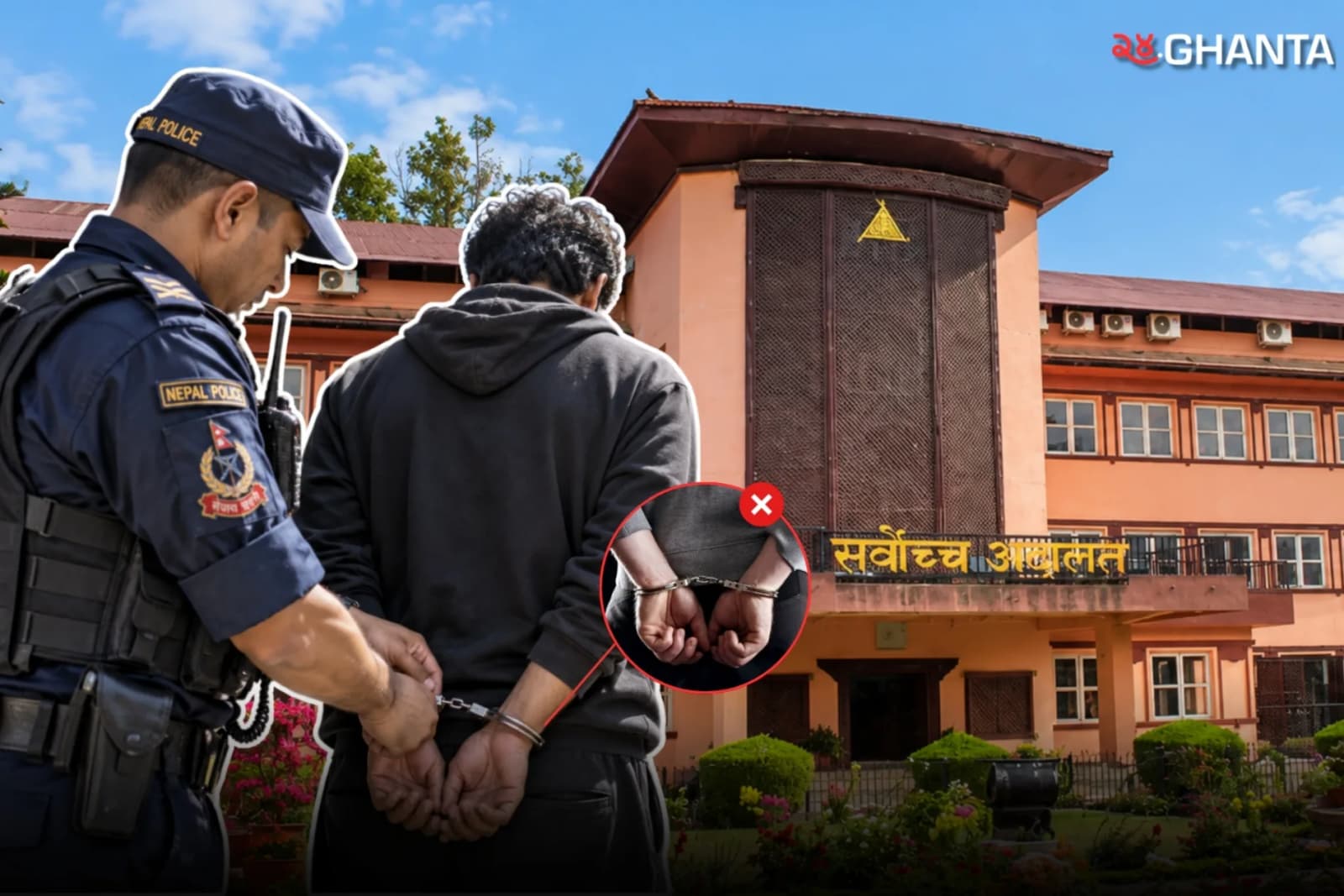
The Supreme Court has ordered Nepal Police to stop routinely handcuffing every person arrested for investigation, ruling that restraints should be used only after an objective assessment finds a genuine risk of escape, violent resistance, or harm to the arrested person or others. The interim order, issued by a joint bench of Justices Nahakul Subedi and Shanti Singh Thapa, also requires police to record why handcuffs were considered necessary in each case.
· 4 min read
Kathmandu, September 22, 2026
Arrest Will Not Automatically Mean Handcuffs
The Supreme Court on September 21 ordered Nepal Police Headquarters to stop automatically handcuffing people simply because they have been arrested or accused, after Nepal Law Campus students Bibek Chaudhary, Roshan Auji and Bikash Yadav challenged the practice through a public-interest writ. The court said police must assess the circumstances of each arrest and may use handcuffs only when specific risks make restraints necessary, with the aim of preventing routine and unjustified use during criminal investigations.
Three Situations Where Handcuffs Can Be Used
The Supreme Court identified three main circumstances that can justify the use of handcuffs.

First, police can consider restraints when there is a genuine risk that the arrested person could escape. That assessment may take into account the allegation, seriousness of the alleged offense and the person's background.
Second, handcuffs can be used when an arrested person displays violent behavior or there is an objectively assessed risk that they may violently resist police.
Third, restraints may be used when there is a risk that the arrested person could harm themselves or another person.
Police Must Explain Why
The ruling does not completely prohibit handcuffs. Instead, it changes them from something used automatically after an arrest into a measure that must be justified by the circumstances.
The court said police officers must make an objective assessment before deciding that handcuffs are unavoidable for carrying out their legal responsibilities. When handcuffs are used, the reason must be recorded.
Why Was the Case Filed?
The case began with a public-interest writ filed by Nepal Law Campus students Roshan Auji, Bikash Yadav and Bibek Chaudhary.
The petition challenged the practice of placing people in handcuffs merely because they had been accused or arrested. The Office of the Prime Minister and Council of Ministers, Ministry of Home Affairs, Nepal Police Headquarters and Press Council Nepal were among the defendants named in the case.
Petitioners Raised Fundamental Rights Concerns
The petitioners argued that handcuffs should be an exceptional security measure rather than a routine part of arrest.
They linked unnecessary handcuffing to constitutional protections concerning human dignity, personal liberty and the principle that an accused person should not be treated as guilty before conviction.
They also asked for tighter restrictions on unnecessarily publishing photographs and videos of arrested people in handcuffs, arguing that such images can publicly portray suspects as criminals before their cases have been decided.
Court Had Earlier Asked for Answers
The case first reached the Supreme Court earlier this month. On September 10, a single bench of Justice Meghraj Pokharel issued a show-cause order requiring the defendants to submit written responses.
Because the petition involved questions of fundamental rights, human rights and detention practices, the court gave the case priority and scheduled a hearing on the request for an interim order for September 21.
Existing Law Lacks Clear Handcuff Standards
An important issue identified during the case is the absence of detailed legal standards specifically determining when handcuffs should or should not be used.
Existing provisions allow police to use necessary force in situations such as preventing an arrested person from escaping, but the Supreme Court noted the lack of sufficiently clear standards governing the specific use of handcuffs.
The interim order therefore establishes conditions police must follow while the case remains pending or until separate legal provisions or standards are introduced.
Order Remains Until Case Is Settled
The Supreme Court's decision is an interim order rather than the final judgment in the case.
The restriction on routine handcuffing will remain in place until the writ petition is finally decided or until new legal provisions or standards governing handcuff use are introduced.
For Nepal Police, the immediate message is clear: an arrest alone will no longer be enough to justify handcuffs. Officers must first identify a specific risk, determine that restraints are necessary, and keep a record explaining the decision.
Published Yesterday in Nepal