
Found Gold Under Your Land? It May Not Be Yours. Found Illegal Items? You Could Still Face Trouble. Here’s What Nepal's Law Says
Nepal’s law treats valuable discoveries and illegal items found on private property differently because ownership, possession, and responsibility are separate legal concepts. While minerals and archaeological objects may come under government protection, a person is not automatically guilty simply because illegal items are found on their property.
· 6 min read
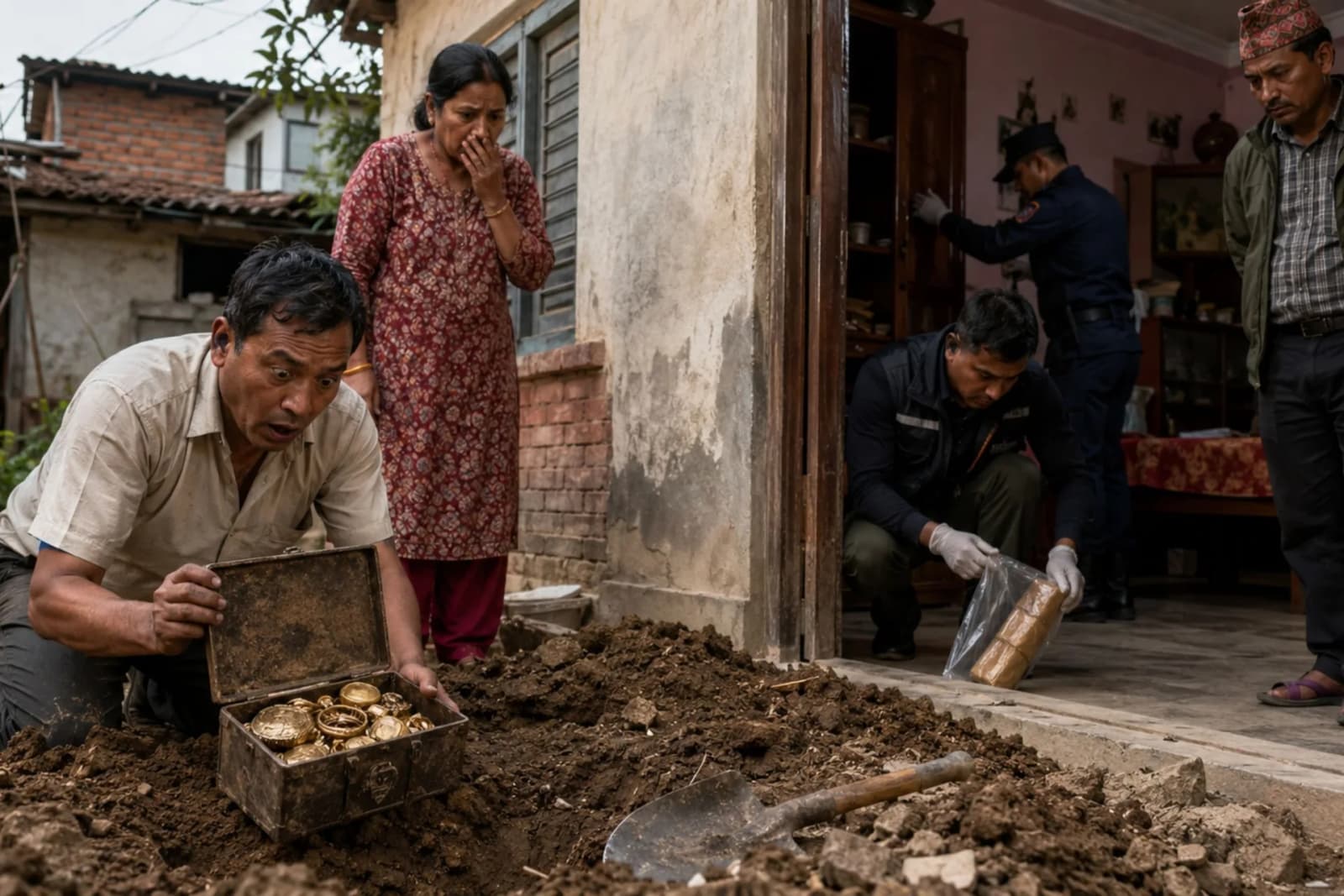
Imagine digging in your backyard and suddenly finding something buried deep under the ground. Maybe it is a box of old coins, a piece of gold, or something that looks like it could be worth a fortune.
For a moment, you might think your life has changed.
But under Nepal’s law, finding something valuable does not always mean you become its owner.

Now imagine the opposite situation. Police search a house, rented room, or piece of land and discover illegal items such as drugs, an unlicensed weapon, or smuggled goods. The first question people often ask is: “It was found on my property. Am I responsible?”
These two situations seem completely different, but they are connected by one important legal question:
Does owning a property mean you own everything found there, or are you responsible for everything discovered there?
Nepali law makes a clear distinction between ownership, possession, and legal responsibility. Understanding this difference can help you know your rights and responsibilities before you ever face such a situation.
Finding Something Valuable Under Your Land Does Not Automatically Make It Yours
Many people assume that if something is found inside their property, it automatically belongs to them.
But legally, that is not always true.
Nepal’s National Civil Code, 2074 (2017), separates the idea of owning land from the ownership of certain things found within or under that land.
The Civil Code lists certain properties as belonging to the government. Under Section 299, mines and minerals are considered government property.
This means if someone discovers a natural mineral resource, such as gold ore or another valuable mineral deposit beneath their land, they cannot simply claim it as personal property.
The land may belong to the person, but the mineral resource follows a different legal rule.
Gold Ore, Old Coins, And Ancient Objects Follow Different Laws
Not everything found underground is treated the same way.
A natural gold deposit and an old historical gold coin may look similar in value, but legally they are different.
If it is a mineral resource
Minerals, including underground resources, fall under government ownership rules. The Mines and Minerals Act, 2042 also regulates the exploration and extraction of minerals in Nepal.
A person cannot simply start mining valuable resources found on their land without following the required legal process and obtaining permission.
If it is an archaeological object
Old coins, statues, historical items, inscriptions, or other archaeological objects are handled differently.
Under Nepal’s Ancient Monument Preservation Act, 2013 BS, archaeological objects discovered in Nepal are protected by the state. Such items cannot simply be sold, destroyed, or taken outside the country without permission.
So finding an ancient statue while digging your land does not mean you can put it on display in your living room or sell it to the highest bidder.
Why Does The Government Protect These Discoveries?
The reason is simple: some discoveries are considered important not only for their financial value but also because they may represent Nepal’s history, culture, or natural resources.
A historical statue may tell a story about Nepal’s past.
A mineral deposit may belong to the country’s natural resources.
That is why the law treats some discoveries differently from ordinary personal property.
But If Illegal Items Are Found On Your Property, Are You Automatically Guilty?
This is where many people misunderstand the law.
If police discover illegal items on your property, it does not automatically mean you committed a crime.
Simply owning a house, land, or room does not by itself prove that you knew about those items.
The important legal questions usually become:
Did you know the item was there?
Did you have control over that place?
Did you have any connection with the illegal activity?
Who else had access to the property?
For example, a homeowner and a tenant may have completely different legal positions if illegal items are found inside a rented room.
Why Illegal Items Can Still Create Serious Problems
Although ownership alone does not automatically make someone guilty, finding illegal items on your property can create serious legal trouble.
Authorities may investigate:
Who had access to the location?
Who placed the item there?
Who knew about it?
Who controlled the area?
In some cases, the person connected to the property may need to explain their relationship with the item and provide evidence showing they were not involved.
Drug Cases Are Especially Serious Under Nepali Law
Drug-related cases are handled strictly in Nepal.
The Narcotic Drugs (Control) Act, 2033 prohibits activities including the illegal possession, storage, transportation, production, and sale of narcotic substances.
If illegal drugs are found in a place connected to you, the situation can become legally complicated.
Evidence becomes extremely important, including:
Who lived there?
Who had access?
Whether someone else could have placed the substance there
Whether there is proof showing lack of involvement
A person should not assume that the situation will solve itself simply by saying, “I did not know.”
The Difference Between Ownership, Possession, And Responsibility
This entire issue comes down to three different legal ideas.
Ownership
Ownership means something legally belongs to you.
Example:
Your house
Your registered land
Your personal belongings
Possession
Possession means you have control over something, even if you may not legally own it.
Example:
A rented room you live in
Items kept under your control
Responsibility
Legal responsibility depends on the facts of the case, including knowledge, control, and involvement.
Owning a property does not always mean you own everything found there.
And it does not always mean you are automatically guilty of everything discovered there.
What Should You Do If You Find Something Suspicious?
If you discover something valuable or unusual:
Do not immediately sell it or hide it
You may not know whether it is a normal valuable item, an archaeological object, or a protected resource.
Report important discoveries
Especially if the item appears old, historical, or connected to archaeology.
Do not extract underground resources yourself
Mining valuable resources without proper authorization can create legal problems.
If illegal items are discovered on your property
Cooperate with authorities
Understand your rights
Keep records of who had access to the property
Seek legal advice before making statements that could affect your case
The Real Lesson: Your Property Gives You Rights, But It Also Comes With Responsibilities
Finding something valuable under your land may sound like winning a lottery, but Nepal’s law does not always see it that way.
Some discoveries belong to the state because they involve national resources or cultural heritage.
At the same time, finding illegal items on your property does not automatically make you a criminal. The law looks deeper into questions of knowledge, possession, and control.
The important thing to remember is this:
Owning land does not mean you own everything connected to it; neither does it mean you are responsible for everything that happens there without proof.
Understanding the difference can protect your rights when unexpected situations arise.
Sources
National Civil Code, 2074 (2017), Section 299 Government ownership of mines and minerals
Mines and Minerals Act, 2042 (1985) Government authority over mining and exploration licensing
Ancient Monument Preservation Act, 2013 BS (1956), Section 13 Restriction on transfer, export, and transaction of archaeological objects
Narcotic Drugs (Control) Act, 2033 (1976), Sections 4 & 12 Prohibited acts relating to narcotic drugs; burden of proof on the person in possession
Published Aug 7 in Researched Article