
When Kathmandu Announced Gambling With Gunfire: The Forgotten History Behind Nepal's Playing Cards
More than a century ago, Kathmandu reportedly announced the start of permitted festival gambling by firing a gun, according to a 1912 historical account. Government records also reveal detailed gambling regulations and a remarkable 1902 bidding process for gambling licenses in Asan. The article explores Nepal's forgotten festival traditions alongside the history of playing cards, from circular Ganjifa decks to today's familiar 52 cards.
· 14 min read
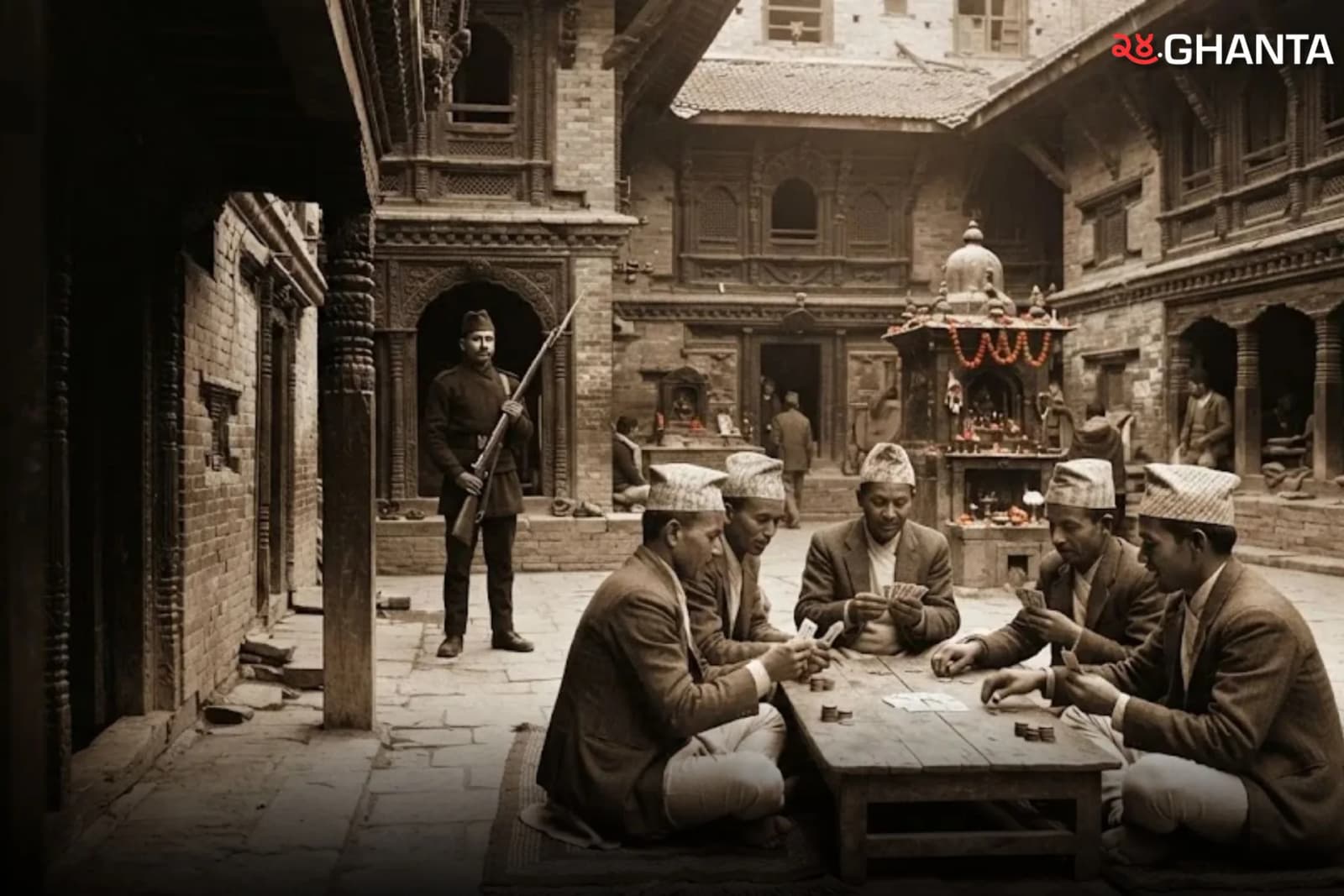
More than a century ago, a gunshot could signal the beginning of officially permitted gambling in Kathmandu. The government even auctioned licenses to operate gambling activities, while traditional playing cards looked nothing like the ones we use today. Behind Nepal's familiar Dashain and Tihar card games lies a surprising history of kings, changing laws, money, and traditions.
When a Gunshot Meant Gambling Could Begin
Imagine walking through Kathmandu more than a hundred years ago.
It is festival season. People are visiting relatives, markets are busy, and families are gathering to celebrate Dashain and Tihar.

Then, suddenly, a gunshot rings out.
It is not necessarily a warning of danger. According to an account published in 1912, it signals something that would seem unusual today: the start of officially permitted festival gambling.
British writer Percy Brown described this practice in his book Picturesque Nepal, published after his travels in the Kathmandu Valley. In Chapter XI, titled Sketches, Brown wrote that the authorities announced when gambling could begin by firing a gun. Once the signal was given, groups gathered in streets, public squares, houses, and shops. Some played cards. Others rolled dice or bet on cowrie shells. People moved between games, watching the players and reacting to unexpected wins and losses.
Brown described a type of cowrie shell game called Tommy Dod, in which players shook and threw 15 shells onto a board before betting on which side would appear more frequently.
However, Brown was a foreign visitor describing what he observed and understood at the time. His account does not establish that gunfire announcements happened everywhere in Nepal or during every festival.
Some sensational gambling stories repeated by travelers of that period also lack independent confirmation.
Still, the description leaves us with an intriguing question.
Why would a government that considered gambling a social problem also announce when people were allowed to participate?
To understand that contradiction, we have to look further back into Nepal's history.
The Kings Who Tried to Stop Gambling
Gambling was a concern for Nepal's rulers long before the Rana period.
Historical research by Simon Cubelic, published in 2018, discusses how gambling regulations evolved under the Malla, Shah, and Rana rulers.
One historical regulation associated with Kathmandu's King Mahendra Malla, who ruled in the 16th century, prohibited gambling. The prohibition appears in historical material later translated and discussed by scholars, including Mahesh Chandra Regmi.
After Prithvi Narayan Shah established control over the Kathmandu Valley, gambling also faced a ban under his rule, according to the historical research cited by Cubelic. Such restrictions were connected with ideas about social discipline, proper conduct, and the financial consequences of gambling.
But the rules did not remain the same.
In 1798, during King Rana Bahadur Shah's reign, gambling was permitted during the Teej festival. Historical research also identifies later permissions associated with Tihar.
This was not an unrestricted nationwide right to gamble.
Different regions could have different rules, and permission during a festival did not necessarily mean that gambling was legal throughout the year.
The change is significant because it shows how rulers were trying to balance two competing concerns. On one side was the desire to control gambling and protect people from financial harm.
On the other was the reality that gambling had become connected with certain cultural and festival practices.
What rulers tried to prohibit on ordinary days could sometimes be permitted during a festival.
And by the middle of the 19th century, the rules became even more detailed.
When Gambling Had Its Own Chapter in Nepal's Law
In 1854, during Jung Bahadur Rana's rule, Nepal introduced the Muluki Ain, an extensive legal code addressing many aspects of society.
Among its provisions was a chapter specifically dedicated to gambling.
Chapter 75, titled On Gambling, included 16 sections regulating the activity.
The legal code has been translated into English and studied by Rajan Khatiwoda, Simon Cubelic, and Axel Michaels in The Muluki Ain of 1854: Nepal's First Legal Code, published by Heidelberg University Publishing in 2021.
The law generally restricted gambling but provided exceptions during Yama Panchak, the five day Tihar period, and certain other permitted occasions. However, being allowed to gamble did not mean people could wager whatever they wanted.
The regulations addressed financial risks. They restricted betting beyond the cash available to a player, borrowing money for gambling, using certain property as stakes, and involving minors.
The concern was straightforward: gambling could turn entertainment into a serious financial problem. A person might begin by betting a small amount but eventually lose savings, borrow money, or put family property at risk.
These concerns were also reflected in an 1855 copper plate inscription issued in the name of King Surendra.
As discussed in Cubelic's research, the inscription referred to people falling into poverty and debt because of gambling and used those consequences to justify stronger controls.
That means debates about gambling's social and economic effects were already taking place in Nepal more than 170 years ago. But there was another side to the government's relationship with gambling.
The state was not only trying to control it. The state could also earn money from it.
And one remarkable event in Kathmandu's Asan market shows exactly how.
The Gambling Auction That Took Place in Asan
In 1902, the busy market area surrounding Annapurna Temple in Kathmandu's Asan became the setting for an unusual government bidding process.
The prize was not a piece of land, a building, or a supply contract. It was permission to operate gambling activities.
The event is documented in historical administrative records examined by researcher Simon Cubelic and preserved through the Documenta Nepalica project.
According to the records, a man named Meheraman Nhuche Pradhan, from Itumbahal, offered to pay 35 mohar rupees annually for the license. The government published a notice allowing other interested bidders to offer more.
On the sixth day, another man named Krishna Bir entered the competition. He offered two mohar rupees more than Meheraman. That brought the amount to 37 mohar rupees.
Meheraman responded by raising his offer by another three mohar rupees, taking the bid to 40. With no further offer received during the announced period, his proposal was initially accepted.
That might sound like the end of an ordinary government auction.
But the story took another turn.
A man named Kulratna Udas, from Asan, submitted a petition explaining that he had been unable to participate before the deadline because he was attending a death related ritual. His request created a dispute between officials. One authority considered allowing him to join the competition, while others argued that the original process had already been completed.
Eventually, the competition was reopened.
Because Dashain was approaching, the authorities arranged another round of bidding rather than following the earlier process in exactly the same way.
The amount began to rise again.
Surviving documents discussed by Cubelic show later bids reaching as high as 84 mohar rupees. That was more than twice the original offer of 35 mohar rupees.
However, the surviving evidence does not conclusively establish every step of the final award. It would therefore be misleading to state that the license was definitely granted at 84 mohar rupees.
More than a century ago, the government was collecting revenue by granting licenses for gambling activities, and people were competing for those licenses through official bidding.
The incident also reveals something about how government administration worked during the Rana period.
There were notices, deadlines, petitions, competing officials' opinions, and decisions that could change the original bidding process. It was not simply a matter of rulers giving permission whenever they pleased.
Gambling was part of a complicated relationship between law, administration, business, and government revenue.
A Strange Contradiction in Rana Era Nepal
The government recognized that gambling could push people into debt and financial hardship. It introduced rules to restrict how people participated. Yet the same government could also collect revenue from licenses that permitted gambling activities.
Was it trying to protect the public, earn money, or accommodate an existing tradition?
The historical evidence suggests that these different interests could exist at the same time. Cubelic's research shows that gambling laws were not simply written and enforced without discussion. Their implementation involved negotiations between officials and members of society.
The Asan auction is a striking example.
It also demonstrates why history is often more complicated than a simple story of good rules and bad behavior. The state was attempting to manage an activity that was socially familiar, financially risky, and potentially profitable.
But there is another fascinating part of this history that goes beyond gambling regulations.
It concerns the playing cards themselves.
Kathmandu Once Had Playing Cards That Were Round
Think about the cards used in a game of Marriage, Flush, or Call Break today. They are rectangular, easy to shuffle, and usually decorated with hearts, diamonds, clubs, and spades.
Now imagine sitting down to play with cards shaped like small circles instead.
According to Percy Brown's 1912 account, such cards could still be found in Kathmandu. Brown wrote that European playing cards were widely used, but older circular Indian cards also remained in circulation.
He described those round cards as being made from layers of paper material and noted that they were gradually disappearing. Traditional playing cards known as Ganjifa were used in different forms across the region.
The Indira Gandhi National Centre for the Arts, an institution under India's Ministry of Culture, documents these cards and their elaborate designs.
A common form of Mughal Ganjifa had eight suits containing 12 cards each.
That meant a deck of 96 cards rather than the modern 52.
Some Dashavatara Ganjifa decks had ten suits of 12 cards, producing a set of 120 cards. These cards often featured colorful illustrations inspired by religious stories, royal culture, and artistic traditions.
The institution also identifies Nepal among regions historically associated with Dashavatara Ganjifa.
However, the evidence has limits.
Brown did not identify exactly which type of circular cards he saw in Kathmandu. Their appearance resembles Ganjifa, but the surviving account is insufficient to establish their precise version or when they first arrived in Nepal.
Still, the larger point is fascinating.
The familiar 52 card deck was not the only kind of playing card known in this part of the world.
Cards varied in shape, artwork, symbols, and number depending on the communities that made and used them.
A 550 Year Old Deck Preserved in New York
A remarkable example of this variety can be found thousands of miles away, at The Metropolitan Museum of Art in New York.
The museum preserves a collection known as The Cloisters Playing Cards.
Made around 1475 to 1480 in the Burgundian territories of the southern Netherlands, the collection contains 52 cards.
The number is familiar. The designs are not.
Instead of the usual hearts, diamonds, clubs, and spades, the cards are divided into four suits featuring objects associated with hunting. Those symbols are hunting horns, dog collars, hound tethers, and game nooses. Each suit includes ten numbered cards and three court cards: a king, queen, and knave.
The cards were produced using layers of paper decorated with ink, paint, silver, and gold.The royal figures wear elaborate clothing that reflects the artistic fashions of medieval Europe.
Museum researchers suggest that some costumes may even have been intended as a playful criticism of the extravagant clothing worn at the Burgundian court.
But the most surprising detail may be their condition.
The cards appear to have received very little use.
Researchers believe they may have been created as a luxury collector's item rather than a deck intended for everyday card games. The Met identifies the collection as the only known complete surviving deck of illuminated ordinary playing cards from the 15th century.
That does not mean the cards were the first 52 card deck ever made.
Instead, they provide rare physical evidence of what some playing cards looked like more than five centuries ago. The collection also reminds us that playing cards were once much more than inexpensive objects used for entertainment.
They could be works of art, displays of wealth, and reflections of the society that created them.
Where Did Our Familiar 52 Cards Come From?
The origins of playing cards are not completely settled.
Historians generally connect their early development with Asian gaming traditions, while surviving evidence shows that their designs changed significantly as they spread between societies.
One important part of the story comes from Egypt's Mamluk period.
According to the International Playing Card Society, a historical collection of Mamluk cards preserved in Istanbul's Topkapi Palace Museum helps explain the development of later European decks.
The reconstructed Mamluk deck contained 52 cards divided into four suits.
Instead of today's familiar symbols, those suits represented swords, coins, cups, and polo sticks. Each suit contained ten numbered cards and three court cards. The structure is remarkably similar to a modern 52 card deck.
But the designs changed as cards moved into different cultures. In parts of Europe, swords, coins, cups, and clubs or batons became familiar suit symbols.
Later, French cardmakers developed the hearts, diamonds, clubs, and spades that eventually spread internationally. Over time, printing made playing cards easier and cheaper to produce.
They became more accessible to ordinary people rather than remaining expensive handmade objects associated with wealthy households and royal courts.
The court cards changed too.
Different traditions featured kings, deputies, queens, knights, and servants.
The familiar king, queen, and jack developed through these changing European designs.
Even the Joker, which many people associate with a standard modern deck, was not originally part of early 52 card decks. It developed in the United States during the 19th century, particularly through card playing traditions associated with the game Euchre.
So, who invented today's playing cards?
There is no single confirmed inventor of the modern deck.
What we hold in our hands today is the result of centuries of changes in art, commerce, technology, and entertainment.
From Ancient Courts to Nepali Living Rooms
Now return to a familiar scene in Nepal.
It is Dashain or Tihar.
Relatives have gathered. Someone brings out a deck of cards. A few people begin playing while others watch, laugh, and comment on the game. Someone prefers Marriage. Another wants to play Flush. Someone else suggests Call Break.
For many families, card games have become part of the social atmosphere of festival celebrations.
But there is a difference between knowing that a tradition is old and knowing exactly how it began. The historical evidence establishes that gambling was connected with certain festivals in Nepal centuries ago.
It also establishes that governments introduced restrictions, created festival exceptions, and even granted licenses for gambling activities.
What it does not establish is a continuous, fully documented path from those older practices to every card game played in Nepali households today.
The specific origins of popular games such as Marriage in Nepal remain difficult to establish with certainty.
It is also important to distinguish playing cards from gambling.
People can play cards simply for entertainment, without betting money. Gambling introduces financial stakes and legal concerns.
Likewise, the fact that historical authorities sometimes permitted gambling during festivals does not mean the same permissions apply under Nepal's laws today.
Still, the historical connection between festival celebrations, gambling regulations, and card playing culture remains an important part of Nepal's social history.
The Forgotten Stories Behind an Ordinary Deck
A deck of playing cards is easy to overlook. We recognize the numbers, the colors, and the familiar royal figures. We shuffle the cards, play a game, and put them away until next time.
But behind those simple pieces of paper lies a remarkable journey. In Kathmandu, a gunshot reportedly once announced the beginning of permitted festival gambling.
During the Rana period, gambling could be regulated through detailed laws and official licenses. In Asan, bidders competed to operate gambling activities under government permission.
Elsewhere, artists created beautiful circular Ganjifa cards with 96 or 120 pieces, while European craftsmen produced luxury decks decorated with gold and silver. Over centuries, different cultures changed the shapes, suits, and pictures until the familiar 52 card deck became widely used. Yet important questions remain.
When did particular card games first arrive in Nepal? How did older circular cards disappear from everyday use? And how did the playing card traditions we recognize today become closely associated with Dashain and Tihar?
Historical documents offer clues, but they do not provide every answer.
Perhaps some forgotten cards are still preserved in old collections. Perhaps family records or museum archives contain details that researchers have not yet fully explored.
For now, the surviving evidence tells a story that is already extraordinary.
The next time someone deals a hand of cards during Dashain or Tihar, remember that the game on the table carries traces of Nepal's rulers, historic laws, distant civilizations, and centuries of cultural change.
What seems like an ordinary deck of cards has a history far bigger than the game itself.
Sources and Research References
1. Percy Brown (1912) Picturesque Nepal, Chapter XI: Sketches
2. Simon Cubelic (2018) Governing Economic Life in Rana Nepal: The Tender Process for the Gambling License at the Market Square of Asan in 1902
3. Documenta Nepalica Historical Asan Gambling License Record (1902)
4. Rajan Khatiwoda, Simon Cubelic, and Axel Michaels (2021) The Muluki Ain of 1854: Nepal's First Legal Code
5. The Metropolitan Museum of Art The Cloisters Playing Cards (ca. 1475 to 1480)
6. Indira Gandhi National Centre for the Arts Ganjifa Cards
7. International Playing Card Society An Introduction
Published 13 hours ago in Researched Article