
The Hidden Cost of Kathmandu Traffic: What Are Traffic Jams Really Costing Us?
Kathmandu’s daily traffic jams are creating a hidden economic cost through wasted time, extra fuel use, and reduced productivity. While no single figure shows the city’s total loss, research shows congestion is affecting commuters, businesses, and the wider economy.
· 8 min read
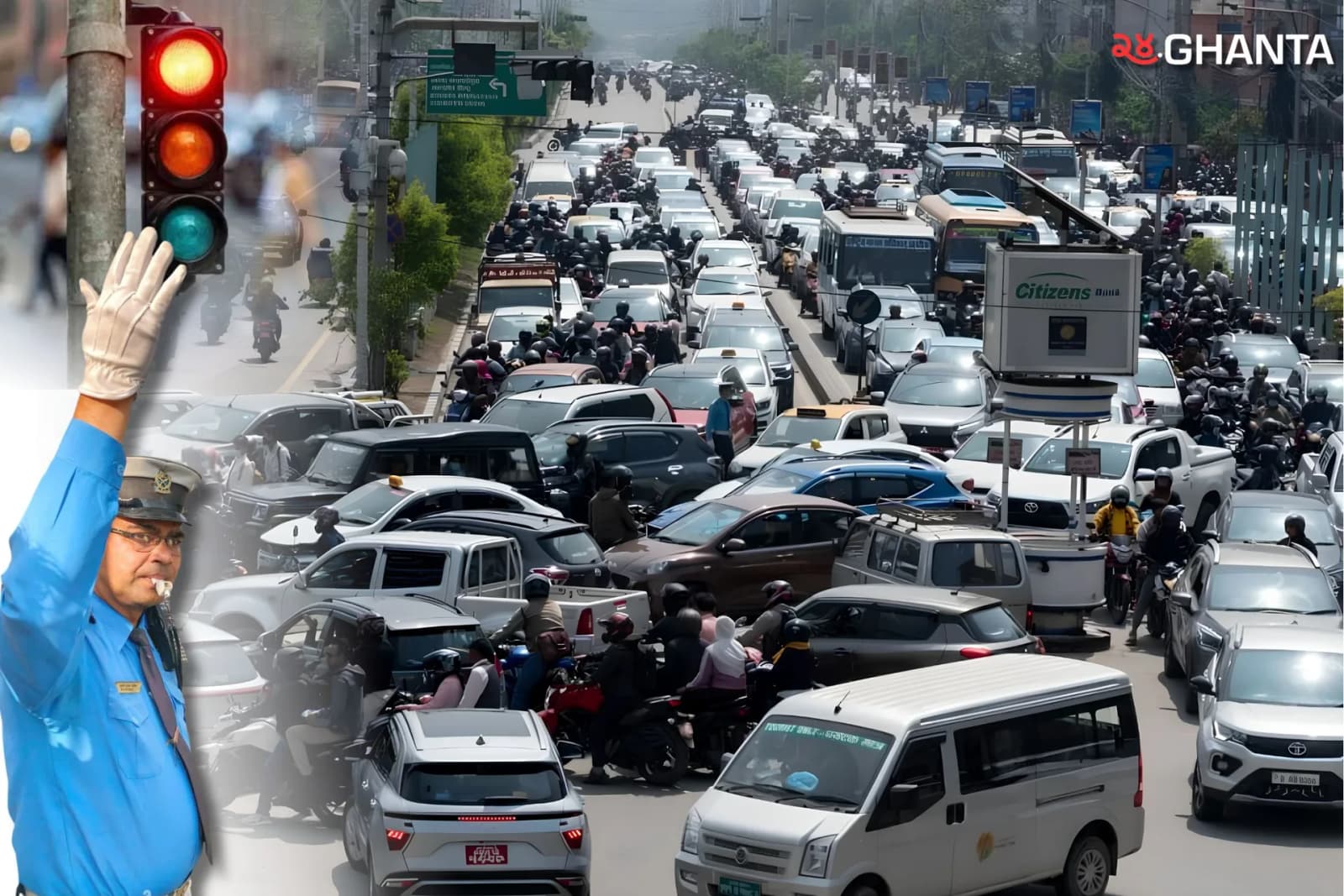
Every morning and evening, the same scene repeats across Kathmandu.
Motorcycles squeeze between buses. Cars move a few meters and stop again. Commuters watch the minutes pass while waiting to reach work, college, or home.
Most people simply call it traffic.

But those lost minutes have a price.
A motorcycle burns additional fuel. A worker loses time that could have been spent working or doing something else. A taxi takes longer to complete a trip. A delivery rider may complete fewer orders. A truck carrying goods may take longer to reach a business.
One person losing 20 minutes may not sound like a major economic problem.
But when delays happen to thousands of people, across multiple trips and hundreds of working days, those minutes begin to add up.
That is the hidden economic cost of Kathmandu’s traffic congestion.
And although Nepal still does not have one comprehensive, up to date figure showing exactly how much Kathmandu Valley loses to congestion every day, recent research gives us important pieces of the answer.
The Cost Starts With an Ordinary Rider
One of the clearest examples comes from people who experience Kathmandu traffic every day: motorcycle and scooter riders.
A 2026 study published in The Harvest examined the experiences of 534 two wheeler users in Kathmandu Valley.
Researchers estimated that the average two wheeler user in their sample lost about 11,730 minutes per year because of traffic congestion.
That is approximately 195.5 hours.
“That means an average rider in the study loses nearly 200 hours every year because of traffic jams.”
But time was only part of the cost.
Researchers estimated the economic value of the lost time at approximately NPR 13,602 per rider per year.
They also estimated an additional NPR 16,501 per year in fuel costs caused by congestion.
Put the two together, and the estimated annual burden was about:
NPR 30,103 per two wheeler user.
That works out to roughly NPR 2,500 per month.
But What Does “Losing NPR 30,000” Actually Mean?
A commuter does not physically hand someone NPR 30,000 at the end of the year because they were stuck in traffic.
Part of the estimate represents actual additional fuel consumption.
The other part represents the economic value of time lost because of congestion.
Time has economic value because it could have been used for work, business, study, rest, family, or other activities.
Imagine spending an additional 30 minutes in traffic every working day.
On one day, that may not seem significant. But those minutes accumulate. Thirty minutes becomes hours. Hours become days. And over an entire year, a seemingly ordinary traffic delay can become a significant loss of both time and money.
We Cannot Simply Multiply NPR 30,000 by Every Motorcycle in Kathmandu
There is an important limitation.
The 2026 study involved 534 two wheeler users.
Its estimate should therefore not simply be multiplied by every registered motorcycle or scooter in Kathmandu Valley to create a total cost for the entire city.
Not every registered vehicle is used every day.
People travel different distances, use different routes, own vehicles with different fuel efficiencies, and experience different levels of congestion.
The NPR 30,103 figure is best understood as an estimate for the average participant in that particular study, rather than a fixed annual cost applying to every rider in Kathmandu.
Still, it demonstrates something important:
Even one ordinary commuter can lose a meaningful amount of time and money to congestion over a year.
The Road Itself Has an Economic Cost
Another study looked at the problem from a different angle.
Instead of asking individual commuters how much congestion costs them, researchers examined what congestion costs on specific roads.
A peer reviewed study published in the Journal of the Eastern Asia Society for Transportation Studies in 2025 analyzed congestion on seven national and strategic urban road links in Kathmandu Valley, using traffic conditions from 2021.
The researchers estimated congestion costs ranging from:
NPR 77,748 to NPR 266,565 per day, per kilometer, per lane.
Across the seven road links analyzed, the average was approximately:
NPR 174,644 per day, per kilometer, per lane.
The lowest congestion cost among the studied links was recorded on Satdobato Gwarko, while the highest was on Koteshwor Jadibuti.
That means one of Kathmandu Valley’s busiest traffic areas also produced the highest congestion cost among the road sections researchers examined.
What Does “Per Kilometer, Per Lane” Actually Mean?
Imagine one kilometer of one lane of road. Now imagine that road operating normally, with vehicles moving relatively freely. Then compare it with the same kilometer during heavy congestion.
Vehicles take longer to travel the same distance. They spend more time operating. Drivers and passengers lose additional travel time.
Researchers can assign an economic value to those differences.
The 2025 study estimated congestion costs by examining additional vehicle operating costs and the economic value of additional travel time under congested conditions compared with free flow conditions.
That is how a traffic jam can be translated into money. A road does not need to be completely blocked to create an economic loss.
Cars, motorcycles, buses, and trucks may still be moving.
The problem is that they are moving far less efficiently than they could be.
Why We Cannot Apply NPR 1.75 Lakh to Every Kathmandu Road
This figure also comes with an important limitation.
The average NPR 174,644 per day/km/lane came from the seven road links examined in the study.
Kathmandu Valley has many different kinds of roads. Some carry enormous traffic volumes. Others carry far fewer vehicles. Some regularly experience severe congestion. Others do not.
Road width, traffic volume, vehicle type, intersection design, travel speed, and many other factors can change the economic cost of congestion.
So it would be misleading to take NPR 174,644 and multiply it by every kilometer of road in Kathmandu.
What the study does show is that congestion on major road sections can create a measurable daily economic cost.
When Traffic Slows, Work Can Slow Too
There is another cost that is harder to see. Imagine a delivery rider who could normally complete ten deliveries during a shift. If congestion makes each trip longer, that rider may complete fewer deliveries during the same working hours.
Now apply the same idea to:
Taxi drivers, Couriers, Buses, Trucks, Repair workers, Salespeople, Businesses waiting for supplies.
Congestion does not necessarily stop these people from working.
Instead, it can make the same amount of work take longer.
That is a productivity problem.
A taxi that spends more time completing one trip has less time available for the next passenger. A delivery rider stuck in traffic may complete fewer orders. A truck delayed on the road may make a business wait longer for supplies. An employee arriving late may lose working time.
However, there is currently not enough reliable public research to put one comprehensive Kathmandu wide rupee figure on all of these business and productivity losses.
Claiming an exact number would therefore be misleading.
But the underlying problem is clear:
When moving around the city becomes less efficient, doing business around the city can become less efficient too.
Why There Is No Single “Traffic Bill”
Kathmandu does not receive one bill at the end of the year saying:
Traffic congestion: NPR X billion.
Instead, researchers try to estimate different types of costs.
These can include:
Additional fuel consumption
Additional vehicle operating costs
Travel time lost to congestion
Lost working or productive time
Delayed movement of goods and services
Environmental and health effects
Different studies include different combinations of these costs.
That is why it is dangerous to compare two congestion estimates without first understanding what each study actually measured.
So, How Much Does Kathmandu Lose Every Day?
This is where the answer becomes less satisfying but more accurate.
There is currently no single comprehensive, up to date figure showing the complete daily economic cost of traffic congestion across Kathmandu Valley in 2026.
Existing research gives us pieces of the answer.
A 2026 study estimated that the average two wheeler user in its sample loses about NPR 30,103 per year through the economic value of lost time and additional fuel consumption.
A separate peer reviewed study, using 2021 traffic conditions, estimated congestion costs averaging approximately NPR 174,644 per day, per kilometer, per lane across seven studied road links.
We know congestion is costing Kathmandu money.
What we still do not know is the complete current bill.
And that lack of an up to date Valley wide estimate is itself important.
Kathmandu experiences serious congestion almost every working day, yet we still lack a comprehensive measurement of what all those delays are costing residents, businesses, and the wider economy today.
The Real Cost Is Hidden in Everyday Life
Kathmandu’s traffic does not send Nepal one large bill at the end of every day.
The cost is scattered across the city.
A rider pays through additional fuel.
A worker pays with lost time.
A taxi driver spends longer completing a trip.
A delivery rider may complete fewer orders.
A truck takes longer to deliver goods.
A business may wait longer for supplies.
Twenty minutes here and thirty minutes there may seem small. But traffic congestion is repetitive. The same road can become congested tomorrow. And the next day.And the day after that. Those minutes become hours. Those hours become days. And those days carry economic value.
That is why Kathmandu’s traffic problem should not only be measured by how long the traffic jam looks on the road.
The bigger question is:
How much money, fuel, and productive time is Kathmandu quietly losing while it waits to move?
Sources and References
Acharya & Upadhaya (2026). “Perceptions of Traffic Congestion among Two-Wheeler Users in Kathmandu Valley.” The Harvest, Vol. 5(1), pp. 58–66. DOI: 10.3126/harvest.v5i1.91161.
Karki et al. (2025). “Economic Impacts of Traffic Congestion in Kathmandu Valley: A 2021 Cost Assessment.” Journal of the Eastern Asia Society for Transportation Studies, Vol. 16.
Published 2 hours ago in Researched Article