
Pretty Enough to Post? How Social Media Is Changing Beauty Standards in Nepal
Social media is exposing young Nepalis to edited faces, flawless skin, and beauty standards that can be difficult to match in real life. A Kathmandu study found that nearly one in four adolescents experienced body image dissatisfaction, with body shaming among the associated factors. Researchers and experts say the conversation needs to focus on healthier self image, realistic expectations, and greater acceptance of natural appearances.
· 9 min read
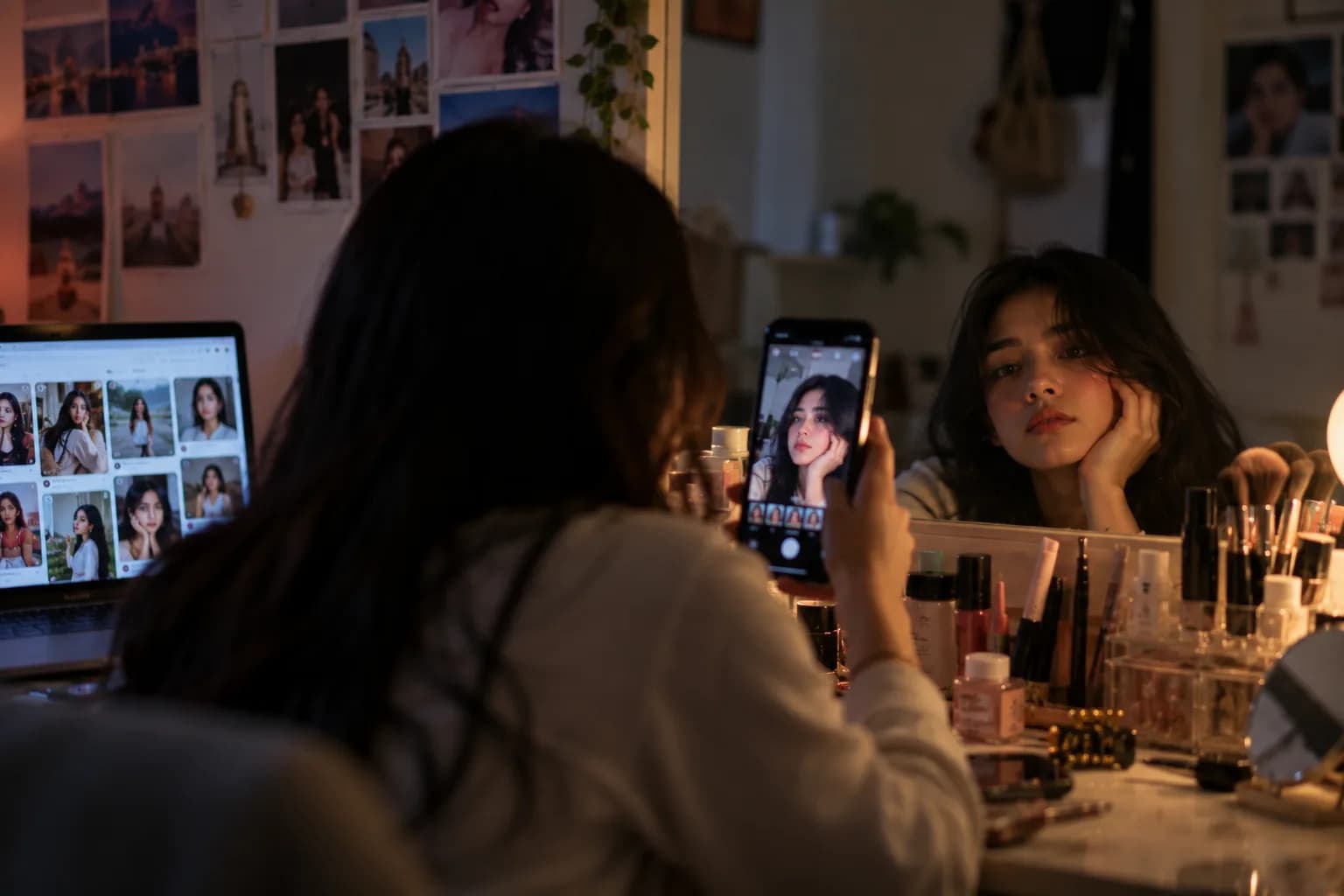
From flawless skin and beauty filters to body shaming and constant comparison, social media is changing how some young Nepalis see themselves. But how much of what we see online is actually real?
When Your Real Face Doesn't Feel Good Enough
You take a selfie. The lighting looks fine, but something about your face bothers you. Maybe it's a pimple, your skin tone, or the way your face looks from a certain angle. So you try another photo. Then another. You adjust the brightness, smooth your skin with a filter, and finally find one you feel comfortable posting.
But here's a question worth asking: Why can a perfectly normal face sometimes feel not good enough for social media? For many young people, Instagram, TikTok, and other platforms are more than places to share photos and videos. They are also spaces where people see, compare, and sometimes question their appearance.

Perfectly smooth skin, sharp jawlines, slim bodies, and carefully edited faces appear throughout social media feeds. And when these images become part of everyday life, it can be difficult to remember that much of what appears online has been carefully selected, filtered, or edited.
In Nepal, where beauty standards have long been shaped by family expectations, advertisements, and popular culture, social media has introduced another layer of pressure.
Social Media Is Already a Big Part of Life in Nepal
According to DataReportal's Digital 2026: Nepal report, the country had approximately 1.48 crore social media user identities in October 2025, equivalent to about half its population. These figures represent social media identities, not necessarily unique individuals, but they show how widely social platforms have become part of daily life.
For young people, scrolling through photos and videos can mean repeatedly encountering influencers, celebrities, friends, and strangers presenting carefully curated versions of themselves.
A 2023 report by The Kathmandu Post explored how this affects Nepali teenagers.
One teenager interviewed for the story described feeling uncomfortable about showing her pimples and blemishes without filters. Another explained how looking at people online made him question his own appearance.
Their experiences highlight something that can be easy to overlook: the pressure to look perfect is not limited to celebrities or influencers. Ordinary social media users can feel it, too.
What Does Research in Kathmandu Show?
The pressure surrounding appearance is not just a topic of online discussion. Researchers in Nepal have also been studying body image dissatisfaction among young people.
A study published in BMC Psychology on March 30, 2026, examined 313 adolescents aged 10 to 19 living in Kathmandu Metropolitan City. The researchers collected data in June 2024.
The findings were concerning:
24.3% of participants experienced body image dissatisfaction.
34.2% reported experiencing body shaming.
Girls had nearly twice the adjusted odds of reporting body image dissatisfaction compared with boys.
Adolescents who experienced body shaming had significantly higher odds of dissatisfaction.
Researchers also found an association between body dissatisfaction and behaviors such as skipping meals. The findings suggest that concerns about physical appearance can affect how young people think and feel about their bodies.
However, the study did not establish that social media caused these problems. Body image is influenced by several factors, including family expectations, social attitudes, personal experiences, and perceptions of beauty.
The study also covered adolescents in Kathmandu, meaning its findings should not be generalized to every young person in Nepal.
Still, it provides important local evidence that body image dissatisfaction deserves more attention.
Nepal Had Beauty Standards Before Instagram
Social media did not invent the pressure to look attractive.
In Nepal, preferences for fair skin, slim bodies, certain facial features, and conventional ideas of beauty existed long before Instagram filters became popular.
A 2019 report by The Kathmandu Post explored colorism in Nepal, highlighting how people with darker skin tones sometimes face hurtful remarks and discrimination.
The report included the experience of former Miss Nepal Nikita Chandak, who faced criticism and online trolling about her darker complexion after winning the title in 2017. Similarly, a 2020 report examining Nepal's modeling industry found that some models experienced rejection because of their skin tone, body size, or gender identity.
These examples show that pressure surrounding appearance was already present in Nepalese society. What social media may be doing is making certain beauty ideals more visible and easier to compare ourselves against.
Earlier, someone might have compared their appearance with classmates, relatives, or celebrities on television. Today, those comparisons can continue throughout the day through a phone screen.
The Problem With Comparing Yourself to a Filter
Beauty filters can change someone's appearance within seconds.
They can smooth skin, hide acne, brighten complexions, reshape facial features, and create an appearance that may be difficult or impossible to achieve naturally.
Using a filter is not necessarily harmful. People may use them for fun, creativity, or personal preference. The concern begins when digitally altered appearances become expectations for real life.
A 2025 systematic review and meta analysis published in the journal Body Image examined 83 studies involving 55,440 participants. Researchers found that greater social comparison on social media was associated with stronger body image concerns and more eating disorder symptoms.
In simple terms, people who compared their appearance more frequently with others online also tended to report greater dissatisfaction with their bodies.
The research does not prove that social media comparison causes these problems in every individual. But it highlights an important relationship between online comparison and body image.
Interestingly, the relationship is not always straightforward. A separate 2022 study involving 229 adolescent girls found that Instagram and TikTok use did not predict subsequent changes in the body image measures examined.
This suggests that how people use social media and what they compare themselves with may matter more than simply having an account.
When Skincare Becomes a Search for Perfection
Beauty trends can also influence how people care for their skin.
Social media is filled with product recommendations, skincare routines, transformation videos, and advertisements promising clearer or brighter skin.
Some of this content can be useful. But the idea that healthy skin must always look smooth and flawless can create unrealistic expectations.
In an April 2025 interview with The Kathmandu Post, dermatologist Dr. Isha Poudel Koirala explained that real skin naturally has pores, texture, fine lines, and occasional breakouts. She warned that constantly chasing filtered perfection can encourage people to overuse skincare products or undergo unnecessary treatments.
The concern is not about using makeup, skincare, or cosmetic treatments. These can be personal choices. It is about feeling that natural features must be hidden or corrected to be considered attractive.
Healthy skin and perfect looking skin are not the same thing.
The Pressure Isn't Only on Girls
Discussions about beauty standards often focus on women, but boys and young men can experience appearance related pressure as well.
Social media frequently presents muscular bodies, defined jawlines, clear skin, and particular hairstyles as desirable features. For some young men, these images may influence expectations about how their bodies should look.
The 2026 Kathmandu study included both boys and girls, recognizing that body image dissatisfaction is not exclusively a female concern. Although girls showed higher adjusted odds of dissatisfaction, boys were also part of the group experiencing body image concerns.
This matters because conversations about appearance, confidence, and body shaming should include everyone.
Can Social Media Also Help People Feel More Confident?
Despite its risks, social media is not entirely negative. The same platforms that promote unrealistic beauty standards can also help challenge them.
A February 2024 article in The Kathmandu Post discussed online skin positivity communities where people share experiences with acne, scars, freckles, and other natural skin features.
Instead of hiding every imperfection, some creators are choosing to show what real skin looks like. International research also suggests that certain social media interventions may help improve body image.
A 2026 systematic review in the Journal of Medical Internet Research, covering eight studies and 4,975 participants, found that some interventions using visual social media platforms showed modest benefits for body image.
The evidence is still developing, and most studies were conducted outside Nepal.
Nevertheless, these findings show that social media can be used to encourage healthier attitudes rather than only reinforce unrealistic expectations.
Who Gets to Decide What Beautiful Looks Like?
Beauty standards have always changed with society.
What was considered attractive by one generation may not be the same for another. Social media has made those changes faster, more visible, and more personal.
For young Nepalis, the pressure can come from many directions: comments from family members, expectations among friends, advertisements, celebrity culture, and the endless stream of images on their phones.
But there is an important difference between wanting to look good and feeling that you must look perfect.
Wearing makeup, using filters, following skincare routines, or choosing a particular style does not automatically mean someone lacks confidence. The real concern is when comparison makes people feel ashamed of their natural appearance or encourages unhealthy behavior.
Perhaps the goal should not be to stop caring about appearance altogether, but to recognize that a filtered photo is not a fair standard for a real person. Because in a world where almost anything can be edited before it is posted, the question is no longer just whether a picture looks good.
It is whether we are beginning to judge our real selves against appearances that may not even exist outside a screen.
Sources and References
1. Body Image Dissatisfaction Among Adolescents in Kathmandu Metropolitan City —BMC Psychology (2026)
2. Digital 2026: Nepal DataReportal
3. On Social Media, Everyone's Perfect. It's Time to Change That The Kathmandu Post (2023)
4. Fair or Not, Some Say It's Time to Talk About Skin Colour Discrimination The Kathmandu Post (2019)
5. Is Nepal's Modelling Industry Inclusive? The Kathmandu Post (2020)
6. The Association Between Social Comparison in Social Media, Body Image Concerns and Eating Disorder Symptoms Body Image (2025)
7. Adolescent Girls' Instagram and TikTok Use: Examining Relations With Body Image Related Constructs Over Time Body Image (2022)
8. Real Skin, Real You The Kathmandu Post (2025)
9. Skin Positivity in the Digital World The Kathmandu Post (2024)
10. Interventions That Use Highly Visual Social Media Platforms to Tackle Unhealthy Body Image Journal of Medical Internet Research (2026)
Published 1 hour ago in Researched Article