
Is Animal Sacrifice Legal in Nepal? Tradition vs Law
Animal sacrifice remains legal under certain traditional religious practices in Nepal, but laws restrict where and how it can take place. The National Penal Code prohibits animal cruelty, requires available alternatives to sacrifice, and provides special protection for cows and oxen. In 2016, the Supreme Court directed the government to gradually end animal sacrifice, raising questions about religious traditions, animal welfare, and legal enforcement.
· 14 min read
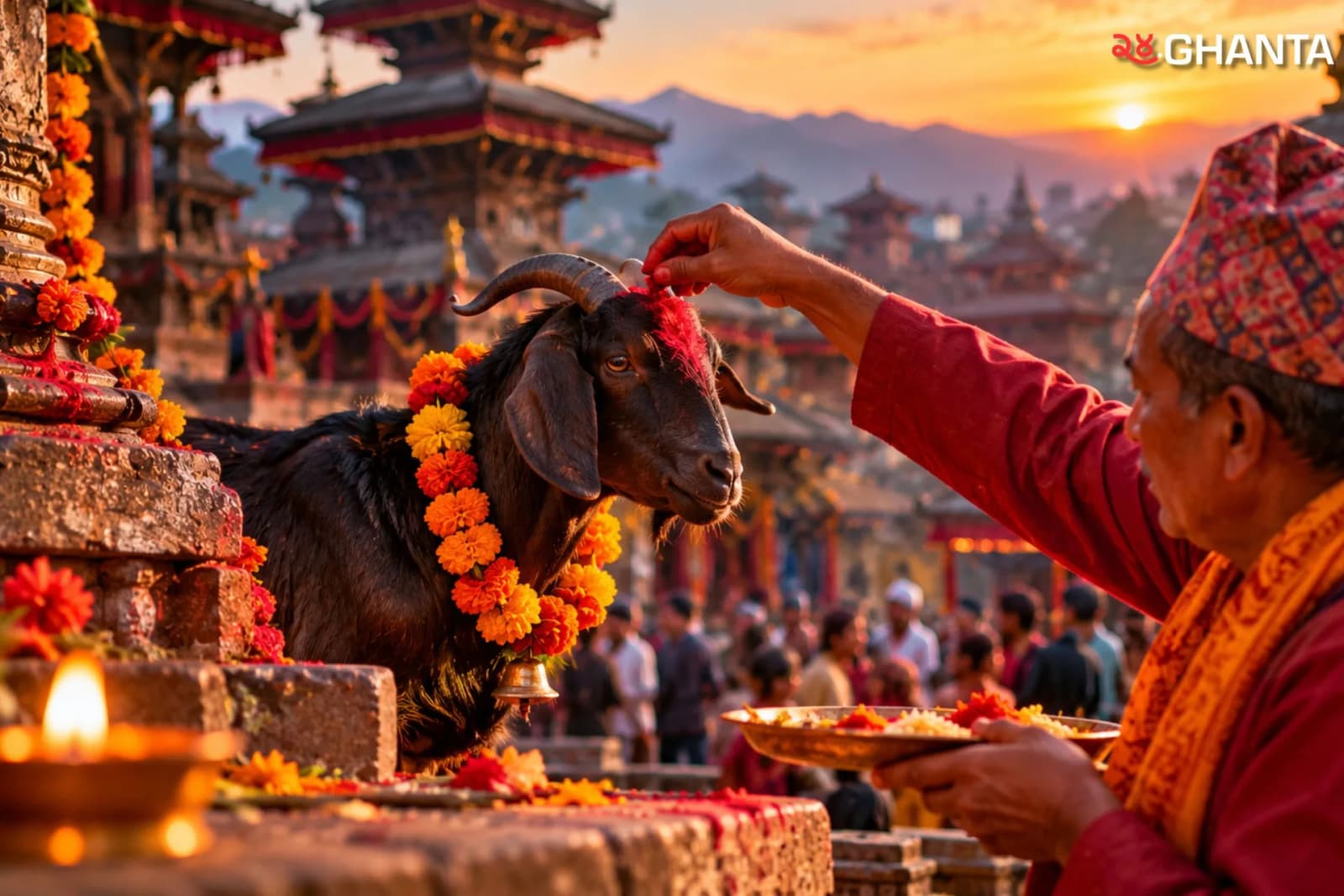
Animal sacrifice remains part of several religious traditions in Nepal. Yet the country also has laws that prohibit animal cruelty, restrict killing animals in public places, and require alternatives to sacrifice when available. A Supreme Court judgment has even called for the practice to end gradually. So what does Nepal's law actually allow?
During Dashain, temples across Nepal fill with devotees seeking blessings from Goddess Durga. Some bring flowers, fruits, and coconuts. Others follow traditions in which goats, buffaloes, chickens, or other animals are sacrificed.
For families who follow these rituals, the practice may carry religious meaning passed down through generations. Others celebrate Dashain without animal sacrifice.

But consider two situations. A person sacrifices a goat at a temple where the ritual has been practiced for generations. Another person sacrifices a goat on an ordinary public road.
Would Nepal's law treat both situations the same way?
Not necessarily.
Nepal's criminal law recognizes some traditional animal sacrifices while restricting where they can take place. There is another detail many people may not know: the law requires available alternatives to animal sacrifice to be adopted.
And in 2016, following a legal challenge concerning mass animal sacrifices at the Gadhimai festival in Bara, the Supreme Court directed the government to work toward gradually ending animal sacrifice. So, is animal sacrifice legal in Nepal? Why does the law recognize some religious traditions while punishing animal cruelty? And did the Supreme Court actually ban sacrifice?
Here is what Nepal's laws and court decisions say.
Is Animal Sacrifice Legal in Nepal?
Certain traditional religious animal sacrifices are recognized under Nepal's law, but there is no unrestricted right to sacrifice animals anywhere or in any manner.
The most important criminal law is the National Penal (Code) Act, 2017, also called the Muluki Aparadh Samhita, 2074.
Chapter 27 deals with offenses involving animals and birds.
Its Section 291 generally prohibits killing animals or birds in public places. However, it recognizes exceptions for religious sites where animal sacrifice has been practiced as a long established tradition. The section also provides exceptions for certain traditional fairs, feasts, exhibitions, events, and places where slaughter has been practiced since ancient times.
In simple words, Nepal's law recognizes that animal sacrifice is part of some religious and cultural traditions. But that recognition comes with conditions.
The location matters. Tradition matters. The species of animal matters. Other laws protecting animals and public health may also apply.
Can Animals Be Sacrificed Anywhere During Dashain?
No. The National Penal Code restricts where animals and birds may be killed.
Under Section 291(1), killing animals and birds in public places is generally prohibited, except where the law provides otherwise.
For this section, public places include roads, bridges, meadows, and places used for people's movement.
Section 291(2) further restricts religious animal sacrifices to religious sites where such sacrifices have been practiced since ancient times.
This means a temple with a long established sacrifice tradition and an ordinary public road are not automatically treated the same way.
For example, celebrating Dashain does not, by itself, give someone permission to sacrifice an animal on a public road. However, the law also recognizes certain traditional fairs, events, and slaughter practices. Whether a particular activity qualifies for an exception depends on the circumstances and applicable legal provisions.
What happens if someone breaks Section 291?
Under Section 291(5), a person who violates the provision may face:
Up to one month in prison
A fine of up to Rs 5,000
Or both
The important point is that religious tradition does not automatically provide permission to sacrifice animals in every public location.
Did You Know Nepal's Law Requires Alternatives to Animal Sacrifice?
This is one of the most surprising parts of the law.
Section 291(3) requires an alternative to animal sacrifice to be adopted when one is available.
This means the law does more than recognize traditional sacrifice. It also requires available alternatives to be used. Some devotees already offer coconuts, flowers, fruits, or other symbolic items instead of sacrificing animals.
But there is an important legal distinction.
The Penal Code does not provide a complete list of acceptable alternatives for every religious practice. Nor does it clearly explain how their availability should be assessed in every case.
Under Section 291(4), if an alternative cannot be adopted and sacrifice is necessary, the sacrifice must take place at the location and according to the method determined by the management of the concerned religious site.
This raises an interesting question:
If symbolic offerings are possible, who decides whether an animal sacrifice is still necessary?
The wording of Section 291 does not fully settle that question. It would therefore be inaccurate to say every sacrifice is automatically illegal simply because flowers or coconuts could be offered. But the law's requirement to adopt an available alternative cannot be ignored either.
If Animal Sacrifice Is Recognized, Why Is Animal Cruelty Illegal?
Nepal's criminal law treats animal cruelty as a separate offense.
Under Section 290 of the National Penal Code, cruel treatment of animals and birds is prohibited. The law covers conduct such as beating or torturing animals, forcing them to carry excessive loads, making them walk or run beyond their ability, and forcing sick or injured animals to work.
It also prohibits giving animals harmful substances, certain forms of abandonment, and other cruel treatment. There is a limited exception for using minimum necessary force when training animals or making them work within their physical capacity.
What is the punishment?
A person convicted under Section 290 can face up to three months in prison, a fine of up to Rs 5,000, or both. This provision is relevant during religious festivals because animals may be transported over long distances, kept in crowded places, or handled before sacrifice.
Importantly, the legal recognition of some traditional sacrifices under Section 291 does not automatically make every form of cruel treatment lawful.
The two provisions address different questions.
Section 290 concerns cruelty. Section 291 concerns killing animals in public places and the conditions governing certain traditional sacrifices.
Whether a particular action is a criminal offense depends on its facts and the applicable law.
Why Is Killing a Cow Different From Sacrificing a Goat?
Nepal's law does not give every animal identical protection. Under Section 289 of the National Penal Code, intentionally killing or injuring cows and oxen is prohibited. If a prohibited act results in the animal's death, the offender can face up to three years in prison.
Causing serious injury can result in up to six months in prison, while other injuries can lead to a fine of up to Rs 50,000.
The law contains a limited exception for necessary action taken to protect a person from injury to life or body caused by a cow or ox. Nepal's Constitution also identifies the cow as the country's national animal under Article 9.
This is why a religious sacrifice exception involving a goat cannot simply be assumed to authorize killing a cow or ox.
Doesn't Nepal's Constitution Protect Religious Freedom?
Yes. But religious freedom is not unlimited.
Article 26 of Nepal's Constitution protects the right to profess, practice, and protect one's religion according to personal conviction.
It also gives religious communities rights concerning the operation and protection of their religious sites and trusts, subject to lawful regulation.
However, Article 26(3) places restrictions on conduct in the exercise of religious freedom that is contrary to public health, decency, morality, or public peace, along with other specified restrictions. Article 30 separately protects citizens' right to live in a clean and healthy environment.
These constitutional provisions become important when religious sacrifice raises questions about disease, sanitation, disposal of animal remains, or environmental pollution. But the Constitution does not itself declare every religious animal sacrifice a criminal offense.
Instead, religious freedom must be considered alongside the specific laws governing animal treatment, slaughter, and public health.
This balance has also been examined by Nepal's Supreme Court.
Why Does Nepal's Slaughterhouse Law Make an Exception for Religious Festivals?
Nepal's Animal Slaughterhouse and Meat Inspection Act, 1999, was introduced to regulate slaughterhouses, meat inspection, and public health. Unlike the National Penal Code, this law mainly focuses on how animals are examined and slaughtered and how meat is inspected before sale. Several sections are important.
Section 8: Examination before slaughter
The Act provides for animals to be examined before slaughter. Meat inspectors can prohibit slaughter when an animal is found to be diseased.
Section 9: Slaughterhouse requirements
Where the Act applies, animals considered suitable for slaughter are generally required to be slaughtered in a slaughterhouse.
Where no slaughterhouse has been established, the meat supervisor may determine the place and time for slaughter.
Section 10: Meat inspection
Meat must be inspected according to the Act. If disease or defects are found, an inspector may restrict the sale or distribution of the meat.
The Important Exception: Section 16
Section 16 provides an exception concerning slaughter outside slaughterhouses during traditional festivals, religious rituals, feasts, and religious ceremonies.
It also addresses consumption of meat with the skin attached on such occasions. This helps explain why traditional religious slaughter receives different treatment from ordinary commercial slaughter under this particular Act. However, the exception does not automatically remove obligations under the National Penal Code or every other applicable law.
Does the Act Apply Across Nepal?
This is another important issue.
Section 1(2) provides that the Act will come into force in designated areas on dates notified by the government through the Nepal Gazette. Therefore, the Act's adoption in 1999 does not automatically establish that every provision became enforceable nationwide that year.
Its actual coverage depends on subsequent government notifications.
What Did the Supreme Court Decide in 2014?
In 2014, Nepal's Supreme Court heard a case challenging a law that allows animal slaughter outside slaughterhouses during certain traditional festivals and religious ceremonies. The petitioners argued that such slaughter could create health risks and environmental problems.
However, on February 3, 2014, the Supreme Court rejected the challenge. It recognized that laws can take religious customs and cultural traditions into account.
This did not mean all animal sacrifice was legal. The Court only upheld the specific festival exception under Section 16 of the Animal Slaughterhouse and Meat Inspection Act.
Did the Supreme Court Ban Animal Sacrifice in 2016?
No, not immediately.
The case was connected to the Gadhimai festival, a religious event held every five years at the Gadhimai Temple in Bariyarpur, Bara district. The festival is known for large scale animal sacrifices, particularly of buffaloes and goats, offered as part of religious traditions. The practice has attracted criticism from animal welfare advocates over concerns about animal cruelty, public health, and the treatment of animals during the festival.
These concerns led to a legal challenge seeking government intervention to regulate animal sacrifice and protect animal welfare.
On August 4, 2016, Nepal's Supreme Court delivered an important judgment in the case filed by Advocate Arjun Kumar Aryal and others. The Court directed the government to work toward gradually ending animal sacrifice while recognizing that changing long-established religious traditions would take time.
Instead of imposing an immediate ban, it directed the government to:
Prepare a plan to gradually end animal sacrifice.
Raise public awareness and reduce the practice.
Strengthen protection against animal cruelty.
Improve veterinary checks, quarantine, and meat safety.
Properly manage animal remains and waste to protect public health.
Avoid government encouragement or support for animal sacrifice.
The Court also ordered an animal welfare committee or another suitable mechanism to prevent cruel treatment.
The key point: The 2016 Gadhimai ruling called for a gradual end to animal sacrifice and required government action. It did not immediately make every religious sacrifice illegal.
What About Animals Brought From India for Sacrifice?
Nepal's Animal Health and Livestock Services Act, 1999, provides for quarantine checks to help prevent animal diseases.
Section 3 allows the government to establish animal quarantine checkpoints. Section 27 allows it to form a committee to prevent cruel treatment of animals.
In its 2016 Gadhimai ruling, the Supreme Court ordered stronger quarantine inspections, certificates for imported animals, and measures to prevent cruelty during transport and sacrifice.
The law is concerned not only with sacrifice itself, but also with how animals are transported and treated beforehand.
Ten Years Later, What Has Changed?
The 2016 Supreme Court ruling called for stronger animal welfare protections and better enforcement of laws concerning slaughterhouses and meat safety.
But implementation has remained a challenge.
In April 2026, RSS reported that the slaughterhouse law was being implemented in only three cities: Hetauda, Butwal, and Surkhet.
In July 2026, the government directed authorities to improve implementation within three months. More recently, reports in October 2026 described plans to expand enforcement across 21 local levels in Kathmandu Valley, along with renewed preparations in Hetauda.
However, these plans do not prove that the rules are already being fully enforced.
The unanswered question is whether the government has carried out all the directions issued by the Supreme Court in 2016.
What Punishment Can Someone Face for Violating Nepal's Animal Protection Laws?
The National Penal Code provides different punishments depending on the offense.
Provision | Offense | Maximum punishment |
Section 289 | Unlawfully killing a cow or ox | Three years in prison |
Section 289 | Causing serious injury to a cow or ox | Six months in prison |
Section 289 | Causing other injury to a cow or ox | Rs 50,000 fine |
Section 290 | Cruel treatment of animals or birds | Three months in prison or Rs 5,000 fine, or both |
Section 291 | Violating public place slaughter or traditional sacrifice restrictions | One month in prison or Rs 5,000 fine, or both |
Another important provision is Section 292, which sets time limits for complaints. For offenses under Section 290, the complaint must be filed within three months of the offense.
For other offenses under Chapter 27, the three month period generally begins when the offense becomes known. The specific offense, evidence, and applicable law will determine how a case is handled.
Tradition and Animal Welfare: Why Do People Disagree?
For some religious communities, animal sacrifice represents devotion, worship, and a tradition passed down through generations. For others, offerings such as coconuts, fruits, flowers, and prayers are meaningful ways to worship without sacrificing an animal.
Animal welfare advocates focus on the treatment of animals, particularly during transport, confinement, and slaughter. Legal commentator Ravi Nayak argued in a 2021 Onlinekhabar opinion article that Nepal should strengthen legal protections against animal sacrifice and cruelty.
His argument reflects one perspective in the debate, rather than an official judicial finding or a view shared by every religious community.
It is important not to assume that all Hindus, temples, or Nepali communities follow the same practices or beliefs.
The debate is therefore about more than whether someone supports or opposes animal sacrifice. It also concerns how religious freedom, cultural traditions, animal welfare, public health, and government responsibilities fit together.
So, Is Animal Sacrifice Legal in Nepal?
Nepal does not have a complete criminal ban on every form of religious animal sacrifice under the laws examined here.
Certain long established religious practices are recognized, but the law places restrictions on where sacrifices can occur. It also requires available alternatives to be adopted, prohibits animal cruelty, and gives cows and oxen special legal protection.
The Constitution protects freedom of religion while recognizing restrictions connected with public health, morality, and public peace.
The Animal Slaughterhouse and Meat Inspection Act provides a traditional festival exception within its own regulatory framework, while establishing meat safety requirements where the Act applies. And the Supreme Court has addressed the issue in two important decisions.
In 2014, the Court declined to invalidate the traditional festival exception. In 2016, it directed the government to work toward ending animal sacrifice gradually and ordered stronger measures concerning animal welfare, quarantine, meat inspection, and public health.
For some Nepalis, animal sacrifice remains a meaningful religious tradition. Others choose not to follow the practice.
But the legal principle is clear: Religious traditions may receive recognition under Nepal's laws, but that recognition does not remove every legal restriction.
Ten years after the Supreme Court's 2016 Gadhimai animal sacrifice judgment, the larger question is not only whether religious animal sacrifice is permitted in Nepal. It is how effectively the government is enforcing existing animal protection laws and implementing the Supreme Court's directions to gradually end animal sacrifice and strengthen animal welfare.
Sources
1. Government of Nepal (2017). National Penal (Code) Act, 2017 (Muluki Aparadh Samhita, 2074). Chapter 27, Sections 289–292.
2. Government of Nepal (2015). Constitution of Nepal. Articles 9, 26, and 30.
3. Government of Nepal (1999). Animal Slaughterhouse and Meat Inspection Act, 2055. Sections 1, 8–10, 16–17.
4. Government of Nepal (1999). Animal Health and Livestock Services Act, 2055. Sections 3 and 27.
5. Supreme Court of Nepal (2014). Decision No. 9319, Case No. 069-WS-0035. Concerning Section 16 of the slaughterhouse law.
6. Supreme Court of Nepal (2016). Advocate Arjun Kumar Aryal and Others v. Government of Nepal and Others. Gadhimai judgment, August 4, 2016.
7. RSS / Ratopati (April 3, 2026).
8. RSS / Ratopati (July 11, 2026).
9. Ratopati (October 1, 2026).
Tags
Published 1 hour ago in Researched Article