
Why Are Crows, Dogs, Cows and Oxen Worshipped During Tihar?
Tihar, Nepal's festival of lights, honors crows, dogs, cows, and oxen through special rituals rooted in Hindu traditions. Each animal represents a unique meaning, from messages and loyalty to prosperity and agricultural contributions. Beyond religious beliefs, these celebrations highlight gratitude, respect for animals, and their importance in Nepali culture and everyday life.
· 10 min read
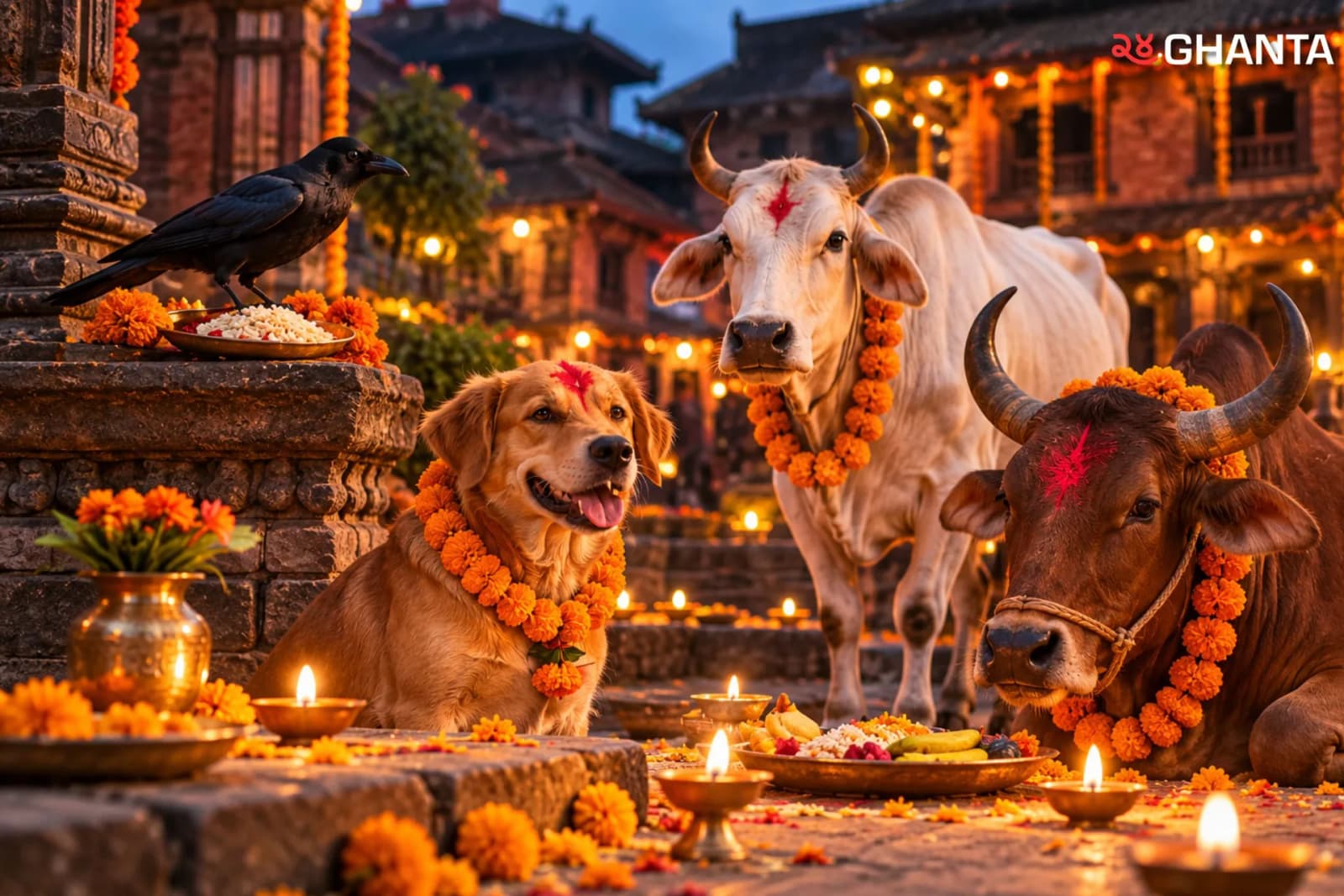
Why does Tihar, Nepal’s festival of lights, begin by worshipping crows, which are traditionally believed to be messengers of Yama, the god of death? And why are dogs, cows, and oxen honored with tika, flower garlands, and special food? Behind these traditions are religious beliefs and stories that reflect the important roles these animals have played in Nepali life for generations.
Every Tihar, homes across Nepal are decorated with colorful lights, marigold garlands, and oil lamps. Families prepare sweets, sing Deusi Bhailo, and gather to celebrate one of the country's most loved festivals.
But there is something that makes Tihar different from many other celebrations.

Before people celebrate Bhai Tika, they honor four creatures that are part of everyday life: crows, dogs, cows, and oxen.
On one day, families leave food for crows. On another, dogs receive tika and flower garlands. Cows are worshipped as symbols of prosperity, while oxen are thanked for their contribution to farming.
But why were these four animals chosen?
The answer is not just about religion. These traditions also reflect how people have depended on animals for food, farming, protection, and companionship for generations.
Why Does Tihar Begin With Worshipping Crows?
Crows are familiar birds in Nepal. They can be seen on rooftops, near homes, and around fields. But their loud calls have also been associated with messages, visitors, and sometimes bad news in traditional beliefs.
That makes the first day of Tihar particularly interesting.
Why does a festival of happiness begin by honoring a bird linked with death and misfortune?
Crows Are Believed to Be Messengers of Yama
On Kaag Tihar, traditionally the first day of the festival, people offer rice, grains, and other food to crows. According to Hindu traditions practiced in Nepal, crows are believed to be messengers of Yama, the god of death.
People traditionally offer food to them as a sign of respect and in the hope of receiving good news and avoiding misfortune.
These are religious beliefs, not evidence that crows can predict future events.
There Is Also a Practical Reason
Crows play a useful role in the environment. They eat insects, including some that damage crops, and also feed on dead animals and other organic matter. For farming communities, this has made them valuable birds.
Cultural scholar Swosti Rajbhandari Kayastha, writing for the Rubin Museum of Himalayan Art, explains that farmers have traditionally valued crows for feeding on crop damaging insects.
So Kaag Tihar is not only about a bird's connection with Yama. It also honors a creature that plays a role in nature and agriculture.
Why Are Dogs Given Tika, Garlands, and Special Food?
Imagine walking through Kathmandu and seeing a street dog wearing a bright marigold garland with tika on its forehead.On most days, people might walk past the animal without noticing it. But during Kukur Tihar, dogs become the center of attention.
Traditionally observed on the second day of Tihar, the festival honors both household pets and street dogs. People apply tika, place garlands around their necks, and offer special food.
Dogs Are Associated With Yama and Bhairava
According to Hindu traditions, dogs are connected with Yama, the god of death, and are believed to act as guardians associated with his world. Dogs are also associated with Bhairava, a fierce form of Lord Shiva. In some traditions, the dog is considered Bhairava's vahana, meaning his vehicle or mount.
These religious connections help explain why dogs are honored during the festival.
The Mahabharata Has a Famous Story About a Dog
There is also a powerful story about loyalty in the Hindu epic Mahabharata. During his final journey toward heaven, Yudhishthira, the eldest of the Pandavas, is accompanied by a dog.
When he is told that the dog cannot enter heaven with him, Yudhishthira refuses to abandon his companion. The dog is eventually revealed to be Dharma, the divine figure associated with righteousness and also identified with Yama in this account.
The story celebrates compassion and loyalty, even toward an animal.
Dogs Also Protect People in Everyday Life
Beyond religious symbolism, dogs have served people for generations. They guard homes, protect livestock, provide companionship, and assist in security and rescue operations. Nepal Police also has a tradition of honoring its service dogs during Kukur Tihar.
The meaning of Kukur Tihar is simple: dogs deserve recognition for their loyalty, protection, and companionship.
Why Are Cows Worshipped as Symbols of Wealth?
For many Nepali families, cows are more than animals raised on farms.
They hold a special place in Hindu religious traditions and have supported households through milk and other resources for generations. On Gai Tihar, traditionally the third day of Tihar, people worship cows by offering food, applying tika, and decorating them with flower garlands.
But why is the cow considered so important?
Cows Are Associated With Goddess Lakshmi
In Hindu traditions followed in Nepal, the cow is closely associated with Goddess Lakshmi, the deity of wealth and prosperity. This is one reason Gai Tihar is traditionally observed alongside Lakshmi Puja.
In the commonly described five day sequence, cows are worshipped in the morning, while Lakshmi Puja takes place in the evening. Families clean their homes, decorate doorways with flowers, light oil lamps, and pray for prosperity.
Why Is the Cow Also Called Gau Mata?
The religious importance of cows is connected with their practical role in human life. Cows provide milk used to prepare curd, ghee, butter, and other dairy products.
Their dung has traditionally been used as fertilizer, fuel, and material for preparing floors and walls in rural communities. Because cows have provided nourishment and supported households, they are often described as motherly or nurturing figures.
The term Gau Mata means Mother Cow.
This should be understood as religious symbolism rather than a literal or scientifically established claim.
Gai Tihar honors the cow as a symbol of prosperity, nourishment, and gratitude for its contribution to family life.
Why Are Oxen Worshipped During Tihar?
Before tractors and modern agricultural machines became widely used, farming in Nepal depended heavily on the strength of oxen. They helped farmers plow fields, prepare land for cultivation, and transport goods.
For generations, these animals played an important role in rural livelihoods.
This is why people honor oxen during Goru Tihar, traditionally observed on the fourth day of the festival.
Oxen are decorated with tika and flower garlands and offered food as a sign of respect.
What Is the Connection Between Oxen and Lord Shiva?
In Hindu tradition, Nandi, the sacred bull, is known as the mount and devoted companion of Lord Shiva. This religious symbolism contributes to the respect shown to cattle.
However, Nandi is specifically a bull in Hindu mythology. The oxen worshiped during Goru Tihar are also honored for their work in agriculture.
Why Is the Festival Also Called Hali Tihar?
Another interesting part of this celebration is its connection with farmers. A hali is a person who plows fields, traditionally with oxen.
According to a report by Rastriya Samachar Samiti, the occasion is also known as Hali Tihar in some traditions, when agricultural workers are recognized and offered special food.
This makes the celebration about more than religious beliefs.
It is also about acknowledging the animals and workers who helped grow food.
Goru Tihar is a festival of gratitude for the hard work that has supported farming families for generations.
What Is the Story Behind Govardhan Puja?
The fourth traditional day of Tihar is also associated with Govardhan Puja.
According to Hindu mythology, Lord Krishna lifted Govardhan Mountain to protect villagers and their cattle from heavy rainfall sent by Indra, the god of rain. The story is traditionally understood as a reminder of protection, nature, and the importance of cattle in people's lives.
During Govardhan Puja, some families make a symbolic representation of the mountain using cow dung and perform prayers.
Related celebrations are known as Godhan Puja in parts of the Mithila region.
Although Goru Tihar and Govardhan Puja are observed around the same time, they have different central meanings.
Goru Tihar recognizes the work of oxen, while Govardhan Puja remembers the religious story of Krishna protecting villagers and their cattle.
Why Is Tihar Also Called Yama Panchak?
Tihar is also known as Yama Panchak, a name linked to Yama, the Hindu god of death, and the festival's five day observance. The crow and dog are especially connected with Yama in traditional religious beliefs.
But the festival also focuses on happiness, prosperity, and the long lives of loved ones.
On Bhai Tika, the final traditional day of Tihar, sisters place tika on their brothers' foreheads and pray for their well being and longevity. In some communities, brothers and sisters exchange tika and blessings.
According to the Nepal Tourism Board, sisters also pray to Yama for their brothers' long lives.
That is one of Tihar's most interesting connections: a festival associated with the god of death also includes prayers for long life and protection.
What Is Mha Puja, and How Is It Connected to Tihar?
Tihar is celebrated differently across Nepal's communities.
For many Newar families, the fourth traditional day of Tihar includes Mha Puja, which means worship of the self. Family members prepare mandalas, light lamps, and perform rituals seeking purification, long life, and well-being.
The celebration is closely associated with the Nepal Sambat New Year.
The Rubin Museum's cultural research describes Mha Puja as an important occasion for personal renewal and family gathering. This gives Tihar another layer of meaning.
Alongside animals, deities, and family relationships, the festival also encourages people to reflect on themselves.
Does Tihar Always Follow the Same Five Day Schedule?
Tihar is traditionally explained through five main days:
Kaag Tihar: Worship of crows.
Kukur Tihar: Worship of dogs.
Gai Tihar and Lakshmi Puja: Worship of cows and Goddess Lakshmi.
Goru Tihar and Govardhan Puja: Worship of oxen and other rituals, including Mha Puja in many Newar families.
Bhai Tika: Celebration of the bond between brothers and sisters.
However, the exact dates of these rituals can vary. Because the observances follow the Hindu lunar calendar, two ceremonies may sometimes fall on the same civil calendar date.
What Do These Four Animals Really Represent?
At first, worshipping crows, dogs, cows, and oxen might seem like four separate religious traditions.
But together, they tell a larger story.
Crows are associated with messages from Yama and also play a role in nature.
Dogs symbolize loyalty, protection, companionship, and guardianship.
Cows represent prosperity, nourishment, and maternal care.
Oxen are honored for their strength, hard work, and contribution to agriculture.
These meanings reflect both traditional religious beliefs and the practical relationships people have developed with animals over generations. Not every Nepali community celebrates Tihar in the same way, and religious stories may be understood differently by different families.
But one shared idea connects these customs.
Tihar is not only about lighting lamps, worshipping deities, and celebrating with family. It is also about showing gratitude to the creatures that have helped people live, work, and thrive.
And perhaps that is the most meaningful part of the festival.
For a few days each year, the animals and birds we often overlook receive special recognition.
Tihar reminds us that gratitude extends beyond people to the living world around us.
Sources and references for your website
Swosti Rajbhandari Kayastha (October 3, 2025). Tihar: Festival of Lights, Rubin Museum of Himalayan Art.
Onlinekhabar (August 13, 2021). Nepal Worships These 7 Animals Every Year, With Special Festivals for Most.
The Himalayan Times (October 29, 2016). Kukur Tihar Being Observed Across the Nation.
RSS / The Himalayan Times (October 26, 2022). Govardhan Pooja Being Observed Today.
RSS / The Himalayan Times (November 11, 2023). Tihar Begins With Worship of Crow.
Lalitpur Metropolitan City. Intangible Heritage Calendar.
Springer Nature (2025). Dharma, Yoga, and Animals in the Mahābhārata. Scholarly discussion of Yudhishthira's refusal to abandon the dog during his journey toward heaven.
Tags
Published Oct 27 in Researched Article