
Students In Doti And Salyan Turn Savings And Snack Money Into Relief For Rasuwa Flood Victims
Students from Doti and Salyan have donated a combined Rs 70,900 to support victims of the Rasuwa Bhotekoshi flood, with some students even contributing money saved from their daily snacks. Their small but meaningful effort highlights how young people across Nepal are joining the wider relief campaign for flood-affected families.
· 4 min read
Kathmandu, September 1: At a time when Nepal is struggling with the enormous human and physical loss caused by the August 26 (Bhadra 10, 2083) Bhotekoshi flood, school students hundreds of kilometres away from the disaster zone have stepped forward with small but meaningful contributions.
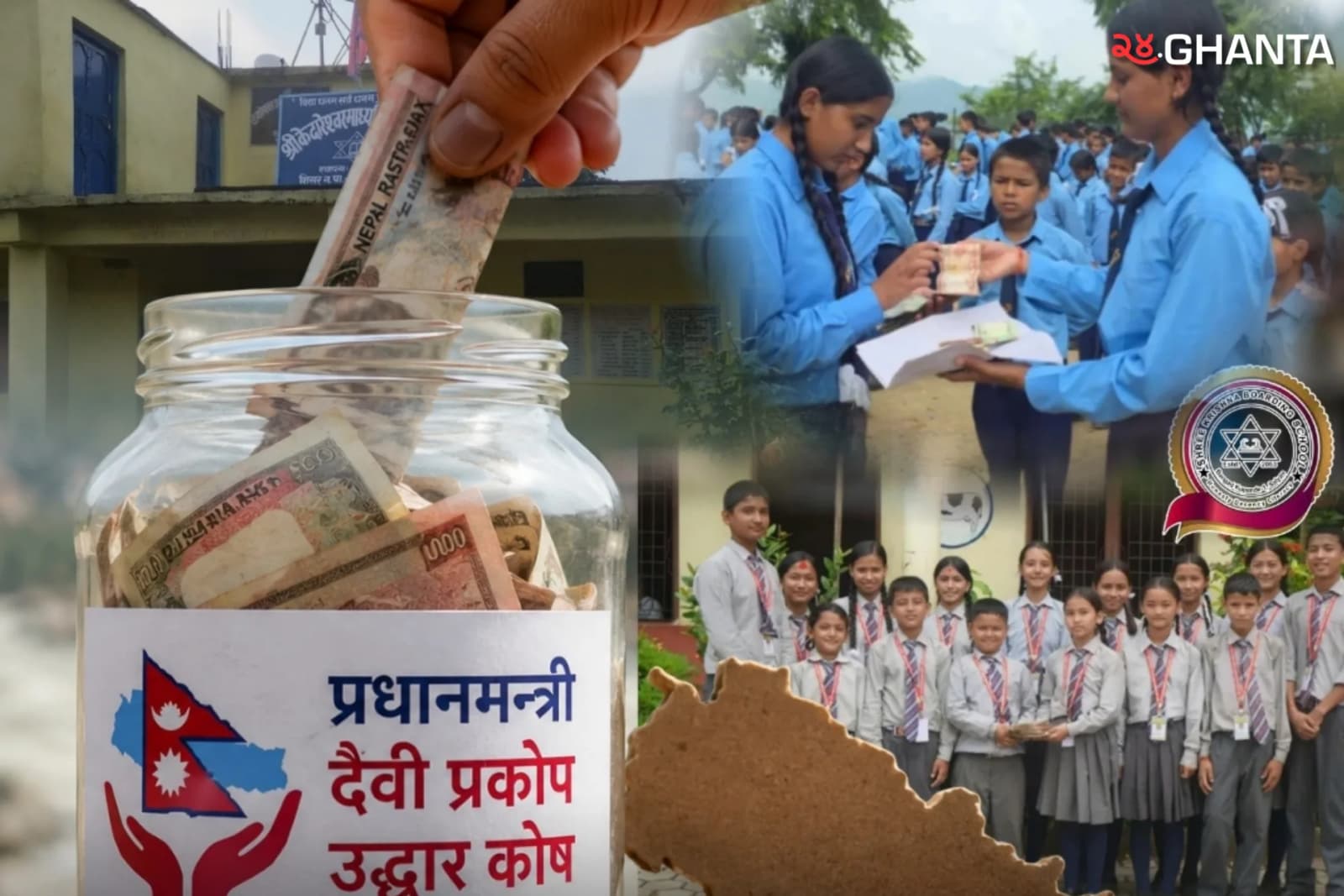
Students from schools in Doti and Salyan have donated a combined Rs. 70,900 to the Prime Minister’s Disaster Relief Fund, with some children even choosing to give up their own snack money to help flood-affected families.
Doti Students Collect Rs 61,815
Students of Shree Kedareswor Secondary School in Kapalleki, Shikhar Municipality Ward 1, Doti, collected Rs. 61,815 to support people affected by the Bhotekoshi flood.

Students studying from Grades 6 to 12 voluntarily collected the money and deposited it into the Prime Minister’s Disaster Relief Fund.
School Principal Gagan Karki said the students wanted their contribution to provide some relief to people suffering after the disaster. He thanked the students and said helping people during difficult times is a responsibility shared by everyone.
Salyan Students Give Up Their Snack Money
An equally touching effort came from Shree Krishna Boarding School in Devsthal, Bangad Kupinde Municipality Ward 1, Salyan, where students collected Rs. 9,085 from money they would normally spend on snacks.
According to teacher Birendra Budha, students from Grades 2 to 10 participated in the collection. Grade 2 students contributed Rs. 490, Grade 3 Rs. 245, Grade 4 Rs. 645, Grade 5 Rs. 855, Grade 6 Rs. 1,525, Grade 7 Rs. 1,220, Grade 8 Rs. 2,325, Grade 9 Rs. 805 and Grade 10 Rs. 1,065.
The entire Rs. 9,085 was deposited into the Prime Minister’s Disaster Relief Fund.
The students explained their decision in simple words. They said missing snacks for a day would not seriously affect them because they could eat after reaching home, but the money saved could provide some help to people suffering after the flood.
Their contribution shows how the Rasuwa disaster has touched people far beyond the areas directly affected.
What Happened In The Rasuwa Flood?
A massive flash flood entered Nepal through the Bhotekoshi river corridor from the Tibet side on August 26, 2026, causing widespread destruction in Rasuwa before moving downstream through the Trishuli river system. Timure and Syafrubesi were among the areas hit particularly hard.
Initial scientific assessments suggest that an ice avalanche may have blocked the Lhende River upstream in Tibet. Water accumulated behind the blockage before being suddenly released, creating the destructive flood. Authorities have said investigations are continuing to establish the complete chain of events.
The disaster damaged homes, markets, roads, bridges, customs facilities and hydropower infrastructure. WHO reports that communities in Rasuwa, Nuwakot, Dhading, Chitwan, Gorkha and Tanahun have been affected, with around 10,000 households reported to need immediate relief. Three health posts were completely damaged, one hospital was partly damaged, and access to two other hospitals was affected in the initial assessment.
The flood also destroyed sections of the important road connecting Nuwakot with the Rasuwagadhi border. The Department of Roads reported extensive damage along the 42-kilometre Betrawati to Rasuwagadhi section, including several bridges.
Search and rescue operations remain particularly difficult around hydropower facilities. As of September 1 (Bhadra 16), hundreds of hydropower workers and staff were still reported missing across projects in Rasuwa and Nuwakot, with mud, debris, floodwater and blocked tunnels making access to underground facilities extremely difficult.
Small Contributions With A Powerful Message
Against the scale of such destruction, Rs. 61,815 from Doti and Rs. 9,085 from Salyan may appear small. But these contributions carry a different value.
The money came from schoolchildren, including students as young as Grade 2, who decided that what they had could be shared with people facing a much greater loss.
Together, the two schools have contributed Rs 70,900.
For the students in Salyan, it meant giving up snack money for a day. For those in Doti, it meant voluntarily collecting whatever they could. For families affected by the flood, these efforts represent something beyond money: people living far away are thinking about them and trying to help.
As rescue, relief, and recovery operations continue, these young students have delivered a simple message through their actions: help does not have to be big to matter.
Published Sep 1 in Nepal