
The Border That Millions Cross Without a Passport
The Nepal India open border supports millions of crossings for work, trade, healthcare, education, and family visits. However, trafficking, smuggling, and illegal migration remain concerns, requiring stronger cooperation and modern security.
· 12 min read
How Safe Is It Today?
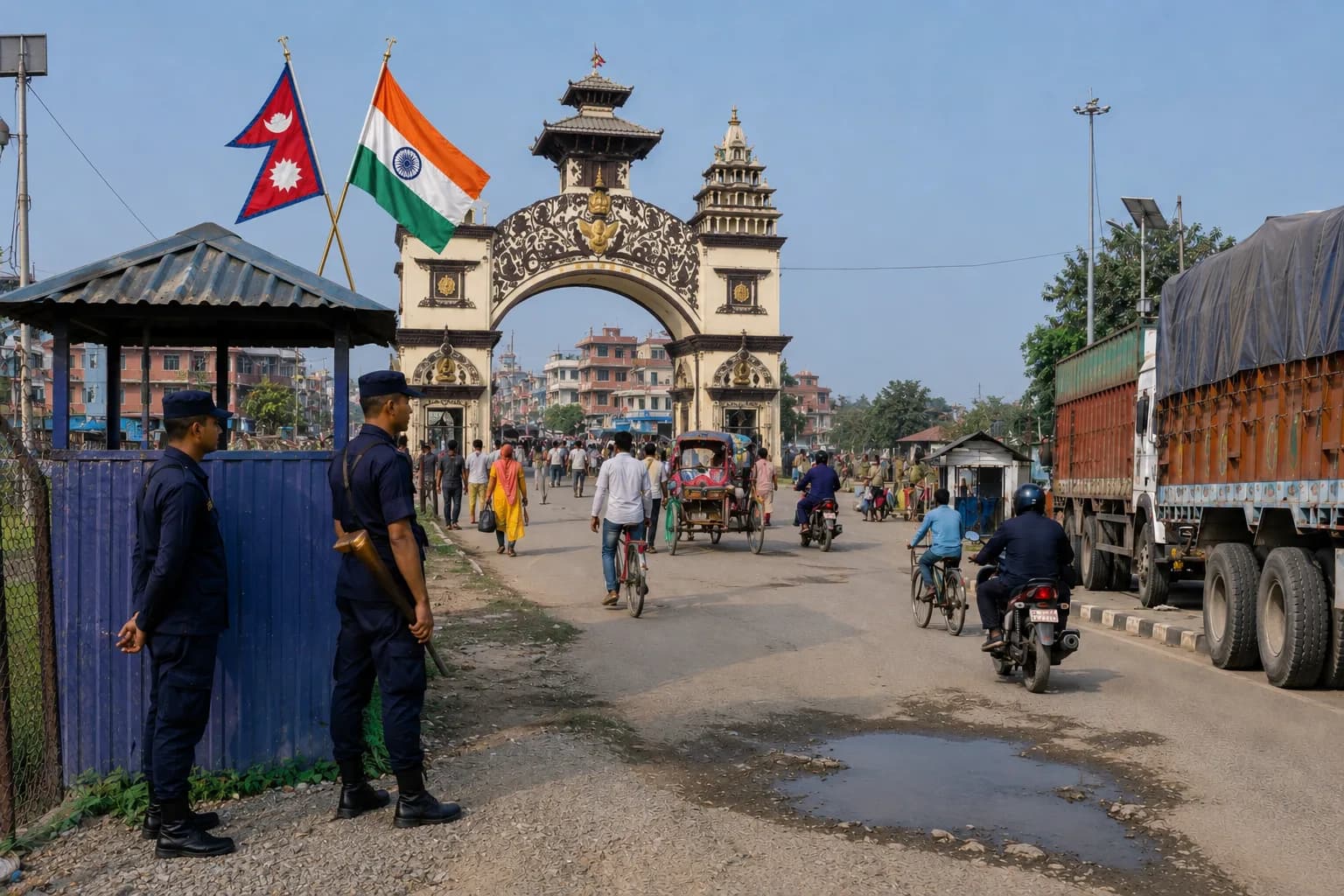
Every morning, shopkeepers open their stalls on both sides of a line that barely feels like one. Students cross to attend college. Laborers cross for work that pays better on the other side. Families split across two countries visit each other the way people elsewhere visit a neighborhood across town. At busy crossings like Raxaul-Birgunj or Sunauli-Bhairahawa, people walk across an international border almost as casually as crossing a street.
It's one of the most unusual borders in the world. Nepali and Indian citizens generally don't need a visa to enter each other's country. Millions of people cross it every year for work, school, healthcare, trade, and family without ever showing a passport.
That openness is remarkable. It's also the reason a fair question keeps coming up: how secure is a border that millions of people can cross easily?

Border at a glance
Length: Roughly 1,880 kilometers, though estimates vary between about 1,751 and 1,880 km depending on the source and survey
Legal foundation: The 1950 Treaty of Peace and Friendship between Nepal and India
Visa required: No, for citizens of either country
Main security forces: Nepal's Armed Police Force (APF) and India's Sashastra Seema Bal (SSB)
Major crossings: Birgunj-Raxaul, Bhairahawa-Sunauli, Nepalgunj, Kakarbhitta, Dhangadhi
Why Is the Border Open in the First Place?
The legal root of all this goes back 75 years, to a single treaty signed in a very different Kathmandu.
On July 31, 1950, India's ambassador to Nepal, Chandreshwar Prasad Narain Singh, and Nepal's prime minister, Mohan Shamsher Jang Bahadur Rana, signed the Treaty of Peace and Friendship. It's only ten short articles long, but it laid the legal groundwork for one of the most unusual relationships between two neighboring countries anywhere in the world.
Most people credit this treaty with creating Nepal's "open border." That's true in spirit, but the treaty itself never actually uses that phrase. What it contains is Article 7, which grants citizens of each country, on a reciprocal basis, the same rights to residence, property ownership, trade, and movement in the other's territory. Movement is one item in that list, not a standalone declaration that the border would disappear. The unrestricted, document-free crossing people experience today grew out of that clause over decades of practice, not from an explicit order written into the treaty.
The treaty isn't permanent by design; either government can end it with one year's written notice. Neither has. And its legitimacy has never gone entirely unquestioned: Nepali critics have long argued it was signed at a moment of Nepal’s weakness, by a Rana regime clinging to power and leaning on India for support, rather than by a government negotiating as an equal. That debate is still unresolved, and we'll come back to it.
Can Anyone Really Cross?
In practice, yes, but the actual rule is narrower than the border's relaxed reputation suggests.
According to the Indian Embassy in Kathmandu and Nepal's own Department of Immigration, Indian nationals traveling by air between the two countries may use only a valid Indian passport or an original Election Commission Voter ID card with a photo. A downloaded or printed Voter ID doesn't count, even with all the right information on it. Neither does an Aadhaar card, a PAN card, or a driving license, despite all three being standard, everyday forms of ID in India.
Neither government publishes a separate rule for crossing by land. The requirement on paper is the same either way. What actually differs is enforcement. Airports check every traveler, every time. Land crossings, especially for people on foot at busy posts like Sunauli and Raxaul, are enforced far more loosely; officials often let pedestrians through without checking any document at all. That gap between the written rule and what happens at the actual checkpost is where the open border's reputation for informality really comes from. It isn't that no rule exists; it's that almost nobody enforces it where most people actually cross.
How Is the Border Actually Protected?
The border is open, but it is not unwatched. Nepal's Armed Police Force and India's Sashastra Seema Bal are the two forces responsible for it, running outposts, patrolling, and coordinating against smuggling and trafficking.
The numbers involved are bigger than most casual travelers probably assume. SSB's total strength is around 94,000, with roughly 45,000 personnel deployed specifically along this border. Nepal's APF has about 37,000 personnel total, with 22,000 nearly 60 percent of the whole force assigned to border duty. Nepal currently runs somewhere between 228 and 250 border outposts, with the exact figure depending on which government reports you check and when it was published. Each post is meant to hold around 35 personnel, though officials openly admit many run understaffed.
That presence isn't fixed; it shifts, sometimes for reasons that have nothing to do with Nepal or India at all. In May 2025, as military tensions spiked between India and Pakistan, APF sharply escalated its posture along this border. Over just 48 hours, the force ran 312 patrols, set up 1,844 checkpoints, deployed more than 10,000 personnel, and carried out 84 joint patrols with SSB.
More recently, APF has also tried a lighter approach at some crossings: plainclothes "Border Interaction Teams" meant to gather security information and build trust with local communities, rather than staffing a visible checkpoint that slows everyone down.
Even the physical border itself needed repair. The boundary pillars marking exactly where the line runs had fallen into disrepair for years, a problem flagged as far back as 2016 by Nepali officials reviewing bilateral relations. Since fiscal year 2023-24, APF has repaired roughly 2,690 pillars; India has repaired 925 over the same period, meaning Nepal has done about three times the volume of maintenance on a boundary both countries are jointly responsible for.
Still, officers on the ground have described real limits to what any of this accomplishes. In a 2021 study, one APF constable posted at Raxaul told researchers it wasn't possible to stop every pedestrian carrying tax-exempt goods from Indian markets, since Nepali customs law at the time allowed duty-free import of small household items. The same research documented APF personnel being physically attacked by smugglers on multiple occasions, with some posts vandalized in the process. Nepal's customs allowances have changed since then, so this specific account reflects conditions as they stood in 2021, not necessarily today's rules but it illustrates a structural problem that's unlikely to have disappeared: enforcement depends partly on what's legal to carry across in the first place, and that line has moved before.
The Biggest Security Challenges
Human trafficking: This is probably what most people actually mean when they ask if the border is safe. The U.S. State Department's 2025 Trafficking in Persons Report kept Nepal on the Tier 2 Watch List for a second consecutive year, meaning the government is making real effort, but not enough to meet international minimum standards. For the tenth year running, Nepal hasn't amended its law to fully criminalize all forms of labor and sex trafficking, and concerns about official complicity in trafficking crimes persist. At a single crossing, Belhiya, in Rupandehi district, the anti-trafficking group Maiti Nepal recorded 253 rescues in one fiscal year alone, and 56 more in a single month the following year. Their own assessment is blunt: it hasn't slowed down.
Gold smuggling: Nepal has quietly become what analysts call a transit hub for gold moving from China into India, taking advantage of gaps in customs enforcement at Kathmandu's airport and along the open southern border. Just how big this gets was clear in 2023, when customs officials at Tribhuvan International Airport seized the largest haul on record: 362 kilograms of gold hidden inside brake pads, worth roughly NPR 3.5 billion. But lawmakers and investigators have both said, on the record, that these seizures mostly catch the couriers carrying the gold not the networks actually running the operation.
Drug trafficking: Marijuana grown in Nepal's southern plains moves into Bihar in large volumes. In Sunsari district alone, more than 14,000 kilograms were seized in a single fiscal year through May 2026, over 60 percent of everything seized across the entire province. Smugglers have adapted their methods over time, increasingly using ambulances since they draw less scrutiny at checkpoints. In October 2025, India's Narcotics Control Bureau and SSB announced they were formally deepening coordination specifically to interdict trafficking across this border.
Wildlife trafficking: INTERPOL lists Nepal as sitting on one of the world's most active wildlife trafficking routes, home to species such as the Bengal tiger, red panda, snow leopard, musk deer, and native rhinoceros that are frequently targeted for parts moved through the same networks used for other contraband.
Illegal migration and organized crime:
Nepal's own police chief put this on the record recently, and plainly. Addressing a parliamentary committee on July 24, 2026, Inspector General of Police Dan Bahadur Karki said the open border, illegal entry of refugees, and Nepal's lack of legal jurisdiction beyond its own borders have become major security challenges. He said illegal entry of Rohingya, Pakistani, and Somali nationals via India has increased in recent years, with some individuals forming groups within Nepal and a portion allegedly involved in crimes including drug trafficking.
Karki also disclosed that several Nepali citizens are currently held in Indian custody on fertilizer-smuggling charges, being handled through informal police-to-police coordination rather than any formal legal mechanism, a gap that exists because Nepali law doesn't currently allow the country to investigate or prosecute crimes committed beyond its own borders.
Nepal's total recognized refugee population from these groups is small, around 600 people, mostly Pakistani nationals from the Ahmadiyya community fleeing religious persecution, and a smaller number of Somalis, most of whom are themselves trafficking victims rather than perpetrators. In direct response to Karki's testimony, the parliamentary committee has since directed the government to modernize Nepal's border security system.
Efforts to Review the Treaty
Nepal and India have discussed updating the 1950 Treaty of Peace and Friendship, but the formal review process has not yet been completed.
In 2016, the two countries formed the Eminent Persons Group, or EPG. It included four experts from Nepal and four from India and was tasked with reviewing the broader relationship between the two countries, including the 1950 Treaty.
The group held nine meetings over two years and completed a joint report in 2018. According to publicly available accounts, the report examined issues related to security, trade, economic cooperation, and the movement of citizens between Nepal and India.
The report was intended to be presented to the prime ministers of both countries. However, that formal handover has not taken place, and the report has not been made public.
Nepali officials and members of the EPG have repeatedly called for the report to be formally received and discussed. In March 2025, former Prime Minister K.P. Sharma Oli told Nepal’s Parliament that his government was still communicating with India about the matter.
Since the report remains confidential, the public cannot independently confirm all of its recommendations. What is known is that experts from both countries completed a joint review in 2018, but its recommendations have not yet entered a formal government-level discussion or implementation process.
So, How Safe Is It?
There is no simple answer.
For millions of Nepali and Indian citizens, the open border functions as intended. Every day, people cross legally for work, education, healthcare, trade and to visit family without the visa requirements that exist at most international borders.
At the same time, government agencies and researchers have consistently identified security challenges. Human trafficking, smuggling, unauthorized crossings and other cross-border crimes remain ongoing concerns. Nepal and India regularly coordinate through their border security forces, and security measures are sometimes increased in response to changing regional circumstances. Both countries have also continued repairing border infrastructure and expanding security deployments in recent years.
The available evidence suggests that the Nepal-India border is neither completely unrestricted nor completely secure. It is an open border supported by long-standing agreements, but one that still requires continuous management and cooperation to address security risks while allowing legitimate cross-border movement.
Seventy-five years after the 1950 Treaty of Peace and Friendship, the border remains one of the world's most unique international frontiers. It continues to support millions of lawful crossings every year while presenting security challenges that both Nepal and India continue to address.
Source:
Treaty of Peace and Friendship, 1950. Ministry of External Affairs, India.
"Valid Travel Documents," Embassy of India, Kathmandu.
"Information for Indian Nationals," Department of Immigration, Nepal.
Yukesh Upreti, "Issues in Border Security of Nepal," Journal of APF Command and Staff College.
"Armed Police Force repair nearly 2,700 Nepal-India border pillars," The Kathmandu Post, December 12, 2025.
"APF Sets Up 312 Patrols, 1,844 Checkpoints Along Border," Nepal News.
Yukesh Upreti, "Issues in Border Security of Nepal," as cited above.
"2025 Trafficking in Persons Report: Nepal," U.S. Department of State.
"Human trafficking from Nepal-India border continues unabated," Khabarhub.
"Gold smuggling and gold-plated politics," myRepublica.
"Gold Smuggling Case in Nepal: Custom Law and Punishment," Law Imperial.
"The Cannabis Corridor," Nepal News.
"NCB, SSB to Strengthen Anti-Drug Trafficking Operations on Indo-Nepal Border," All India Radio News.
"Nepal," INTERPOL.
"IGP says open border, illegal refugee entry pose major security challenges," Peoples' Review, July 24, 2026.
"Nepal's Southern Border Has Become An Open Regional Crossroads," myRepublica. "Parliamentary committee directs government to modernize Nepal's border security system," Khabarhub.
Timalsina, Saroj Kumar, "Nepal-India Relations: Efforts to Review 1950's Treaty," International Journal of Innovative Science and Research Technology, 2019.
"Nepal in talks with India to receive EPG report, says Oli," The Kathmandu Post, March 21, 2025.
Published Jul 29 in Researched Article