
How Safe Is the Water You Drink Every Day?
A national survey found E. coli contamination in drinking water at the point of use among 60.4% of the household population represented by the water quality indicator. Public health tests also detected fecal contamination in parts of Kathmandu, while 589 KUKL monitoring records reviewed showed satisfactory results. The findings raise concerns about leaking pipelines, household storage, and whether water remains safe from its source to the glass.
· 11 min read
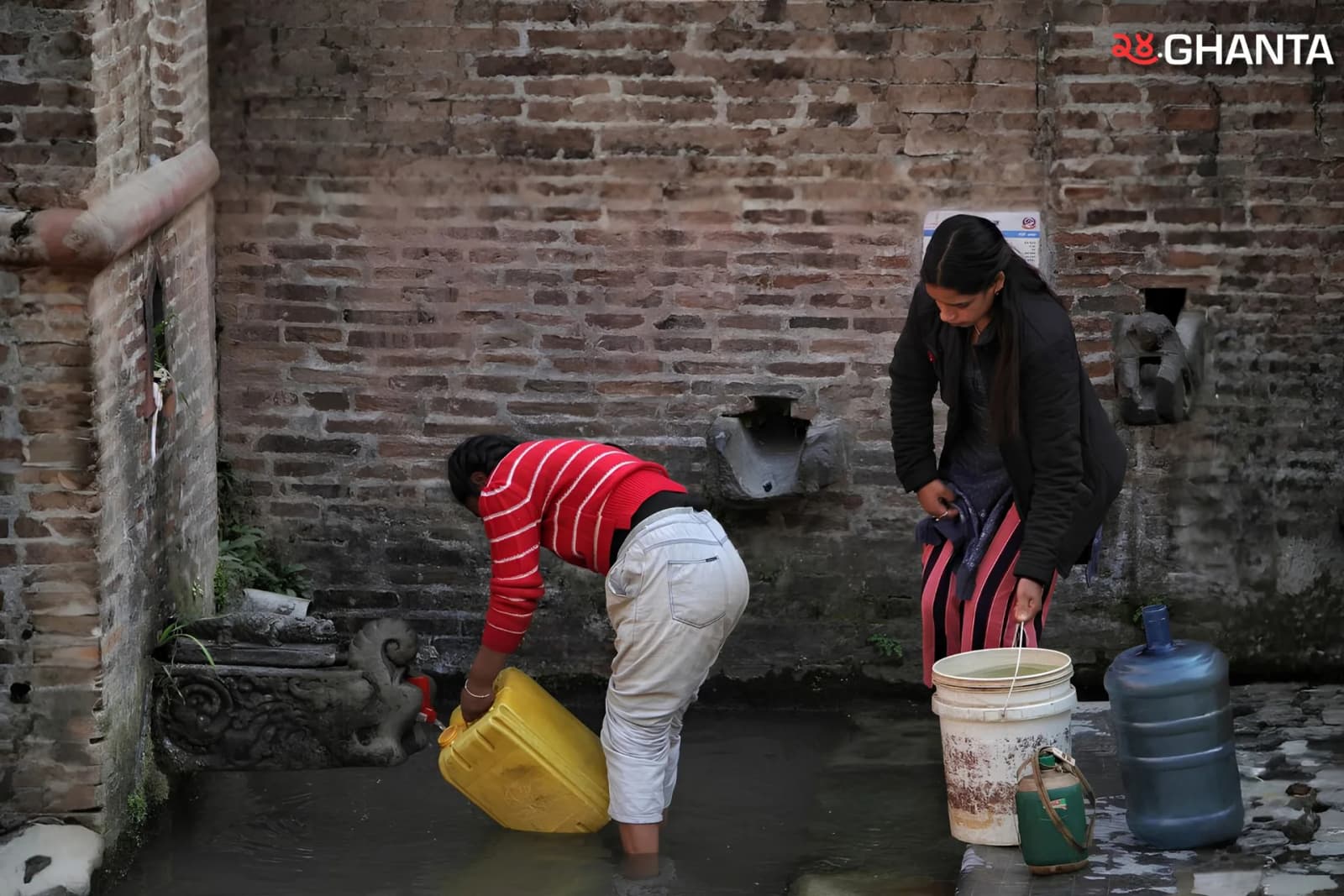
You turn on the tap, fill a glass and drink. The water looks clear. It smells normal. It tastes normal.
But none of those things can tell you whether the water contains bacteria linked to fecal contamination.
For families across Kathmandu Valley, drinking water may come from municipal taps, jars, tankers, wells, underground storage tanks, rooftop tanks and household filters. Some families rely on several of these sources at the same time.

That makes one basic question surprisingly difficult to answer:
How safe is the water we drink every day?
Recent testing has detected E. coli and fecal coliform in drinking-water samples from parts of Kathmandu Valley. Jar water, which many people consider safer than tap water, has also failed microbiological testing in some investigations.
At the same time, Kathmandu Upatyaka Khanepani Limited's own Bhadra 2083 monitoring records show the samples in that dataset as satisfactory.
So the story is not simply that Kathmandu's water is safe or unsafe. The more important question is:
Where can water quality change between the source and the glass?
Nepal Has Improved Water Access, But Safe Water Is Another Question
Nepal has made major progress in improving access to drinking water.
But access and safety are not the same thing.
The Nepal Multiple Indicator Cluster Survey 2024–25, conducted by Nepal's National Statistics Office in partnership with UNICEF and published in February 2026, provides one of the clearest recent pictures of the country's drinking water situation.
According to the survey:
60.4% of household members represented by the water quality indicator had E. coli contamination in drinking water at the point of use.
46.1% had E. coli contamination detected at the source or point of collection.
Only 47.5% met the survey's criteria for safely managed drinking-water services, an improved source on the premises, available when needed and free from E. coli.
That difference is important. A household may have access to an improved water source and still end up consuming microbiologically contaminated water.
Having water does not automatically mean having safe water.
Kathmandu Tests Found Fecal Contamination
In the weeks before the 2026 monsoon, the Public Health Office in Kathmandu tested drinking water samples from different parts of the district. More than one fourth of the samples contained hazardous microbes.
Officials reported E. coli and fecal coliform in tap water samples collected from Kageshwari Manohara, Chandragiri, Dakshinkali, Nagarjun and Kirtipur. E. coli normally lives in the intestines of humans and other warm blooded animals.
When it is detected in drinking water, it indicates fecal contamination or a failure in the barriers meant to protect water from such contamination.
That does not mean every E. coli strain will make someone seriously ill. But it is an important warning that the water has been exposed to contamination and that other harmful microorganisms may also be present. The concerning part was not only what the tests found.
The Public Health Office later said it had been unable to continue testing for a period because of various constraints. That meant authorities did not have continuous information about drinking water quality across the areas they had been testing.
Another Round of Testing Found Contamination in Every Sample Tested
In July 2026, the Public Health Office reported another round of water testing. Samples were collected from households and public taps in:
Kathmandu Metropolitan City
Chandragiri Municipality
Kirtipur Municipality
Dakshinkali Municipality
Gokarneshwar Municipality
According to the office, fecal coliform and E. coli were found in every sample included in that particular testing round.
That finding sounds alarming, but it needs to be interpreted carefully. It does not mean that every household or every tap across those municipalities was contaminated.
It means that every sample included in that specific round of testing tested positive.
Without the full sampling frame including the exact number of samples, the precise locations and how those sites were selected the result should not be used to describe all households across Kathmandu Valley.
Still, the finding was serious enough for officials to point to several possible causes.
They cited:
old and leaking water pipelines,
Drinking water lines located near sewer lines,
weak infrastructure, and
poor protection of water sources.
But KUKL's Own Monitoring Shows a Different Picture
This is where Kathmandu's water story becomes more complicated. Kathmandu Upatyaka Khanepani Limited also conducts water quality testing at treatment plants, reservoirs, outlets and distribution points.
The Bhadra 2083 KUKL laboratory dataset reviewed for this article contains 589 numbered test records.
All 589 records are marked “Satisfactory,” and total coliform is recorded as zero in the dataset reviewed.
The records include samples from locations such as:
New Sundarijal Water Treatment Plant
Mahankalchaur
Bansbari
Bode
Sainbu
Khumaltar
Kirtipur
Panipokhari
The dataset also includes tap samples from neighborhoods such as Dillibazar, Gyaneshwor, Kalopul, Ratopul, Putalisadak, Kamaladi, Tilganga, Baneshwor and Kapan.
KUKL's monitoring includes parameters such as turbidity, pH, electrical conductivity, alkalinity, hardness, iron, ammonia, chloride, free residual chlorine and total coliform. So why did Public Health Office testing detect fecal contamination while KUKL's Bhadra dataset shows satisfactory results?
The answer is not necessarily that one set of tests is wrong.
The samples were taken at different times, from different places and potentially from different points in the water system.
There is also a technical difference.
The KUKL sheet reviewed here reports total coliform, while the Public Health Office reports specifically discuss E. coli and fecal coliform.
They should therefore not be presented as identical tests conducted on identical water.
Instead, together they raise a more important question:
Can water be safe at one point in the system but face contamination risks before it reaches the consumer?
Source: Kathmandu Upatyaka Khanepani Limited, Water/Waste Water Quality Assurance Division, Bhadra 2083 water-quality records
Follow the Water
To understand the problem, it helps to follow the journey of water. For many Kathmandu households, that journey may look something like this:
Water source
↓
Treatment plant
↓
Reservoir
↓
Distribution pipeline
↓
House connection
↓
Underground tank
↓
Rooftop tank
↓
Household pipe
↓
Filter or boiling
↓
Your glass
WHO's updated 2026 drinking-water guidelines say drinking-water risks should be managed throughout the full system from “catchment to consumer.”
WHO recommends:
Health based targets,
Water safety plans,
sanitary inspections,
Risk based management, and
independent surveillance.
In simple terms:
It is not enough for water to leave a treatment plant safely. It needs to stay safe until somebody drinks it.
Old and Leaking Pipelines Can Increase the Risk
Kathmandu's distribution network is one possible weak point.
Public health officials have specifically warned about old and leaking water lines, especially where drinking water pipes run close to sewer lines.
If water infrastructure is damaged or poorly protected, contamination can become more likely. That means a satisfactory result at a treatment plant does not automatically describe every point farther down the distribution network.
This is why testing needs to happen at multiple stages, not only at the source or treatment plant.
Then the Water Reaches Your Home
The journey still may not be over. Many homes, offices, apartment buildings, hotels and restaurants in Kathmandu store water in underground tanks and rooftop tanks.
Poorly maintained household storage can create another potential opportunity for contamination. That raises a very simple question:
When did you last clean your water tank?
But this point needs to be treated carefully.
The evidence reviewed for this article does not prove that household tanks caused the contamination found by the Public Health Office.
To establish that, researchers would need to test the same water at different stages, for example:
municipal line → underground tank → rooftop tank → kitchen tap
Only then could they determine where water quality changed.
That remains an important unanswered question.
Is Jar Water Really Safer?
When people do not trust tap water, many turn to jar water.
It feels safer because it has been commercially processed and packaged. But jar water is not automatically safe.
In July 2025, Godawari Municipality in Lalitpur collected samples from 10 separate bottled water companies. Six of the 10 samples tested positive for fecal coliform.
Authorities sealed factories supplying contaminated water and said production would resume only after improvements and further testing.
But this result should not be exaggerated. It does not mean 60% of all jar water sold across Kathmandu Valley was contaminated. It only describes the 10 suppliers included in that particular Godawari investigation.
Still, the finding challenges one common assumption:
Paying for packaged water does not automatically guarantee safe water.
It Is Not Only Tap and Jar Water
Previous testing cited by the Public Health Office has detected harmful microbes in several types of water.
These included:
public-tap water,
jar water,
water supplied by the state utility,
tanker water,
tube-well water,
well water, and
water from the Melamchi River.
That matters because Kathmandu households often use more than one water source. One family may use municipal water for washing, tanker water for storage and jar water for drinking.
Another may use groundwater and then filter it. So the water safety question is bigger than simply asking whether tap water is safe. It is about the whole chain.
Why the Monsoon Makes the Risk Worse
The rainy season adds another layer of risk. Heavy rainfall and flooding can contaminate water sources and damage infrastructure. Public health officials repeatedly warn that drinking-water contamination becomes more common during Nepal's monsoon.
Contaminated water can transmit or contribute to water-borne diseases including:
diarrhea,
dysentery,
typhoid,
cholera,
hepatitis A, and
hepatitis E.
That is why health authorities regularly urge people to pay extra attention to water safety during the rainy season.
Birgunj Shows How Serious a Water Borne Outbreak Can Become
Nepal saw a major example in Birgunj in August 2025.
Health facilities began reporting a sudden increase in acute watery diarrhea on August 22, 2025. By August 28, WHO reported that more than 600 cases had been recorded, including 187 active cases. Laboratory testing confirmed Vibrio cholerae in selected samples.
WHO worked with Nepal's health authorities on:
case detection,
sample collection,
laboratory support,
clinical management,
surveillance, and
community engagement.
Water safety was also part of the response.
The Department of Water Supply and Sewerage Management deployed a mobile water-quality laboratory, while chlorine tablets and chlorine solution were provided and UNICEF helped support chlorine availability.
The Birgunj outbreak does not mean Kathmandu is currently facing the same situation. But it shows why drinking water contamination and weak monitoring cannot be ignored until large numbers of people start falling sick.
Why E. Coli Matters
E. coli may sound like a complicated laboratory term. Its meaning in drinking water testing is actually straightforward. E. coli normally lives in the intestines of humans and animals.
When it is found in drinking water, it indicates fecal contamination or a failure in the barriers meant to keep fecal contamination out of the water. Not every strain of E. coli causes serious disease.
But its presence is important because it tells scientists that contamination has occurred and that other harmful microorganisms may also be present.
And this is exactly why drinking water contamination can be difficult for an ordinary person to detect.
Unsafe water can still look perfectly clear.
You cannot judge microbiological safety simply from color, smell or taste.
What Can People Actually Do?
When drinking water safety is uncertain, WHO advises people to use properly treated water.
During the Birgunj cholera response, WHO advised the public to drink water that had been boiled, chlorinated or otherwise safely treated.
Families can also reduce risk by:
keeping drinking water containers clean and covered,
maintaining household filters properly,
keeping underground and rooftop tanks clean,
preventing contamination while transferring water,
checking that packaged water containers are properly sealed, and
being especially careful during the monsoon and after flooding.
But household precautions cannot become the entire solution.
Safe drinking water cannot be only the consumer's responsibility.
Families cannot inspect underground pipelines.
They cannot see E. coli.
They cannot test every jar.
They cannot know how every tanker has been cleaned.
That responsibility also belongs to water suppliers, municipalities, regulators and public health authorities.
The Bigger Question Is What Happens After Contamination Is Found
Kathmandu already has water quality testing. But testing alone is not enough. When contamination is detected, people should be able to know:
Was it found in their neighborhood?
Was the same source tested again?
Was chlorination increased?
Was a damaged pipe repaired?
Was the public warned?
Was a supplier inspected?
Did later testing show the problem had been fixed?
WHO's 2026 guidance emphasizes surveillance and preventive risk management, not simply occasional testing.
Kathmandu's Water Problem Is Not Only About Quantity
For years, Kathmandu's water debate has focused heavily on supply.
Is Melamchi running?
When will the water come?
How many hours will the tap flow?
How much water is entering the Valley?
Those are important questions. But another question deserves just as much attention:
What happens to the water after it enters the system?
The Public Health Office has documented fecal contamination in samples from parts of Kathmandu. Jar water has failed testing in specific investigations.
The NMICS 2024–25 found E. coli contamination at the point of use among 60.4% of household members represented by the water quality indicator.
At the same time, all 589 Bhadra 2083 KUKL records reviewed for this article were marked satisfactory, with total coliform recorded as zero.
Those findings do not necessarily contradict one another. They show how complicated drinking water safety can be. The water that finally reaches your glass may have passed through a source, treatment plant, reservoir, kilometers of pipeline, a household storage tank and a filter.
So perhaps the most useful question is not simply:
“Is Kathmandu's water safe?”
A better question is:
“Where does safe water stop being safe?”
Because the water in your glass may look completely clean.
The harder question is whether you know what happened to it before it got there.
Main Sources
1. Nepal Multiple Indicator Cluster Survey 2024–25
National Statistics Office & UNICEF Nepal
Published: February 2026
2. “Monsoon returns, and so do drinking water safety fears”
The Kathmandu Post
May 28, 2026
3. “Latest tests find faecal contamination in Kathmandu drinking water”
The Kathmandu Post
July 12, 2026
4. KUKL Water Quality Reports
Kathmandu Upatyaka Khanepani Limited
5. “60 percent of jar water samples collected from Godawari found contaminated with faecal coliform”
The Kathmandu Post
July 29, 2025
6. WHO Guidelines for Drinking-water Quality
World Health Organization
June 17, 2026
7. “Cholera outbreak in Birgunj: WHO supporting scaling up response to save lives”
WHO Nepal
August 29, 2025
Tags
Published 2 hours ago in Researched Article