
Why Do We Celebrate Dashain? The Story Behind Nepal’s Biggest Festival
Dashain is one of Nepal's most important festivals, celebrating Goddess Durga's victory over evil while bringing families together for tika, jamara, and blessings. Its history dates back centuries, with Malla and Shah rulers helping shape its religious, cultural, and royal traditions. Beyond religious beliefs, Dashain reflects Nepal's farming heritage, diverse communities, family reunions, and the joy of returning home.
· 17 min read
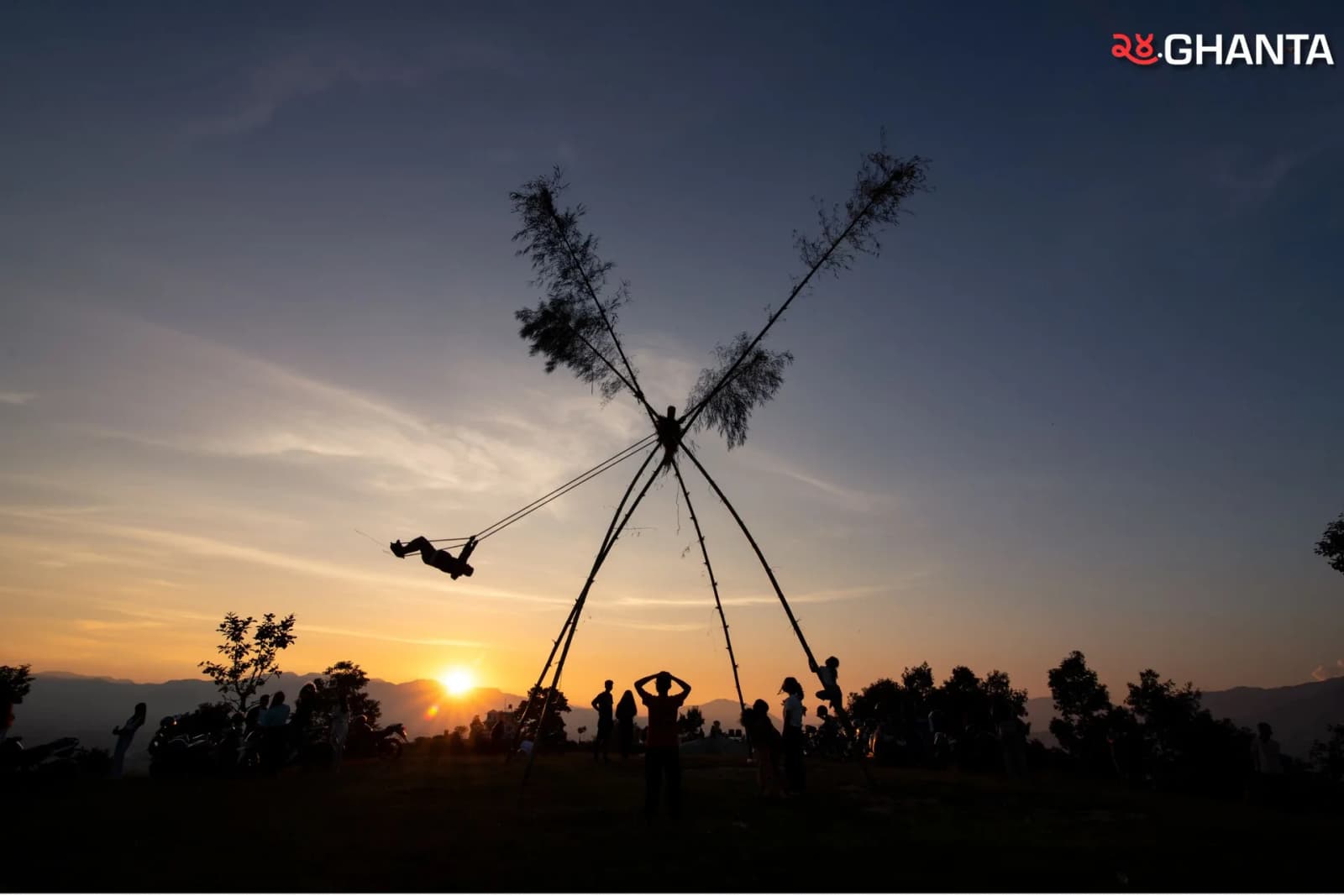
We celebrate Dashain with tika, jamara, family gatherings, and blessings. But have you ever wondered how the festival began, why it is celebrated in autumn, and how it became so important in Nepal? Its story goes back centuries and involves religion, kings, farming, and traditions that continue to shape Nepali life today.
Every year, as Dashain approaches, Nepal begins to feel different.
The familiar sound of Malashree Dhun fills the air. Markets become crowded, colorful kites appear in the sky, and bamboo swings are built in villages. Families begin preparing special meals, buying new clothes, and planning their celebrations.

People working or studying away from home start thinking about returning to their families. Children look forward to receiving tika, blessings, and dakshina (money given by elders), while parents and grandparents prepare to welcome their loved ones.
For many Nepalis, Dashain is more than just a festival. It is the time of year they look forward to the most.
But there is a question we rarely stop to ask: Why do we actually celebrate Dashain?
The most familiar explanation is that Dashain celebrates the victory of good over evil. According to Hindu tradition, Goddess Durga defeated a powerful demon named Mahishasura.
However, that religious story is only one part of Dashain's history.
Historical records show that Nepal's Malla kings were already celebrating the festival more than 600 years ago. Later, the Shah rulers helped make it an important state festival. Farming traditions, local beliefs, and family customs also played a role in shaping the celebrations we know today.
So, how did a festival connected with Goddess Durga become one of Nepal's most important celebrations?
The answer begins with an ancient religious story.
Why Do We Worship Goddess Durga During Dashain?
The main religious reason for celebrating Dashain comes from Hindu beliefs about Goddess Durga.
Durga represents strength, courage, and protection. She is worshipped as a powerful goddess who protects the world from evil. One of the best known stories about her comes from the Devi Mahatmya, a sacred Hindu text that is part of the Markandeya Purana.
According to the story, a powerful demon named Mahishasura was threatening the gods and causing suffering.
The gods tried to defeat him but failed. They then combined their divine powers to create Goddess Durga.
Armed with weapons given by the gods, Durga fought Mahishasura and eventually defeated him.
For Hindu devotees, her victory represents the victory of good over evil, justice over wrongdoing, and courage over fear.
This is why the worship of Goddess Durga is an important part of Dashain.
The first nine nights of the festival are known as Navaratri. During this period, devotees worship the goddess and her different forms.
The tenth day, known as Vijaya Dashami, is associated with victory and is celebrated by receiving tika, jamara, and blessings from elders.
Is Dashain Also Connected to Lord Rama?
Yes. Another Hindu tradition connects Vijaya Dashami with Lord Rama's victory over Ravana in the Ramayana.
This story is especially important in the Dussehra celebrations observed in different parts of India. Both stories teach a similar lesson: good can defeat evil, even after a difficult struggle. However, they come from different religious traditions, and the ways people celebrate them are not always the same.
In Nepal, worship of Goddess Durga is a central part of Dashain.
How Old Is Dashain? Was It Celebrated Before Nepal Was Unified?
You may have heard that Dashain has been celebrated for thousands of years.
While the religious traditions connected with the festival are very old, historians cannot identify one exact year when Dashain first began in Nepal.
Historian Mahesh Raj Panta has studied old documents and historical records to understand how the festival developed.
According to Panta, references to Dashain in Nepal can be traced back to around 1375 AD, meaning the festival was being celebrated more than 650 years ago. But this does not mean Dashain started in 1375.
It simply means there are historical references to the festival from that period. It may have existed earlier, but historians need reliable evidence to prove that.
Panta also explains that surviving records from Nepal's Licchavi period do not clearly mention Dashain as a festival.
An inscription from the reign of King Manadeva in 503 AD mentions Bhagawati, a goddess associated with Dashain. However, worshipping a goddess does not necessarily mean the festival existed in the same form we know today.
What is clear is that Dashain was celebrated long before modern Nepal was unified.
The Malla Kings Were Already Celebrating Dashain
Before the Shah rulers took control of the Kathmandu Valley, Dashain was already important to the Malla kings. According to Panta, an interesting event took place in 1678 AD.
On Vijaya Dashami, Malla King Nripendra Malla and Gorkhali King Prithvipati Shah established a special friendship at Mohan Chowk in Hanuman Dhoka.
Choosing Dashain for this occasion suggests that the festival was already an important date for royal ceremonies and relationships.
Another historical account from 1666 AD describes Mahanavami celebrations under King Srinivasa Malla of Lalitpur. Panta reports that the king arranged religious ceremonies and provided money for the celebrations.
These examples show that Dashain did not begin with Prithvi Narayan Shah or the unification of Nepal.
Research by Dr. Astrid Zotter at Heidelberg University in Germany supports this historical picture.
Her research project examines how Nepal's kings worshipped Goddess Durga from at least the 14th century. It studies old documents, inscriptions, royal records, and religious ceremonies.
The research explains that autumn goddess worship was already an important part of royal life during the Malla period.
The important fact is that Dashain was celebrated in Nepal centuries before the country became unified under the Shah dynasty.
How Did Dashain Become Such a Big Festival in Nepal?
If Dashain existed before Nepal's unification, why did it become so widely celebrated?
One important reason is the role of Nepal's kings and government.
Before unification, present-day Nepal was divided into different kingdoms. People followed different religious traditions and celebrated different festivals.
When the Shah rulers conquered the Kathmandu Valley in 1768–1769, they took control of the former Malla royal palaces and religious institutions.
According to Heidelberg University's research, the Shah rulers continued several religious traditions already practiced by the Malla kings. They also introduced some of their own ceremonies.
Over time, Dashain became closely connected with the monarchy, government offices, and military.
Royal ceremonies, official celebrations, and government support helped make it a major festival.
Dashain also became an important occasion for showing loyalty to rulers and maintaining relationships between the state and its people.
However, the history is more complicated than simply saying that the festival united everyone.
Heidelberg's research also examines how the rulers encouraged different communities to participate in Dashain. These efforts sometimes strengthened social divisions and placed pressure on people whose traditions were different.
This helps explain why Dashain became important across Nepal, while some communities continued to question its connection with the former Hindu monarchy.
Why Did Kings Give So Much Importance to Fulpati?
Fulpati, the seventh day of Dashain, has a special connection with Nepal's royal history.
It involves sacred flowers, leaves, and plants used during religious worship.
One of Nepal's best-known Dashain traditions is the ceremonial bringing of Fulpati from Gorkha to Kathmandu.
According to historian Mahesh Raj Panta, the ceremony became especially important after Prithvi Narayan Shah took control of Kathmandu.
He also suggests that festival leave for government workers and special allowances for soldiers became more important during this period.
But Fulpati was not completely new to the Kathmandu Valley.
Panta points to records from the Malla period showing that Fulpati-related ceremonies were already being performed before Shah rule.
In other words, the Shah rulers helped expand and change existing traditions rather than introducing Dashain from nothing.
Was Dashain Originally Celebrated in Chaitra Instead of Asoj?
Here is something many people may not know.
Nepal celebrates two important Dashain observances: Bada Dashain in autumn and Chaite Dashain in spring.
This raises an interesting question.
Was Dashain originally celebrated in Chaitra and later moved to Asoj?
One popular story says that Dashain was once mainly celebrated during the hotter months of Chaitra.
According to this explanation, people prepared large amounts of meat and other food for the festival. Because temperatures were high and refrigerators did not exist, food could spoil quickly.
The story suggests that people eventually preferred celebrating during the cooler autumn months.
Another popular explanation is connected to farming.
For centuries, agriculture was central to the lives of many Nepalis. Autumn brought changes in farming activities, and the end of the heavy monsoon rains could make traveling easier.
This could have made the season more suitable for visiting relatives and holding large celebrations.
But there is an important fact to understand.
There is no conclusive historical evidence in the cited sources proving that Dashain was officially moved from Chaitra to Asoj because of hot weather or spoiled food.
Hindu religious traditions include Navaratri celebrations in different seasons. Spring and autumn observances are both important, and some traditions recognize four seasonal Navaratris.
It is possible that different seasonal celebrations existed over time and that the autumn festival gradually became more popular in Nepal.
So the story about Dashain being moved because of hot weather is interesting, but it should be treated as a popular explanation rather than a proven historical fact.
Is Dashain Also Connected With Harvesting?
Yes. Dashain also has important connections with agriculture.
The Nepal Tourism Board describes Dashain as a major harvest festival.
In farming communities, seasonal changes affect when people can rest, travel, and visit relatives.
The festival is also connected with grains, growth, and hopes for a good harvest.
One example is jamara, the sacred shoots grown during Dashain.
However, it is not correct to say that all Nepali farmers finish harvesting rice before Dashain.
Rice harvesting happens at different times across Nepal, and in many places, the main harvest continues after the festival.
Dashain's connection with farming is therefore about the wider agricultural season, not simply the end of every harvest.
What Happens During the Main Days of Dashain?
Dashain is not only about receiving tika.
The festival traditionally lasts around 15 days, beginning with Ghatasthapana and ending with Kojagrat Purnima.
Each major day has its own meaning.
Ghatasthapana
The First Day
Dashain begins with Ghatasthapana. Families prepare a sacred space, install a ritual vessel, and plant grains that will grow into jamara. Worship of Goddess Durga also begins.
Fulpati
The Seventh Day
Sacred flowers, leaves, and plants are brought into homes and temples. The traditional Fulpati procession from Gorkha to Kathmandu is a well-known part of Nepal's royal history.
Maha Ashtami
The Eighth Day
Devotees offer special prayers to Goddess Durga. Some families and temples perform animal sacrifices, while others make offerings of fruits, flowers, or other items.
Mahanavami
The Ninth Day
Special worship is performed for the goddess. Many people also worship their vehicles, tools, and machines. Kathmandu's Taleju Temple traditionally opens to devotees on Mahanavami.
Vijaya Dashami
The Tenth Day
Families receive tika, jamara, and blessings from elders. Relatives visit one another, and in many communities, tika ceremonies continue for several days.
Kojagrat Purnima
The Final Day
The festival ends on the full moon, with religious observances associated with Goddess Lakshmi.
These are the main celebrations, although customs vary among families, regions, and communities.
Why Do We Plant Jamara and Put Tika on Our Foreheads?
For many families, the most meaningful moment of Dashain is receiving tika and jamara from elders.
But what do they actually mean?
Why Is Jamara Important?
On Ghatasthapana, families plant grains, usually barley, in a sacred space. The grains grow into small yellow or green shoots called jamara.
They are often grown in an area with limited sunlight, which gives them their familiar yellow color.
Jamara is considered sacred and is used during the worship of Goddess Durga. It is also associated with growth, fertility, and prosperity, reflecting the importance of agriculture in Nepali life.
On Vijaya Dashami, elders offer jamara along with tika and blessings.
Why Do We Receive Tika From Elders?
Dashain tika is commonly made from rice, yogurt, and red vermilion. Elders place tika on the foreheads of younger relatives and give blessings for good health, happiness, success, and long life.
For many families, this is one of the most emotional parts of Dashain.
It is a way of showing respect to elders and receiving their love and good wishes. In the past, tika ceremonies were also connected with the monarchy, when kings gave tika as part of royal traditions.
Today, the practice is most commonly associated with family relationships.
Not every community uses the same tika. While red tika is common, some communities use white tika or follow other traditions.
Why Are Animals Sacrificed During Dashain?
Animal sacrifice is one of Dashain's oldest and most debated traditions.
In some Hindu religious practices, animals are sacrificed as offerings to Goddess Durga, particularly during Maha Ashtami and Mahanavami. These rituals are connected with forms of goddess worship that emphasize strength, protection, and the defeat of evil.
Animal sacrifice has also been part of certain royal and temple traditions in Nepal.
However, not everyone follows this practice. Some families offer coconuts, fruits, flowers, or other items instead of sacrificing animals.
Views about animal sacrifice are different even among people who celebrate Dashain.
Some see it as an important religious custom, while others oppose it because of concerns about animal welfare or their belief in nonviolence. This is one example of how the same festival can be understood and practiced differently.
Why Do People Worship Their Cars, Motorcycles, and Tools During Dashain?
You may have seen people placing tika on motorcycles, cars, buses, or machines during Dashain.
But why do we worship these objects? Part of this tradition is connected with religion, and part is linked with Nepal's military history.
According to historian Mahesh Raj Panta, worshipping weapons during Mahanavami was connected with preparations for war in medieval Nepal.
After the monsoon, travel routes often became easier to use. This could make the season more suitable for military movement. Kings and soldiers performed religious ceremonies involving their weapons before military activities.
However, tool worship also has broader religious meanings beyond warfare. Today, people worship the tools, vehicles, and equipment they depend on for their work and daily life.
The purpose is generally to seek blessings for safety, protection, and success.
Why Does Malashree Dhun Remind Us of Dashain?
For many Nepalis, the sound of Malashree Dhun is enough to make them feel that Dashain is near. The traditional melody is closely connected with the festival season and the worship of Goddess Durga.
It has an important place in the musical traditions of the Newar community in the Kathmandu Valley. According to a 2021 report by The Kathmandu Post, music experts have connected the tune with traditions dating back to the Malla period.
However, its exact beginnings remain a subject of discussion among researchers. Over time, Malashree Dhun became widely recognized as music associated with Dashain.
Today, it is heard in homes, temples, public places, and festival programs.
For many people, the melody brings back memories of childhood, family gatherings, and the excitement of the holidays.
Do All Nepalis Celebrate Dashain in the Same Way?
Although Dashain is widely celebrated, not everyone in Nepal follows the same traditions.
Nepal is home to many communities with different religions, languages, and cultural practices.
Some communities have celebrated Dashain for generations, while others follow their own festivals or choose not to celebrate it.
Mohani: Dashain in Newar Culture
Many Newar families celebrate the festival as Mohani or Mohani Nakha.
Mohani has a long history in the Kathmandu Valley and includes traditions connected with family deities, goddess worship, religious ceremonies, and special feasts. Some families visit goddess temples and take part in rituals that are different from those followed in other parts of Nepal.
According to research from Heidelberg University, early Newari texts referred to the festival as Mahani.
This shows that the tradition had an important place in Newar culture long before the Shah rulers conquered Kathmandu.
Although Mohani and Dashain share the same broad festival period, their customs and meanings can differ.
Why Do Some Indigenous Communities Have Different Views About Dashain?
Dashain also has a complicated history for some Indigenous communities. In the past, Nepal's Hindu monarchy and government promoted Dashain as a major state festival.
Some communities accepted and adapted it into their own traditions.
Others questioned why a festival connected with Hindu state power should be treated as equally important for everyone. A 2016 research paper by Tek Bahadur Dong studied Dashain celebrations among Buddhist Tamang communities in Kavre.
The study found that people within the same community had different views. Some continued celebrating Dashain because it brought families and relatives together.
Others wanted to give greater importance to Lhochhar and traditions connected with their Tamang identity. The research also explains that celebrating Dashain does not automatically mean giving up one's own culture.
Similarly, choosing not to celebrate it can be a way of protecting and expressing cultural identity.
This is why Dashain cannot be understood as having exactly the same meaning for every Nepali.
Why Do We Fly Kites, Play on Bamboo Swings, and Wear New Clothes?
Dashain is not only about religious worship.
For generations, children and adults have enjoyed flying kites, playing on bamboo swings, wearing new clothes, and eating special meals. But some popular stories about these activities are also interesting.
One traditional belief says that people should leave the ground at least once during Dashain by playing on a swing. Another story says that flying kites sends a message to the rain gods that the monsoon should end.
These are popular beliefs and local stories, not historical facts that have been conclusively proven.
What we do know is that kites and swings have long been familiar parts of Nepal's autumn festival season. Bamboo swings, often called linge ping, are especially associated with Dashain in villages.
New clothes, delicious food, and visits to relatives also add to the excitement.
These traditions may not all have the same religious meaning, but they help make Dashain memorable for many families.
Why Is Dashain Still So Important to Nepalis Today?
Dashain has changed over the centuries, but for many people, its emotional importance remains strong. In the past, Dashain was closely connected with goddess worship, royal ceremonies, agriculture, and the state.
Today, those traditions still matter, but the festival is also strongly associated with family reunions. For someone working in Kathmandu, Dashain may mean returning to their village after months away.
For a Nepali living abroad, it may bring back memories of home and relatives they cannot visit. For grandparents, it may be the rare time when children and grandchildren gather under one roof.
Dashain is also an important period for travel, shopping, and family spending. People buy clothes, prepare food, exchange gifts, and visit relatives.
But not everyone has the same experience.
Some people cannot return home because of work, money, or distance. Others celebrate different festivals or choose not to observe Dashain. For many who do celebrate, the happiest memories are often the simplest ones.
Receiving blessings from grandparents. Eating together with relatives. Meeting old friends. Flying kites with cousins. Or returning to a childhood home after a long time away.
These moments help explain why Dashain remains important even as Nepal and its traditions continue to change.
So, Why Do We Really Celebrate Dashain?
Dashain does not have just one meaning.
Religiously, it celebrates Goddess Durga and the victory of good over evil.
Historically, it developed through centuries of royal worship and became a major state festival.
Culturally, it is connected with farming, seasonal changes, and different community traditions.
For many families, it is a time to return home, receive blessings, and spend time together.
The Dashain we celebrate today has been shaped by all these influences.
Its religious stories are ancient, its documented history in Nepal goes back centuries, and its traditions have continued to change with each generation. The kings who once helped shape the festival are no longer in power. Some customs have changed, and different communities continue to celebrate in their own ways.
But for many Nepalis, one feeling remains the same.
Dashain is more than a celebration of good defeating evil. It is also about family, memories, traditions, and returning to the people and places that feel like home.
Sources and References
1. Mahesh Raj Panta Onlinekhabar (2023, originally published in 2021)
2. Heidelberg University Dr. Astrid Zotter
3. Nepal Tourism Board
4. Tek Bahadur Dong (2016) Social Science Baha Conference
5. Erin Davis (2016) Mahavidya
6. Onlinekhabar (2020)
7. The Kathmandu Post (October 12, 2021)
8. The Kathmandu Post (September 25, 2019)
Research note: Religious stories are presented as beliefs, historical accounts are attributed to their sources, and popular explanations are not treated as proven facts. In particular, the claim that Dashain was moved from Chaitra to Asoj because of hot weather has not been established by the cited historical evidence.
Tags
Published 1 hour ago in Researched Article