
The Real Cost of Kathmandu’s Air Pollution: How Much Is Dirty Air Costing Nepal?
Kathmandu's Polluted air is costing lives, health and money. Air pollution costs Nepal over 6% of GDP annually, while Kathmandu Valley alone faces an estimated $1.25 billion yearly health burden.
· 15 min read
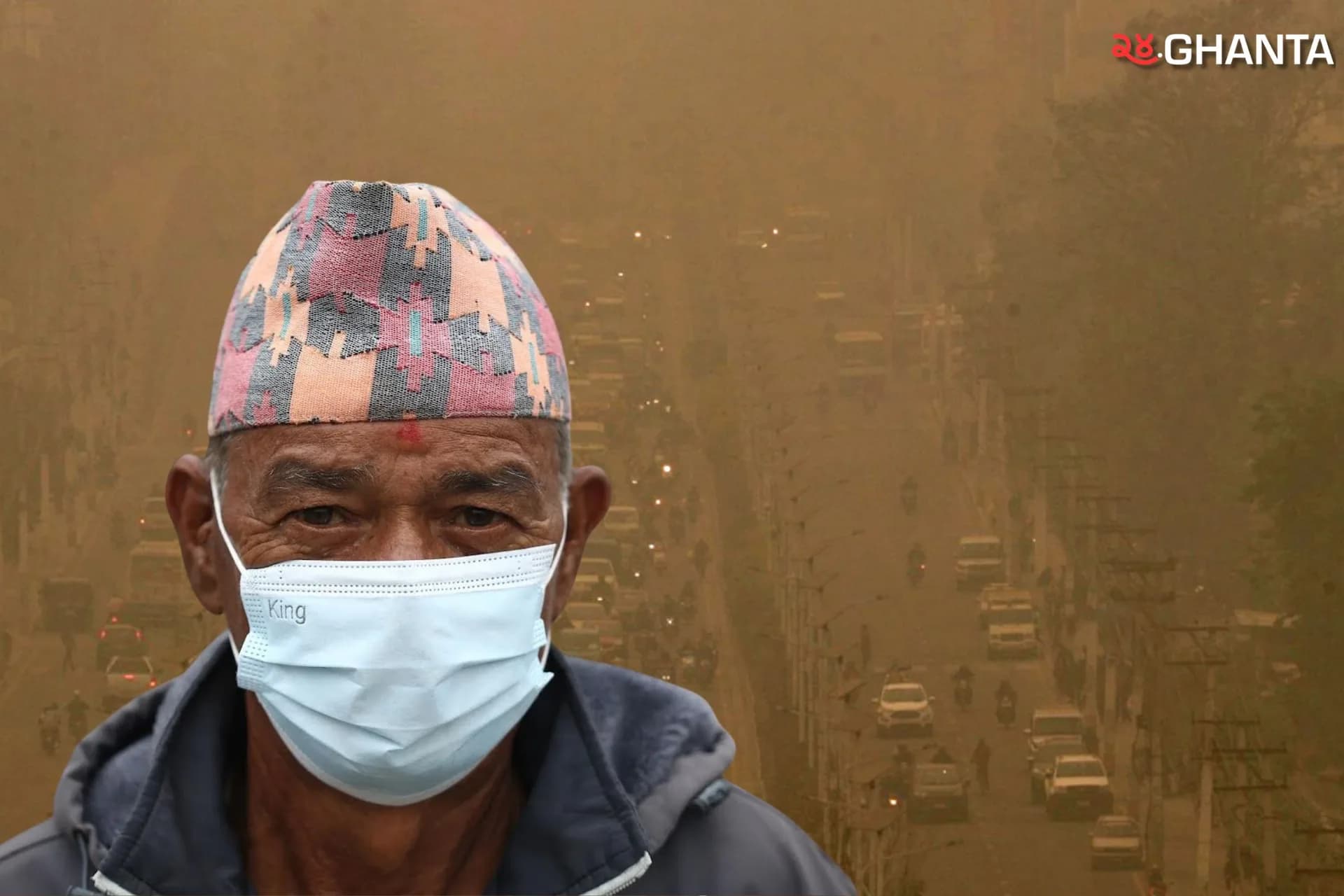
Kathmandu does not shut down when the air becomes dangerous.
Buses still push through traffic. Children still walk to school. Street vendors still sit beside busy roads. Construction workers still report to dusty job sites, and traffic police still spend hours standing between vehicles, pumping exhaust into the air.

People keep working. They keep studying. They keep moving.
And they keep breathing.
That is what makes Kathmandu's air pollution crisis so easy to underestimate. The gray haze hiding the hills is visible. Much of the real damage is not.
It can appear as a persistent cough, another doctor's appointment, medicine a family did not expect to buy, or a worker losing income because they are too sick to work. At a national level, those individual losses become something much bigger: premature deaths, lost years of healthy life, lower productivity, and enormous economic damage.
And Nepal is already paying that bill.
According to the World Bank's 2025 assessment, air pollution is the number one risk factor for death and disability in Nepal. It is associated with approximately 26,000 premature deaths every year and reduces the average Nepali's life expectancy by 3.4 years. The World Bank estimates that poor air quality costs Nepal more than 6 percent of its gross domestic product, or GDP, every year.
Dirty air is not just making Nepal sick.
It is making Nepal poorer.
What Does Losing More Than 6 Percent of GDP Actually Mean?
GDP, or gross domestic product, is the total value of goods and services a country produces. When the World Bank says poor air quality costs Nepal more than 6 percent of GDP, it does not mean the government receives one giant pollution bill.
The cost is scattered throughout society.
It includes health damage, people dying earlier than they otherwise would, workers missing work because they are sick, and people being less productive while working. The World Bank also identifies effects on tourism and aviation. Its full report says pollution affects labor productivity through health-related absences and impaired cognition, while the economic effects on tourism and aviation are also significant.
Think of one worker who becomes sick and misses several days of work. The family may lose income while simultaneously paying for treatment. The employer loses productive hours. Now multiply similar effects across thousands of workers and households and add the economic value of premature deaths and long-term illness.
That is how something invisible in the air becomes an economic problem.
Kathmandu Valley Alone Faces an Enormous Health Bill
More recent research brings the scale of the problem much closer to home.
A 2026 peer-reviewed study of PM2.5 pollution in Kathmandu Valley estimated an annual average of 99.3 micrograms per cubic meter of air. In winter, when pollution becomes trapped in the Valley more easily, that average climbs to 135.2 micrograms per cubic meter.
But what do those numbers actually mean?
The World Health Organization recommends that average PM2.5 exposure over an entire year should be no more than 5 micrograms per cubic meter. In simple terms, Kathmandu Valley's annual average in the study was nearly 20 times that guideline.
Winter was even more striking. The study's winter average of 135.2 was more than 27 times WHO's annual guideline. And this was not only a winter problem. During the monsoon, when rain helped bring PM2.5 down to 54.8, the average was still roughly 11 times the WHO annual guideline.
These comparisons make the scale much easier to see. Kathmandu's air was not just slightly above WHO's health-based recommendation. The study found PM2.5 levels far above it across every season analyzed, with winter standing out as the worst.
That matters because the danger is not limited to a few visibly smoggy days. For Kathmandu residents, the bigger concern is repeated exposure to polluted air over months and years and the health cost that can come with it.
Around 8,900 Premature Deaths and a $1.25 Billion Health Burden in One Valley
The same 2026 study estimated that long-term PM2.5 exposure was attributable to approximately 8,900 premature deaths each year in Kathmandu Valley. Researchers valued the resulting health burden at approximately $1.25 billion annually.
But deaths and dollars do not tell the whole story.
The researchers also estimated about 5.75 lakh disability adjusted life years, or DALYs, lost every year because of PM2.5 exposure. The term sounds complicated, but it is essentially a way of measuring how much healthy human life is lost.
If someone dies 10 years earlier than expected, those 10 years of life are lost. But early death is not the only loss. A person may survive and still spend years living with an illness or disability that reduces their health and quality of life. Researchers count that loss too.
DALYs bring those two losses together: years lost because people die earlier than expected, and healthy years lost because people live with illness or disability.
So, 5.75 lakh DALYs does not mean that 5.75 lakh people died or became disabled. It means that, across Kathmandu Valley's population, the health effects attributed to PM2.5 were estimated to equal the loss of about 5.75 lakh years of healthy life in a single year.
The study also found that the working-age population, particularly people aged 15 to 59, accounted for the largest share of the estimated economic burden. That matters because these are the years when many people are earning incomes, supporting families, running businesses and contributing to the economy.
This is where the cost of dirty air becomes more than a health statistic. Illness can mean doctor visits, medicine, time away from work and financial pressure on families. At a larger scale, poor health can also reduce the productive capacity of a workforce.
However, the study's $1.25 billion estimate should not be read as $1.25 billion in hospital bills or wages directly lost because of pollution. Researchers used an economic method that assigns a value to years of healthy life lost through premature death and disability.
Behind that billion-dollar figure, then, is something much more human: people losing health, healthy years of life and, in some cases, years they might otherwise have lived.
What Exactly Is PM2.5?
The most dangerous part of Kathmandu's polluted air may not be the dust you can see.
PM2.5 means fine particulate matter measuring 2.5 micrometers or less in diameter.
These particles are extremely small. Their size allows them to penetrate deep into the lungs, and particulate pollution is associated with serious cardiovascular and respiratory effects. WHO notes that PM2.5 can penetrate through the lungs and enter the bloodstream, affecting major organs.
That is why a hazy Kathmandu skyline is more than a visibility problem.
The real concern is what people are breathing into their bodies.
Where Is Kathmandu's Pollution Coming From?
There is no single villain.
Kathmandu's air is affected by a mixture of pollution sources, including vehicles, industries such as brick kilns, biomass and waste burning, road dust, and other combustion sources. The World Bank also identifies household cooking, forest fires, and pollution transported across borders as important parts of Nepal's wider air pollution problem.
That last point is important because air does not stop at a national border.
The World Bank describes Nepal as part of the wider Indo-Gangetic Plain and Himalayan Foothills airshed. In simple terms, an airshed is an area where air and the pollution carried by it moves across connected regions. Some pollution affecting Nepal can therefore travel from outside the country, just as pollution produced inside Nepal can travel elsewhere.
Kathmandu also has a geographical disadvantage. The World Bank specifically notes the Valley's bowl-shaped geography surrounded by mountains, which can worsen the pollution problem.
This is why there is no single exhaust pipe Nepal can turn off and suddenly get clean air.
Kathmandu is dealing with pollution produced by the way the city moves, builds, burns, cooks, and grows, combined with pollution that can arrive from farther away.
Why Does Kathmandu's Air Feel Worse in Winter?
Kathmandu's pollution is not equally severe throughout the year.
A peer-reviewed study examining winter air quality across Kathmandu Valley found very high daily PM2.5 concentrations during the winter of 2018. At the urban Ratnapark monitoring site, daily concentrations ranged from 72 to 149 micrograms per cubic meter. At a suburban Lalitpur site, they ranged from 88 to 161 micrograms per cubic meter.
The 2026 Kathmandu Valley health study also found a clear seasonal pattern, with the highest average PM2.5 levels during winter and substantially lower levels during the monsoon.
Part of the reason involves the atmosphere.
During unfavorable winter conditions, the air near the ground can become more stable, and pollution disperses less effectively. Combined with Kathmandu's surrounding mountains and continuing emissions from traffic, burning, industry, and dust, pollutants can remain concentrated near where people live and breathe.
Rain during the monsoon, by contrast, can help remove particles from the atmosphere, which is one reason pollution levels generally decline during that season.
So the familiar winter haze is not random.
It reflects a combination of emissions, geography, and seasonal weather conditions.
“Stay Indoors” Is a Privilege Not Everyone Has
When pollution becomes dangerous, advice often sounds simple: reduce your exposure and avoid unnecessary outdoor activity.
But what if the outdoors is your workplace?
A traffic police officer cannot direct vehicles from home.
A construction worker cannot lay bricks through a laptop.
A street vendor cannot move the sidewalk indoors.
Drivers, delivery workers, construction workers, and many others have jobs that keep them outside or close to pollution sources for hours.
For them, protecting their health can collide directly with earning a living.
Research involving brick kiln communities in Kathmandu Valley illustrates just how unequal exposure can become.
A 2026 study measured average PM2.5 concentrations of 151.2 micrograms per cubic meter around brick kiln workplaces, compared with 8.8 micrograms per cubic meter at control grocery store locations.
And exposure did not necessarily end when workers went home.
Researchers measured an average of 84.6 micrograms per cubic meter in households within one kilometer of brick kilns, compared with 7.5 micrograms per cubic meter in control households farther away.
The researchers also found associations between higher PM2.5 exposure and respiratory symptoms including persistent coughing, breathlessness, wheezing, phlegm and bronchitis. Persistent coughing was the most commonly reported problem among the brick kiln workers studied.
That is what the economic phrase “lost productivity” can look like in real life.
It can mean someone missing a shift because they are sick.
It can mean earning less while spending more on treatment.
It can mean a worker forcing themselves through another day because staying home is financially impossible.
Children Pay a Price Even Without a Hospital Bill
Children do not earn salaries, so their losses rarely appear neatly in economic calculations.
But they still pay a price.
In March 2021, Nepal's air pollution became severe enough for the government to order educational institutions closed for four days because of concerns about students' health. Smoke and haze had covered Kathmandu and other areas during the episode.
Think about what that means.
A problem in the atmosphere entered the classroom.
Children lost school time. Families had to adjust their routines. The pollution had become serious enough that simply continuing with normal school life was considered a health concern.
And schools do not have to close for pollution to affect children.
They still travel through the city, spend time outdoors, and breathe the same air.
That is part of pollution's cost too, even when nobody receives an invoice for it.
Kathmandu Breathes the Same Air, But Not Everyone Has the Same Protection
Pollution can cover an entire city under the same gray sky.
That does not mean everyone experiences it equally.
Someone working inside an office may be able to reduce time beside a congested road. A household with more money may be able to improve indoor filtration or take other measures to reduce exposure.
A street vendor has fewer options.
So does a construction worker.
So does a traffic officer standing in Kathmandu's congestion for hours.
That makes air pollution an issue of inequality as well as health.
Some of the people facing the greatest exposure may also have the least freedom to avoid it.
So asking “How much is pollution costing Nepal?” is only half of the question.
The other half is:
Who is being forced to pay the highest price?
Could Dirty Air Affect Mental Health Too?
The physical health evidence is already strong. The mental health picture requires more careful language.
International research increasingly suggests an association between air pollution and mental health. A 2026 systematic review and meta-analysis of 81 studies found consistent associations between exposure to several air pollutants and increased risks of depression and anxiety, although the researchers also noted issues such as differences between studies, publication bias, and varying evidence quality.
Another recent meta-analysis specifically examining anxiety found associations between both short- and long-term exposure to several air pollutants and anxiety disorders.
If people repeatedly decide the air is too unhealthy for a morning walk, outdoor exercise, or an afternoon with their children, pollution begins changing how freely they use their own city.
That quality of life cost is difficult to put into rupees or dollars.
But it is still a cost.
Is Pollution Making People Look Older?
Studies have investigated whether air pollution contributes to skin aging, including pigmentation changes and wrinkles. A 2026 systematic review examining 77 studies found that many studies reported harmful associations between air pollution and skin conditions, including skin aging. But the researchers also concluded that the overall certainty of evidence for causal relationships was generally low to very low because of limitations in the available studies.
Another systematic review and meta-analysis focusing specifically on long term PM2.5 exposure found a possible association with pigment-related skin aging, while evidence for wrinkles remained limited and uncertain.
So can we say Kathmandu's polluted air is making residents visibly older?
No, not confidently.
Tourism and Aviation Pay Too
The bill does not end at the hospital door.
The World Bank says air pollution has negative effects on tourism and Nepal's aviation sector, in addition to its effects on health and labor productivity.
It is important not to stretch that finding further than the evidence allows. The World Bank report establishes broader economic effects on these sectors; it does not mean every flight delay, cancellation, or tourism decline in Kathmandu can be blamed on air pollution.
But it does show why Nepal's economic burden is much larger than medical expenses alone.
The cost of polluted air moves through workers, businesses, hospitals, households and major sectors of the economy.
And Without More Action, the Cost Could Grow
Perhaps the most worrying part of the World Bank assessment is that today's burden is not necessarily the worst-case scenario.
The Bank's report projects that, without additional measures, average PM2.5 concentrations under its baseline scenario could reach 52 micrograms per cubic meter in Kathmandu Valley by 2035. It warns that continued high pollution would mean additional premature deaths, greater pressure on the health care system, and a growing drag on productivity and competitiveness.
That makes air pollution not only a question about what Nepal is paying today.
It is also a question about what Nepal is willing to pay tomorrow.
So, How Much Is Kathmandu's Dirty Air Really Costing Nepal?
There is no single number capable of capturing everything.
But what researchers already know is alarming.
Across Nepal, the World Bank estimates approximately 26,000 premature deaths every year from air pollution.
It estimates that pollution reduces the average Nepali's life expectancy by 3.4 years.
It puts the economic cost of poor air quality at more than 6 percent of Nepal's GDP annually.
And in Kathmandu Valley alone, a 2026 study estimated approximately 8,900 premature deaths, 575,247 years of healthy life lost, and around $1.25 billion in annual economic burden associated with PM2.5 exposure.
Those are the statistics.
But perhaps the true cost becomes easier to understand when the numbers disappear.
It is the worker coughing through a shift because staying home means losing a day's income.
It is a family spending money on another doctor's appointment.
It is the traffic officer breathing exhaust through another afternoon.
It is the child walking to school under a gray sky.
It is the older person looking outside on another polluted winter morning and deciding it might be safer to remain indoors.
One of those moments alone does not look like an economic crisis.
Multiply them across families, workplaces, neighborhoods and years, and the picture changes.
Kathmandu's dirty air is not free. Nepal is already paying for it in medical costs, lost work, reduced productivity, disrupted lives and, most importantly, years of human life.
The question is no longer whether pollution has a price.
It is how long Nepal can afford to keep paying it.
Sources and References
World Bank. Towards Clean Air in Nepal: Benefits, Pollution Sources, and Solutions. 2025.
World Bank. Towards Clean Air in Nepal: Benefits, Pollution Sources, and Solutions Full Report. 2025.
Discover Public Health. Health and Economic Costs Attributable to Ambient Air Pollution Levels in the Kathmandu Valley, Nepal. 2026.
World Health Organization (WHO). Air Quality and Health: Health Impacts and Types of Pollutants.
Peer-reviewed research. Wintertime Air Quality Across the Kathmandu Valley, Nepal.
Environmental Research. Systematic Review and Meta-Analysis on Air Pollution, Depression and Anxiety. 2026.
American Journal of Clinical Dermatology. Air Pollution and Skin Diseases: A Systematic Review. 2026.
Systematic Review and Meta-Analysis. PM2.5 Exposure and Clinical Skin Aging. 2026.
The Kathmandu Post. Government Decides to Shut Schools for Four Days as Air Pollution Reaches Hazardous Levels. March 29, 2021.
Discover Public Health. Health and Economic Costs Attributable to Ambient Air Pollution Levels in the Kathmandu Valley, Nepal. 2026.
Published 8 hours ago in Researched Article