
From Cash to QR: Where Is Nepal’s Digital Money System Heading?
Nepal is quickly changing the way people pay, with QR codes becoming a familiar part of everyday life, from tea shops to larger businesses. Digital payments are growing rapidly, while cash remains important for many people. As Nepal moves toward a more connected financial system, the bigger challenge will be making digital payments safe, simple, and accessible to everyone.
· 12 min read
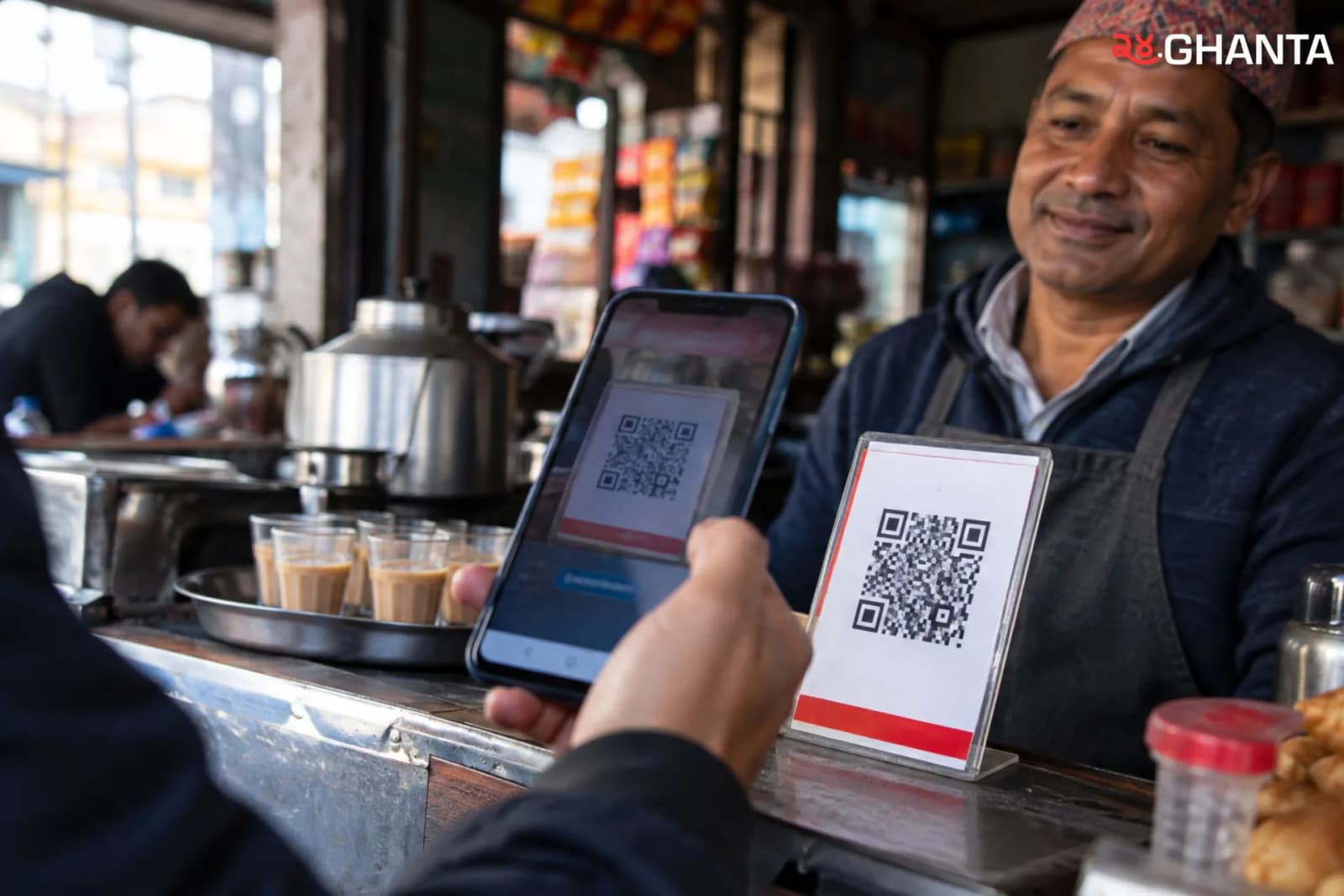
You walk into a tea shop. The bill is Rs. 50. Instead of reaching into your pocket and waiting for change, you pull out your phone. The shopkeeper points to a small black and white square beside the counter.
Scan. Enter Rs. 50. Tap Pay. A few seconds later, the money is sent. This simple experience has become increasingly familiar across Nepal, from restaurants and grocery stores to clothing shops, taxis, and small roadside businesses.
But that little QR code represents something much bigger. Nepal is changing the way money moves. And official figures show just how quickly that change is happening.

QR Payments Are Growing Fast
According to Nepal Rastra Bank's latest Payment Systems Indicators, Nepal recorded 72.44 million QR transactions worth Rs. 164.43 billion in the month ending in mid August 2026.
A year earlier, in the month ending in mid-August 2025, there were 40.93 million QR transactions worth Rs. 100.68 billion. That means the number of monthly QR transactions increased by about 77% in one year, while their value increased by around 63%.
Going back to the reporting period ending in mid July 2024, Nepal recorded only about 20.83 million QR transactions worth Rs. 61.74 billion.
QR is also only one part of Nepal's growing digital payment system.
In the month ending in mid August 2026, Nepal recorded about 78.65 million mobile banking transactions worth Rs. 580.56 billion and 53.01 million digital wallet transactions worth Rs. 48.59 billion.
Faster payment systems including connectIPS, Fonepay IBFT, InstaFund and SCT IBFT handled another 20.50 million transactions worth Rs. 552.40 billion.
These categories should not simply be added together because some types of digital payments can overlap. For example, a person may use a mobile banking app to make a QR payment. But taken together, the numbers show one thing clearly: digital payments are no longer a small part of Nepal's financial system.
But Is Nepal Actually Becoming Cashless?
Not exactly.
Cash is still an important part of everyday life in Nepal. People still withdraw money from ATMs, pay with banknotes and use cash in places where digital payments may be inconvenient or unavailable. But NRB's figures show an interesting change.
In the month ending in mid August 2025, people made about 10.34 million ATM cash withdrawals worth Rs 83.21 billion. One year later, that had fallen to about 9.07 million withdrawals worth Rs 70.05 billion.
That is roughly a 12% decline in the number of ATM withdrawals and a 16% decline in their value.
During that same one year comparison, QR transaction volume increased by about 77%.
This does not prove that cash is disappearing. ATM withdrawals are only one measure of cash use, and Nepal still has a large cash economy. But the numbers suggest that digital payments are replacing cash in at least some everyday transactions.
So rather than calling Nepal "cashless," it may be more accurate to say that Nepal is becoming less dependent on cash for certain payments.
Why Did a Little Square Become So Popular?
A QR code does not look revolutionary. That may be part of its success. Think about a small tea shop. Accepting card payments generally requires the appropriate card payment setup. Once a business is properly set up for QR payments through a bank or payment provider, however, the shopkeeper can display a QR code at the counter.
The customer scans it using a supported banking or wallet app, enters the amount and pays. There is no need to count banknotes or search for change. For a country with many small businesses, that simplicity matters.
But the QR code is only the part customers can see. Behind every payment is a much larger system connecting customers, businesses, banks and payment companies. When you scan a QR and send Rs 100, the system has to identify where the money is coming from, where it should go and whether the transaction has been completed.
This is why Nepal Rastra Bank developed the NepalQR Standardization Framework and Guidelines.
The framework emphasizes interoperability essentially making different parts of the QR payment ecosystem work together and also establishes requirements related to security, merchant verification, settlement and customer protection.
Imagine needing one payment app for your coffee shop, another for your grocery store and another for your taxi. QR payments would quickly become frustrating.
NRB's framework was designed to move Nepal toward a more connected QR ecosystem instead of separate systems that cannot communicate with one another. The central bank's framework specifically describes interoperability as a primary objective for Nepal QR based payments.
The framework document dates to 2020, while NRB's website lists its publication on March 1, 2021. So when a QR payment appears to happen in seconds, there is actually a much bigger financial system working quietly behind the screen.
QR Is No Longer Just About Shopping
Nepal's 2026 flood relief effort showed how digital payment infrastructure can be used for something much bigger than buying coffee or groceries. Following the floods, people were able to contribute digitally to the Prime Minister's Disaster Relief Fund instead of relying only on traditional bank deposits.
Data reported from the Finance Ministry, Fonepay and Nepal Clearing House Limited showed that Fonepay processed 889,145 transactions, including 815,219 domestic QR payments worth Rs 2.095 billion for the relief fund.
NCHL had separately recorded 246,614 transactions, including 112,932 domestic QR payments worth Rs 390.5 million. Digital infrastructure also allowed money to come from outside Nepal.
More than Rs. 1.4 billion reached the fund through 93,850 international Visa and Mastercard transactions. India's UPI and China's Alipay were also among the international payment channels used.This is where Nepal's digital payment story becomes much bigger.
The same infrastructure used to pay a restaurant bill can also support donations, business payments, government transactions and cross border payments.
But Is Everyone Moving at the Same Speed?
This is one of the most important questions in Nepal's digital transition.
Millions of QR transactions do not necessarily mean millions of different people are using them. NRB's administrative figures count accounts, transactions, and registered users, not necessarily unique individuals. One person can have accounts with multiple banks or use several financial apps.
To understand how widely people themselves are participating, survey data provide another perspective. World Bank Global Findex data for 2024 show that about 60% of Nepali adults aged 15 and older had an account.
Interestingly, there was almost no gender gap in account ownership: 59.8% of women had an account, compared with approximately 60.2% of men.
But having an account and actually using digital payments are different things.
In 2024, only about 22% of women made or received digital payments, compared with 35% of men. The World Bank's latest assessment confirms those figures.
Income also makes a difference.
Among adults in the poorest 40% of households, around 22% made or received digital payments, compared with roughly 32% among the higher-income 60%.
So Nepal may have made significant progress in giving people access to financial accounts, but there is still a gap in how actively different groups use digital finance.
That raises a bigger question:
Who gets to participate fully in Nepal's digital future?
Someone with a smartphone, bank account, mobile data, and years of experience using apps may find QR payments extremely easy. Someone without reliable internet, digital skills, or confidence using financial apps may have a completely different experience.
That is why the success of digital finance cannot be measured only by how many QR codes appear at shops.
It also has to be measured by who can actually use them safely and confidently.
When Money Moves Faster, Scams Can Too
Convenience brings another challenge.
In a digital economy, criminals do not necessarily need to physically steal someone's wallet.
Sometimes a fake message is enough. Phishing links, fake banking websites, fraudulent social media accounts, requests for passwords or OTPs and fake payment information can all be used to target people.
The risk became serious enough during the 2026 flood-relief campaign that Nepal Rastra Bank issued a specific public notice on August 31 warning about possible fraud involving fake bank accounts or QR codes used in the name of the Prime Minister's Disaster Relief Fund.
That means digital financial literacy needs to go beyond knowing how to scan a QR code. Before paying, users should ask simple questions:
Does the recipient's name match the person or business I want to pay?
Is this the correct QR code?
Is the website or link genuine?
Why is someone asking for my password, PIN, or OTP?
NRB's own NepalQR framework says payment participants should invest in customer education and specifically highlights awareness about the dangers of sharing sensitive information such as PINs, OTPs and CVVs.
The lesson is simple:
The easier money becomes to move, the more important it becomes to know where it is going.
Nepal's QR Codes Are Crossing Borders
Another important change is happening quietly. QR payments are beginning to cross national borders. NRB now separately tracks cross border QR acquisition in its monthly statistics.
In the month ending in mid August 2026, Nepal recorded 317,332 cross border QR transactions worth about Rs 842 million.
A year earlier, in the month ending in mid August 2025, there were 133,107 such transactions worth Rs 373 million.
That means the number of monthly cross-border QR transactions more than doubled in a year. This matters for Nepal because tourism, travel and economic activity connect the country closely with its neighbors, particularly India.
For a visitor, easier cross border payments can mean less dependence on exchanging physical currency for every small purchase.
For businesses, it can mean making it easier for international customers to pay. And for Nepal's financial system, it represents another step away from payment networks that stop at the border.
Your Digital Payments Could Eventually Matter Beyond Paying
The next stage of Nepal's digital financial transformation may be about more than moving money. Consider a small business that operates mostly in cash.
Hundreds of transactions can take place without automatically creating a detailed electronic financial record. Digital payments are different. Each transaction can leave a record.
With appropriate regulation and privacy protections, electronic transaction histories can potentially give financial institutions more information when assessing a small business for credit.
This is already entering Nepal's regulatory conversation.
Nepal Rastra Bank amended its Digital Lending Guidelines in June 2026. The central bank's official records confirm the first amendment was published on June 9. NRB's monetary policy framework has also called for facilitating digital lending to micro, small and medium sized enterprises based on electronic transactions.
This could become particularly important for small businesses that have economic activity but limited traditional financial records. The QR code beside the cash box, therefore, may eventually do more than receive money.
It can become part of a digital financial history.
What About a Digital Nepali Rupee?
Nepal Rastra Bank is also studying another idea: a Central Bank Digital Currency, or CBDC. Think of it as a possible digital form of central bank money.
For example, we currently have physical Nepali rupees such as a Rs 100 note. A CBDC would allow central bank money to also exist in a digital form. But Nepal has not launched a digital rupee.
For now, NRB is mainly studying a wholesale CBDC, which would be designed primarily for use between banks and financial institutions, rather than for everyday payments at shops.
The study is still under discussion, so this does not mean Nepal is planning to remove cash or replace physical rupees.
It simply means NRB is studying how an official digital form of central bank money could be used in Nepal's financial system in the future.
Nepal's Next Challenge Is Bigger Than QR
Perhaps the clearest indication of where Nepal wants to go came in September 2026.
Nepal Rastra Bank published the Strategic Framework of the Fintech Strategy for Digital Financial Services 2026/27 2030/31 on September 15.
Its ambition goes far beyond increasing the number of QR payments. The strategy envisions a digital financial ecosystem that is safe, trusted, inclusive, innovative, interoperable and resilient.
Its priorities include stronger digital infrastructure, better regulation and supervision, greater innovation, improved digital financial literacy and stronger cooperation across the financial ecosystem.
The strategy also gives particular attention to groups including MSMEs, rural communities, young people, women, children and workers in the gig economy.
And Nepal still has work to do.
A July 2026 Asian Development Bank assessment of Nepal's digital payment landscape highlighted challenges involving interoperability, digital identification, technical integration, adoption by small businesses and skills shortages. It also identified infrastructure improvements and cross-border payment solutions as important areas for future development.
In other words, Nepal has proved that digital payments can grow quickly.
The harder job now is making the entire system reliable, secure, and accessible enough to work for more people and businesses.
So, Will Cash Disappear?
Probably not anytime soon. And perhaps that is the wrong question. Cash still has advantages.
A banknote does not need a charged phone. It does not depend on mobile data. It can still work when a network is unavailable. And for many people, particularly those less familiar with digital technology, physical money remains simple and familiar.
The more interesting transformation is about choice. Not long ago, many everyday transactions in Nepal had one obvious ending: cash changed hands.
Today, a Rs 50 cup of tea can be paid for with a phone. A small shop can receive money digitally. A customer can transfer money without standing in a bank queue. A tourist can increasingly use cross border digital payment systems.
And during a national emergency, hundreds of thousands of people can send donations electronically.
That is why Nepal's journey is bigger than:
Cash → QR.
It is increasingly becoming:
Cash → QR → connected payment networks → cross-border payments → wider digital financial services.
The QR code sitting beside the cash box is only the most visible part of Nepal’s digital payment transformation.
Behind it, Nepal is building a much larger digital financial system. The biggest question is no longer whether Nepalis will scan QR codes. Millions of transactions show that they already do.
The real question is whether Nepal can make digital money safe, simple, reliable and inclusive enough that everyone, not only the most connected, can benefit from it.
Sources
Nepal Rastra Bank Payment Systems Indicators, Saun 2083
Nepal Rastra Bank NepalQR Standardization Framework and Guidelines
Nepal Rastra Bank Payment Systems Department
World Bank Global Findex / Nepal financial sector assessment
Asian Development Bank Advancing Digital Payments in Nepal, July 2026
Nepal Rastra Bank Digital Lending Guidelines
Kathmandu Post / PTI reporting 2026 Flood Relief Digital Payments
Published 2 hours ago in Researched Article