
Gandaki Has Opened the Door to Cannabis Farming. But Is It Really Legal Under Nepal’s Federal Law?
Gandaki Province has opened a regulated path for medicinal and industrial cannabis farming under licenses, testing and government monitoring, but recreational use remains illegal and questions remain over how the provincial law will operate alongside Nepal’s federal narcotics law.
· 12 min read
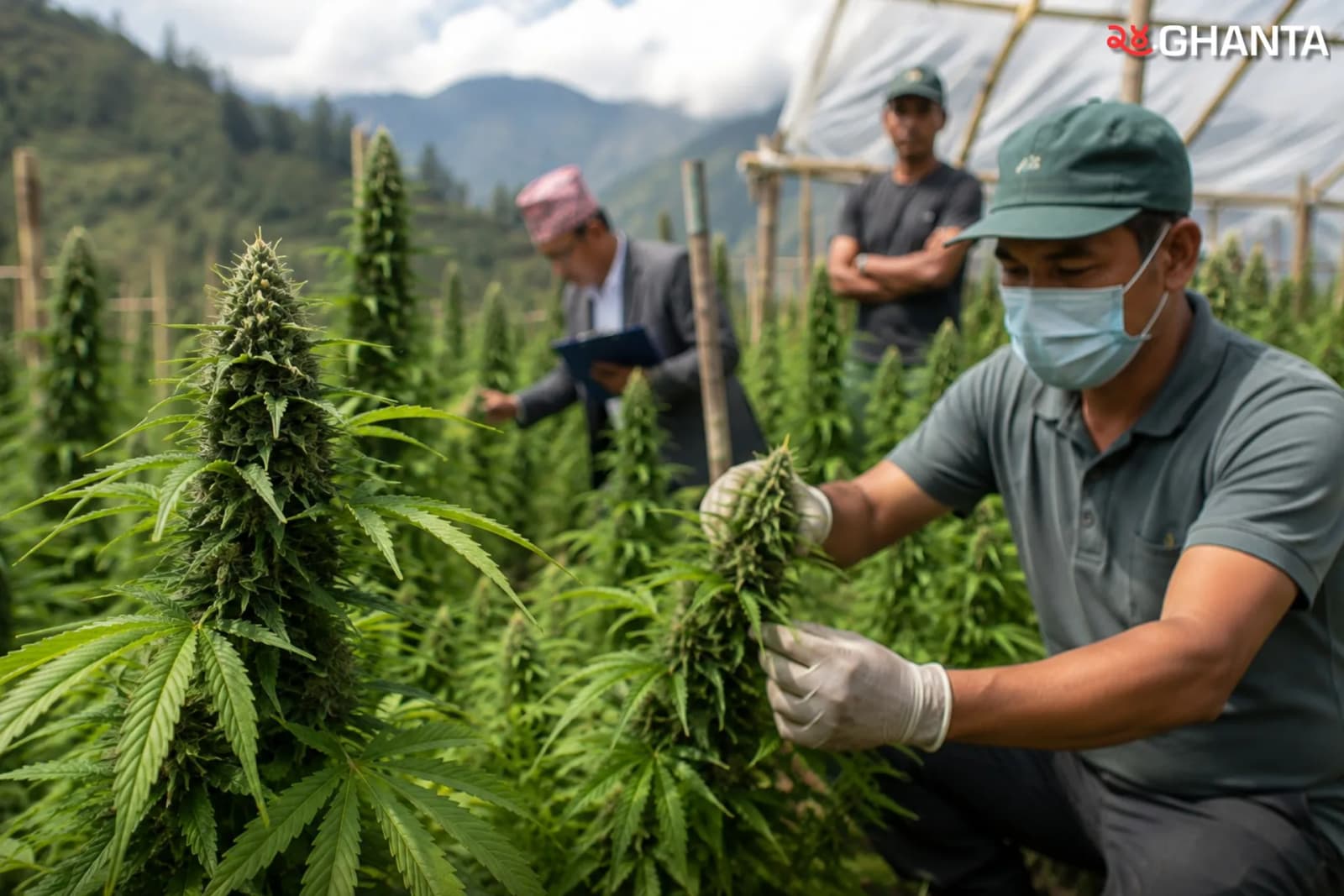
For nearly five decades, Nepal’s message on cannabis has been straightforward: growing, selling, possessing, and using marijuana is generally illegal.
Now Gandaki Province has complicated that picture.
In August 2026, Gandaki authenticated a new law creating a regulated pathway for cannabis cultivation for medicinal and industrial purposes. It is the first provincial move of its kind in Nepal and could eventually allow licensed farmers to grow cannabis under strict government supervision.

But this is not recreational legalization, and it does not mean that now or anywhere else in Gandaki can simply start planting marijuana at home.
More importantly, Nepal’s federal Narcotic Drugs (Control) Act, 2033 (1976) has not been repealed. That law continues to prohibit cannabis cultivation and other cannabis related activities generally.
So Gandaki’s new law raises a bigger question than simply who can get a license:
What happens when a province creates a legal route for an activity that an existing federal law still restricts?
That question sits at the heart of Gandaki’s cannabis experiment.
First, What Has Gandaki Actually Legalized?
Gandaki has not legalized recreational marijuana.
Instead, the province has created a regulatory framework intended to permit cannabis cultivation for specific medicinal and industrial purposes, subject to licensing, government monitoring, designated cultivation areas, security requirements, testing, controlled harvesting, and regulated transportation.
Gandaki Province Chief Dilli Raj Bhatta authenticated the law in early August after a dispute over its possible conflict with federal law.
The Associated Press reported that the legislation took effect following authentication and that farmers would need official provincial permission and would be closely monitored.
That means the basic idea is:
Licensed + approved purpose + government oversight = potentially permitted under Gandaki’s provincial framework.
Unlicensed or recreational cultivation = not legalized.
You Cannot Simply Plant Cannabis Because You Live in Gandaki
This is probably the most important thing for farmers and ordinary residents to understand.
Living in Gandaki does not give someone an automatic right to grow cannabis.
The provincial framework requires cultivation to take place through an official licensing and monitoring system. The law also provides for designated cultivation areas rather than allowing cannabis farming everywhere in the province.
Applicants are expected to provide information about their land, intended use, proposed production, and prospective buyers, among other requirements.
The law also establishes infrastructure and security requirements before cultivation can be authorized.
So someone who hears that “Gandaki legalized cannabis” and plants marijuana behind their house without authorization would not suddenly become a legal cannabis farmer.
Unauthorized cultivation remains a very different matter.
The 0.3% THC Rule
Gandaki’s framework also places restrictions on THC content.
THC, or tetrahydrocannabinol, is the main psychoactive compound in cannabis, the chemical largely responsible for the “high” associated with marijuana.
Under the provincial framework described in the authenticated legislation and subsequent reporting, cannabis entering the regulated medicinal and industrial system is subject to a 0.3% THC limit at specified stages.
Testing is therefore an important part of the system.
The law provides for testing through government facilities or arrangements with qualified institutions, helping regulators determine whether cannabis produced under the program complies with the required standard.
In other words, the province is not creating an unrestricted marijuana market. It is attempting to create a controlled agricultural and industrial supply chain.
Even Harvesting Would Be Supervised
Getting a license would not mean the government simply walks away.
The provincial law establishes monitoring requirements throughout cultivation and harvesting.
Growers are required to notify authorities when their crops are ready. Harvesting is subject to official supervision and documentation, with local officials, monitoring bodies, and police involved in the process.
Transportation is similarly controlled.
Shipments are to be documented and sealed before being moved, with restrictions on when and where those seals can be opened.
The idea is to create a traceable chain:
Farm → Harvest → Storage → Transportation → Authorized buyer
That traceability is important because the same plant being treated as an agricultural or pharmaceutical input under one regulatory system remains tightly controlled under Nepal’s national narcotics regime.
Nepal’s Federal Cannabis Ban Has Not Disappeared
This is where the story becomes legally complicated.
Nepal’s Narcotic Drugs (Control) Act, 2033 (1976) remains in force.
Section 4 of the federal Act generally prohibits a person from cultivating, producing, preparing, purchasing, selling, distributing, importing, exporting, trafficking, storing, or consuming cannabis.
So Gandaki’s new provincial law did not repeal Nepal’s national cannabis prohibition.
A provincial legislature cannot simply erase an Act of the federal Parliament by passing its own law.
But the federal Act itself is more nuanced than an absolute ban with no exceptions.
The Federal Law Already Contains Limited Exceptions
Section 6 of the Narcotic Drugs (Control) Act is particularly important.
It says the Act does not prevent the Government of Nepal, or an institution working under its full supervision and control after obtaining a special license, from cultivating, producing, manufacturing, importing, or exporting narcotic drugs for medicinal or scientific research purposes.
The same provision also addresses supplying narcotic drugs on the recommendation of a recognized medical practitioner.
This matters because it shows that Nepal’s federal law already recognizes the possibility of legally controlled narcotic-drug activity for certain purposes.
But there is an important legal distinction.
Section 6 specifically refers to the Government of Nepal or an institution under its full supervision and control with a special license.
It does not plainly say that a license issued independently by a provincial government automatically satisfies this federal exception.
That leaves an important question unanswered:
Does a Gandaki cannabis license fit within the federal legal framework, or does additional federal authorization or coordination remain necessary?
That is one of the issues that makes the new law legally significant.
So Which Law Wins: Federal or Provincial?
There is no responsible one-word answer.
Nepal’s Constitution divides legislative power among the federal, provincial, and local governments.
Schedule 6 gives provinces authority over several matters, including agriculture and livestock development, factories, industrialization, trade, business, and transportation.
That provides part of the constitutional basis for Gandaki’s argument that it has authority to regulate an agricultural crop intended for medicinal and industrial production.
But Nepal’s Constitution also assigns important powers to the federal government, including the formulation of criminal law, while other subjects are shared between different levels of government.
The legal question therefore is not simply:
“Is cannabis agriculture?”
It is also:
“When regulating cannabis cultivation, where does provincial agricultural authority end and federal narcotics and criminal-law authority begin?”
That boundary is precisely what makes Gandaki’s new law controversial.
The Province Chief Raised That Exact Concern
This conflict was not discovered after the law was passed.
It nearly stopped the legislation before authentication.
After the Gandaki Provincial Assembly passed the cannabis bill, Province Chief Dilli Raj Bhatta returned it to the assembly for reconsideration.
One of the central concerns was that the bill's provisions could conflict with Nepal’s existing federal Narcotic Drugs (Control) Act and raise questions about whether Gandaki had exceeded its constitutional legislative authority.
The provincial assembly disagreed.
Lawmakers passed the bill again.
That triggered an important constitutional rule.
Why the Province Chief Eventually Had to Sign It
Article 201 of Nepal’s Constitution sets out what happens when a Province Chief receives a bill from a provincial assembly.
A Province Chief may return a non-money bill for reconsideration.
But Article 201(4) says that if the Provincial Assembly considers the returned bill and passes it again either unchanged or with amendments and sends it back, the Province Chief must authenticate it within 15 days.
That is what happened with Gandaki’s cannabis legislation.
The assembly passed the bill again, and Bhatta subsequently authenticated it.
But there is an important distinction:
Authentication makes a bill an Act. It does not necessarily amount to a court ruling that every provision of that Act is constitutional or compatible with every federal law.
That question can still arise if the law is challenged.
Gandaki Says It Has Constitutional Authority
Gandaki officials have defended the legislation.
According to a report by the Kathmandu Post, Gandaki Chief Attorney Chiranjeevi Sharma Paudel has argued that the province has constitutional authority over agriculture and that Nepal’s existing legal framework does not completely close the door to controlled cannabis cultivation for medicinal and industrial purposes.
Agriculture and livestock development are indeed included in Schedule 6 of Nepal’s Constitution, which lists provincial powers.
Paudel has also pointed to provisions of the federal narcotics law allowing controlled activity for medicinal purposes and to developments in international cannabis regulation.
Those arguments help explain the provincial government’s legal position.
But they should be described as Gandaki’s legal interpretation, rather than as a final judicial determination.
No court ruling cited here has conclusively established that a Gandaki-issued cultivation license automatically overrides or satisfies every requirement of Nepal’s federal narcotics law.
What If a Licensed Farmer Is Prosecuted?
Consider a practical example.
A farmer receives a valid Gandaki license, grows cannabis inside an officially designated area, follows the THC requirements, maintains the required security infrastructure, sells only to an authorized medicinal or industrial buyer, and complies with every provincial condition.
Then a case is brought alleging that the cultivation violates the federal Narcotic Drugs (Control) Act.
The farmer would have an obvious argument: the cultivation was specifically authorized by the provincial government under a duly authenticated provincial law.
But federal authorities could raise another question: does that provincial authorization satisfy the requirements of the federal narcotics regime?
If those positions cannot be reconciled, a court could ultimately have to examine the constitutional division of powers, the federal Act, and the provincial Act to determine how they operate together or whether a particular provision is invalid because of a conflict.
So a provincial license should not be described as a guaranteed shield against every possible federal legal challenge.
At the same time, it would also be misleading to describe a farmer complying with Gandaki’s licensing system as simply an ordinary illegal grower.
That legal tension is one of the biggest unanswered questions surrounding the new system.
What Happens If You Grow Without a License?
Gandaki’s law does not provide blanket legalization.
Unauthorized cultivation can still expose a person to Nepal’s federal narcotics law.
The Narcotic Drugs (Control) Act contains criminal penalties for prohibited cannabis related activities, with punishment varying according to the particular offense and circumstances.
Gandaki’s provincial framework also distinguishes serious conduct from regulatory violations.
Failures involving matters such as records, approvals, security, or transportation may trigger provincial administrative penalties, while conduct falling outside the authorized system can be referred for action under existing narcotics law.
So the message for the public is straightforward:
Gandaki has legalized a regulatory pathway, not marijuana generally.
Can Farmers Start Applying Now?
Not necessarily.
Passing and authenticating a law is only the first step.
A regulatory system of this complexity also needs implementing rules, designated cultivation areas, administrative procedures, inspectors, testing arrangements, application systems, and other operational infrastructure.
The Kathmandu Post reported on August 7 that detailed regulations and implementation guidelines still needed to be drafted before cultivation licenses could actually be issued.
That distinction matters enormously.
A law can exist while the system needed to use it is still being built.
So farmers should not interpret the authentication of the Act as permission to begin planting immediately.
They need to wait for the provincial government’s official licensing process, designated cultivation areas, and implementing instructions.
What Remains Illegal?
Despite the headlines, Gandaki has not legalized recreational cannabis.
The new framework does not permit people to grow marijuana at home for personal consumption.
It does not create an unrestricted cannabis market.
And it does not erase Nepal’s federal narcotics legislation.
What Gandaki has created is much narrower: a government-controlled pathway intended to allow cannabis to be cultivated as a medicinal and industrial crop under licenses, monitoring, THC restrictions, controlled harvesting, secure transportation, and authorized sales.
Everything outside that system remains legally risky and potentially criminal.
Why This Law Matters Beyond Cannabis
Gandaki’s cannabis law is about more than one crop.
It is also a test of how Nepal’s federal system works when provincial economic and agricultural policymaking meets an older national criminal law.
The Constitution gives provinces meaningful powers of their own. But cannabis sits at the intersection of agriculture, industry, health, narcotics control, and criminal law.
That makes Gandaki’s experiment unusually complicated.
If the system works, it could provide farmers with a new regulated crop and create opportunities for pharmaceutical, textile, fiber, oil, and other industries.
If the legal boundaries remain unclear, however, farmers and businesses may hesitate to invest until they know exactly how provincial licenses interact with federal narcotics requirements.
And if the two legal regimes eventually collide in court, the resulting decision could have implications far beyond cannabis. It could help define the boundary between federal and provincial legislative power in Nepal.
For now, Gandaki has opened a legal door to tightly regulated medicinal and industrial cannabis cultivation. It has not opened the door to marijuana generally, and it has not erased Nepal’s federal narcotics law.
The next chapter will depend on how the province implements the licensing system, how federal authorities respond, and whether Nepal’s courts are eventually asked to decide where one government’s authority ends and another’s begins.
What Happens When Federal and Provincial Laws Clash?
Nepal’s Supreme Court has dealt with similar disputes before.
In the Sagarnath Forest case, Madhesh Province argued that the federal government was interfering in forest management, even though the Constitution gives provinces authority over certain forest matters. The Supreme Court supported the province’s authority and made it clear that the federal government cannot simply take away powers that the Constitution gives to provinces.
In simple terms, federal law does not always win, and provincial law does not always win either. When there is a conflict, the Supreme Court looks at the Constitution and asks: Who actually has the power to make rules about this issue?
That same question could come up with Gandaki’s cannabis law. Gandaki can argue that growing cannabis for medicine and industry is part of agriculture, which is a provincial responsibility. But the federal government could argue that cannabis is also a controlled drug covered by national narcotics law.
If the two laws cannot work together, the Supreme Court may eventually have to decide which government has authority over the disputed part of the law.
Sources
Government of Nepal, Narcotic Drugs (Control) Act, 2033 (1976) particularly Sections 4 and 6.
Constitution of Nepal, particularly Article 201 and Schedule 6.
Gandaki Province cannabis cultivation legislation / Provincial Gazette, 2083 for the provincial licensing, cultivation, monitoring, THC, harvesting, transportation, and enforcement framework.
Sagarnath Forest jurisdiction dispute Constitutional Writ Nos. 076-WC-0001 and 076-WC-0010.
The Kathmandu Post, Deepak Pariyar, “Inside Gandaki’s new cannabis law: Who can grow it, where, and under what rules,” August 7, 2026.
The Kathmandu Post/Kantipur, reporting on the Province Chief returning the cannabis bill and the Provincial Assembly passing it again.
Associated Press, “Nepal’s Gandaki province legalizes medical cannabis farming and use,” August 5, 2026.
Published Aug 13 in Researched Article