
Nepal Pollutes Little, But Pays Heavily: The Fight For Climate Justice
Nepal contributes only a tiny share of global emissions, yet faces some of the growing costs of climate impacts. Its adaptation plan estimates about $47.4 billion may be needed through 2050, with $45.9 billion expected from external support. The climate justice debate is about whether vulnerable countries like Nepal are receiving fair support without being pushed deeper into debt.
· 9 min read
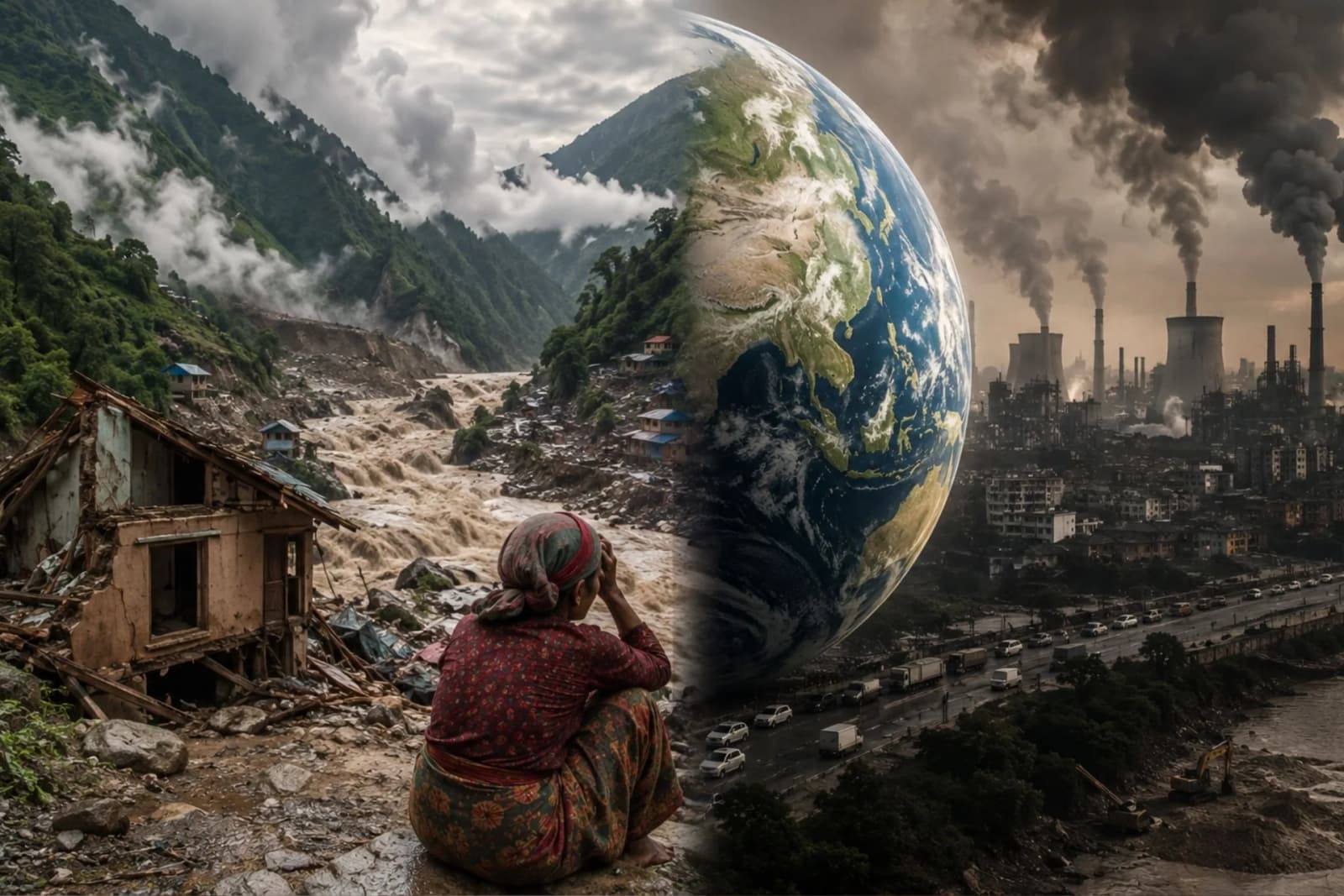
Nepal produces very little of the pollution driving global climate change. Yet the country still has to spend heavily to protect farms, water supplies, roads, homes, energy projects and communities from a changing climate.
That is the basic idea behind climate justice: the countries that contributed the least to global warming are not always the countries that face the smallest risks or the lowest costs.
For Nepal, the question is simple:

If Nepal helped create only a tiny part of the problem, should it have to pay most of the cost of protecting itself?
How Much Does Nepal Actually Contribute?
Nepal is a very small emitter on the global scale.
Global Carbon Budget data presented by Our World in Data shows Nepal produced about 18.8 million tonnes of CO₂ in 2024, around 0.05% of global CO₂ emissions. Using a broader measure covering greenhouse gases, the World Bank estimates Nepal produces about 0.1% of total global greenhouse gas emissions.
The World Bank describes Nepal as a negligible contributor to climate change. At the same time, it warns that without stronger climate resilience, Nepal's economy could be at least 7% smaller by 2050 than it otherwise would have been because of unchecked climate impacts.
That difference matters in everyday life. A farmer who loses crops loses income. A damaged bridge needs to be rebuilt. A community facing water shortages needs new infrastructure. When public money repeatedly goes toward recovery and protection, there is less available for other needs.
But Climate Change Did Not Create Nepal's Floods And Landslides
This is an important fact.
Nepal experienced floods, landslides and droughts long before today's human-driven climate change. The mountains, steep valleys, powerful rivers and monsoon already made Nepal naturally vulnerable to disasters.
Climate change did not create those hazards.
But a warming climate can change some of the conditions around them, including temperature, glaciers, snow, water availability and extreme rainfall.
That is why scientists should not automatically say every major flood was "caused by climate change." A specific disaster can have several causes, and linking an individual event to human-caused climate change requires scientific evidence.
A better question is:
How is climate change changing risks Nepal already has?
Nepal Says Preparing For The Future Could Cost $47.4 Billion
Nepal has already calculated how expensive adapting to climate change could be.
Its official National Adaptation Plan 2021-2050 estimates that its priority adaptation programs could require about $47.4 billion (7.21kharba).
Nepal expects to contribute around $1.5 billion (22,831.5 crore ) from its own resources.
The plan identifies another $45.9 billion (6.97 kharba) as requiring external support.
Adaptation does not simply mean rebuilding after disasters.
It means trying to reduce damage before it happens. That can include stronger early warning systems, safer infrastructure, better water management, more resilient agriculture and protection for vulnerable communities.
In simple terms, adaptation is like strengthening the house before the storm instead of waiting for it to collapse.
So Who Is Supposed To Help Pay?
The international climate system gives developed countries a special responsibility.
Article 9 of the Paris Agreement says developed country parties shall provide financial resources to assist developing countries with climate mitigation and adaptation. Other countries are encouraged to contribute voluntarily. Why developed countries?
The UN climate system follows the principle of "common but differentiated responsibilities and respective capabilities."
In simpler words:
Climate change is everyone's problem, but every country did not contribute equally to creating it, and every country does not have the same ability to pay for the solution.
Does That Mean Rich Countries Legally Owe Nepal $45.9 Billion(6.97kharba)?
No.
This is one of the most important distinctions.
Nepal's $45.9 billion(6.97kharba) figure is the amount its adaptation plan estimates will be needed from external sources. It is not a bill legally assigned to the United States, Europe, Japan, or any other country.
The Paris Agreement creates climate finance obligations for developed countries, but it does not say:
"Germany must give Nepal this amount."
or:
"The United States must pay Nepal this much every year."
There is no international formula assigning Nepal a fixed share.
So the $45.9 billion is a financing need, not a legal debt owed directly to Nepal.
What About The Famous $100 Billion(152.2 kharba) Promise?
This is often misunderstood in Nepal.
Developed countries agreed in 2009 to collectively mobilize $100 billion (152.2 kharba ) every year by 2020 to support climate action in developing countries.
But that money was never promised to Nepal alone. It was meant for developing countries collectively.
Developed countries also failed to reach the target by the original 2020 deadline.
According to the OECD, the goal was finally exceeded in 2022, when climate finance reached $115.9 billion(1.76 kharba). It then reached $132.8 billion(2,019.22 Araba) in 2023, and $136.7 billion(2,076.47 Kharba) in 2024.
So the target was eventually exceeded, but two years later.
That means saying "Nepal was promised $100 billion and never received it" would be false.
How Much Has Reached Nepal?
There is no single number that safely represents every dollar of climate finance Nepal has received.
Money comes through many channels: international climate funds, foreign governments, development banks, UN agencies and other programs.
One clear example is the Green Climate Fund, or GCF.
As of August 2026, its official Nepal portfolio lists 6 projects with $157 million (23.87 arba) in GCF financing and $5.9 million (89.94crore) in approved readiness support.
The projects include climate-resilient forests and communities, clean cooking, climate resilience in river basins, and protection from glacial lake and glacial river flooding.
But this does not mean Nepal has received only $157 million in climate finance.
GCF is just one source. Nepal also receives climate-related finance through other international funds and development partners.
Announced Money Is Not Always Money Already Spent
This is another important part of the story.
Suppose a climate project worth $30 million(4.60kharba) is announced for Nepal.
That does not necessarily mean $30 million has already reached communities.
Climate finance can move through several stages:
Pledged → Approved → Disbursed → Spent
A project can therefore have millions of dollars approved while only part of that amount has actually been transferred or spent.
So when discussing climate finance, the public should ask:
How much was approved? How much actually arrived? How much was spent? And what did it achieve?
Is Climate Finance Free Money?
Not always.
Some climate finance comes as grants, which generally do not need to be repaid.
Some come as loans, which do.
Others are concessional loans with cheaper interest or longer repayment periods, but they are still debt.
According to the OECD, of public climate finance globally in 2024, about 67% was provided through loans, while around 29% was provided through grants. These are global figures, not Nepal-specific numbers.
That creates one of the biggest climate justice questions:
Should a country that contributed very little to global warming have to borrow money to protect itself from its consequences?
Loans can finance useful roads, energy projects and infrastructure. But taking on debt also means future public money may have to be used for repayment.
Are Developed Countries Breaking International Law?
The answer is more complicated than simply saying yes or no.
The Paris Agreement does contain a real obligation for developed countries to provide financial resources to developing countries. It also requires developed countries to report information about financial support they provide and mobilize.
But the agreement does not guarantee Nepal a specific amount.
So Nepal cannot simply claim that another country illegally owes it the full $45.9 billion estimated in its adaptation plan.
However, developed countries did fail to meet the $100 billion collective climate finance target by the original 2020 deadline. That failure is documented by the OECD and remains an important part of the climate finance debate.
Nepal Also Has A Responsibility
Climate justice is not only about asking wealthy countries for more money.
Nepal must also show that the money it receives is being used properly.
Citizens should be able to ask:
How much climate finance entered Nepal? Was it a grant or a loan? How much was actually spent? What was built? Which communities benefited? Did the project actually make people safer?
Nepal's own climate plans recognize the need for stronger climate finance tracking and accountability.
Because ultimately, climate finance is not about numbers on an international report.
It matters whether a farmer has reliable water for the next crop, whether a settlement receives an early flood warning, whether a bridge is built strongly enough to survive future hazards, and whether a family is safer than before.
The Real Fight For Climate Justice
Nepal's strongest argument does not need exaggeration.
The country contributes only a tiny share of global greenhouse gas emissions. Yet it faces significant climate-related risks and estimates that preparing for them could cost tens of billions of dollars.
Developed countries have agreed under the international climate system to provide financial support to developing countries. Some of that money is reaching Nepal, but through a complicated mix of funds, grants, loans and projects.
There is no fixed amount that wealthy countries legally owe Nepal.
And the famous $100 billion climate finance promise was never $100 billion for Nepal alone.
So the real questions are more important:
Is Nepal receiving enough support for the risks it faces? Is that support coming as grants or as new debt? Is the money actually reaching vulnerable communities? And can Nepal clearly show where the climate finance it receives is being spent?
Behind those questions are ordinary people farmers protecting their next harvest, families living near vulnerable rivers, mountain communities depending on changing water sources, and taxpayers helping rebuild damaged public infrastructure.
That is what climate justice means for Nepal: a country that contributed very little to the global problem should not be left to carry its growing costs alone, while Nepal itself must also make sure every dollar it receives is used transparently and effectively.
Nepal did not create much of the pollution driving global climate change, but it still has to live with the risks and costs of a warming world. That is why climate justice matters.
The issue is not about saying wealthy countries owe Nepal one fixed amount. It is about whether vulnerable countries are receiving enough fair, accessible support, especially grants to prepare for climate risks without being pushed deeper into debt. At the same time, Nepal also has a responsibility to use climate finance well, track it clearly, and make sure it reaches the people who need it most.
In the end, climate justice is simple: countries and communities that contributed least to the problem should not be left to carry the heaviest burden alone.
Credible Sources
UNFCCC: Paris Agreement Article 9 and official climate-finance guidance on developed-country responsibilities.
OECD: Official tracking of the $100 billion climate-finance goal and 2022–2024 finance figures.
World Bank: Nepal Country Climate and Development Report, including Nepal's approximately 0.1% share of global greenhouse-gas emissions and the estimate that GDP could be at least 7% smaller by 2050 under unchecked climate impacts.
Green Climate Fund: Official Nepal portfolio showing six projects, $157 million in GCF financing and $5.9 million in approved readiness support.
Government of Nepal National Adaptation Plan 2021–2050: Source for Nepal's $47.4 billion adaptation estimate, including $1.5 billion expected domestically and $45.9 billion requiring external support.
Published Sep 1 in Researched Article