
NEPSE’S NEXT CHAPTER: Intraday Trading and Short Selling What Investors Should Know Before the Market Changes
Nepal is preparing to introduce intraday trading and short selling, which could make NEPSE faster and more flexible. The reforms may create new opportunities, but also bring higher risks and bigger potential losses. For now, the systems are planned, not fully operational, and current NEPSE rules still apply.
· 11 min read
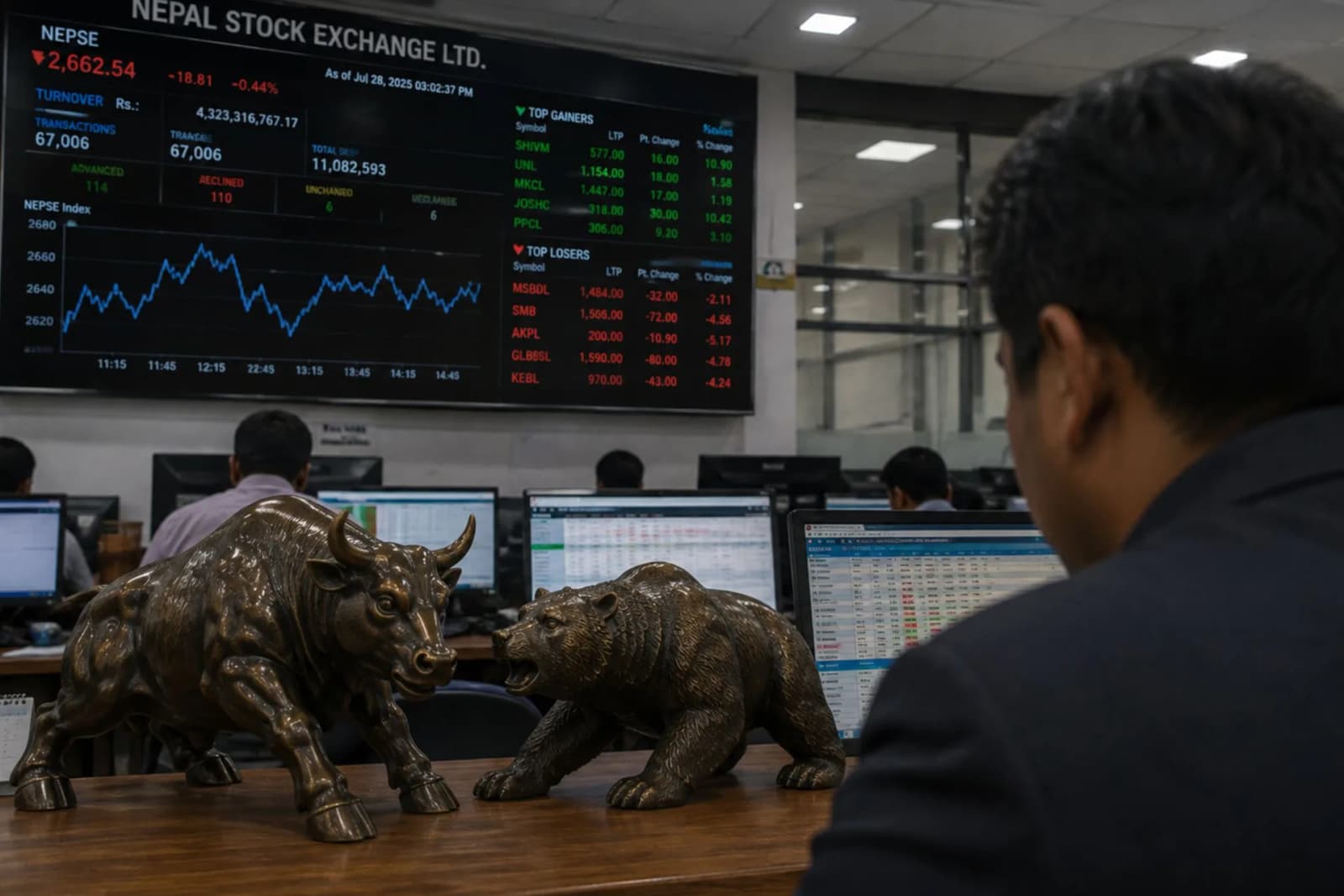
For years, trading on the Nepal Stock Exchange has followed a fairly simple rule: if you want to sell a stock, you generally need to own it first.
Buy shares, wait for the trade to settle, and then sell them when you choose. Nepal’s secondary market currently operates on a T+2 settlement cycle, meaning a regular trade is settled two business days after it takes place.
But Nepal is now preparing for a much bigger change.

The government has announced plans to gradually introduce intraday trading, short selling, and derivatives as part of a broader effort to modernize the country’s capital market. SEBON has also urged NEPSE, CDS, and Clearing Limited (CDSC) to proceed with the work required for short selling and intraday trading.
These systems are not yet fully operational, and many of the detailed rules still need to be finalized. But if implemented, they could fundamentally change how people trade on NEPSE.
For the first time, investors could eventually be able to trade the same stock within a single day and, through a regulated short-selling system, potentially make money when a stock falls, not only when it rises.
Here is what we know so far, what is still being developed, and why these changes matter even if you have no intention of becoming a day trader.
How NEPSE Works Today
NEPSE currently operates on a T+2 settlement cycle.
In simple terms, if you buy a stock on the trading day known as “T”, the transaction is formally settled two business days later. CDSC, which handles clearing and settlement for securities traded on NEPSE, confirms that the market currently follows T+2 settlement.
That system is one reason conventional same-day trading is not currently available to ordinary NEPSE investors.
Short selling is also not currently available as a normal trading facility. Investors generally sell securities they already own rather than selling borrowed shares in anticipation of a price decline.
That is the part of the market SEBON, and the government now wants to change.
Intraday Trading: Buying and Selling on the Same Day
Intraday trading sounds complicated, but the basic idea is simple.
You buy a stock and sell it during the same trading session.
Suppose you buy shares at Rs. 500 in the morning. If the price reaches Rs. 520 later that day, an intraday system could allow you to sell those shares and close the position before the market closes.
You would not have to hold the position overnight just to complete the trade.
For active traders, that matters because prices can change significantly between one trading day and the next. Closing a position before the market shuts can reduce exposure to overnight news or events.
It can also increase trading activity and liquidity because the same capital can potentially be used more actively.
But faster trading does not mean easier profits.
Intraday trading can magnify mistakes just as quickly as it creates opportunities. Brokerage fees, taxes, price movements, liquidity, and execution speed all matter when positions are opened and closed within a short period.
SEBON had already been studying the feasibility and technical requirements of intraday trading before the government included the mechanism in its FY 2083/84 reform agenda. In July 2026, SEBON also directed NEPSE and CDSC to move the necessary work forward.
That makes the direction clear.
What is not yet clear is exactly when ordinary investors will receive access and what the final operating rules will look like.
Short Selling: Making Money When a Stock Falls

Short selling would represent an even bigger change for NEPSE.
Normally, an investor tries to:
Buy low → Sell high
Short selling reverses the order:
Borrow → Sell → Buy back → Return
Imagine you believe a stock trading at Rs. 500 is overpriced.
Under a regulated short-selling system, you could borrow shares, sell them at around Rs. 500, and wait.
If the price falls to Rs. 400, you could buy the same number of shares back for Rs. 400 and return them to the lender.
Your gross difference would be Rs. 100 per share before borrowing costs, commissions, taxes, and other applicable charges.
But if the stock instead climbs to Rs. 600, the trade works against you. You would have to spend more to buy the shares back than you originally received when you sold them.
That is what makes short selling particularly risky.
With an ordinary stock purchase, the stock can theoretically fall only to zero. With a short position, the potential loss can become much larger because there is no fixed ceiling on how high a stock’s price can eventually rise over time.
Where Do the Borrowed Shares Come From?
This is one of the most important questions.
A proper short-selling system needs a legal and organized way for traders to borrow shares. Internationally, this is generally handled through a securities lending and borrowing system, often called SLB.
Think of it as a regulated marketplace for temporarily lending shares.
A long-term investor may own shares that they have no intention of selling anytime soon. Through an SLB framework, those securities could potentially be made available to borrowers.
The lender continues to have an economic interest in the securities while receiving compensation under the lending arrangement. The borrower gets temporary access to the shares and must eventually return the required securities according to the rules.
The exact structure Nepal will use, including collateral requirements, lending fees, eligible participants, recall procedures, and settlement rules, will depend on the final framework.
Those details should not be treated as settled until SEBON, NEPSE, and CDSC publish the applicable rules.
Margin Trading Is Different, And It Is Already Here
This is where an important distinction needs to be made.
Margin trading is not the same thing as short selling.
Margin trading allows an investor to buy securities using a combination of their own money and financing provided through an authorized intermediary.
And unlike intraday trading and short selling, Nepal already has a new regulatory framework for it.
SEBON approved the Margin Trading Facility Directive, 2082, which took effect from Falgun 1, 2082. The framework allows eligible brokers to provide margin trading facilities subject to regulatory requirements.
So Nepal is not starting all of these reforms from zero.
Margin trading is already part of the changing market structure, while intraday trading and short selling remain part of the next stage of reform.
Not Every Stock May Be Suitable for These Tools
One question investors naturally have is whether every company listed on NEPSE would be available for margin trading or future short selling.
That should not be assumed.
For example, SEBON’s margin-trading framework uses eligibility requirements for securities that can be financed through the facility.
A future short-selling system could similarly restrict participation based on factors such as liquidity, public shareholding, trading history, financial condition, or other criteria.
But until the final short-selling rules are published, it would be premature to say that commercial banks, hydropower companies, or any other particular group will definitely qualify.
The safer conclusion is simple:
Expect eligibility rules but wait for SEBON and NEPSE to publish them before assuming which stocks will be included.
NEPSE’s Price Limits Matter More Once Short Selling Arrives
This is where things become particularly interesting.
NEPSE uses price limits to control how far an individual security can move during a trading day. Current 2026 rules have been reported as allowing individual stocks to move as much as 15% in either direction during a session, following changes introduced in April 2026.
That is important for anyone thinking about short selling.
Suppose a trader borrows and sells shares expecting the price to fall.
Instead, demand explodes.
The stock begins climbing toward its upper price limit, and sellers disappear from the market.
The short seller now wants to buy shares back and close the position, but there may not be enough shares available at an executable price.
That is one of the situations in which a short position can become extremely uncomfortable.
The important distinction is that a daily price limit and a market-wide circuit breaker are not the same thing. The individual-stock limit restricts the price range in which that security can trade, while market-wide circuit-breaker rules can temporarily halt or suspend trading when the overall NEPSE index moves sharply.
That distinction becomes much more important in a market where traders can hold short positions.
Short Selling Has Risks That Ordinary Buying Does Not
Short selling is often described simply as “making money when stocks fall.”
Technically, that is possible.
But the description hides the other half of the story.
A short seller has to find securities to borrow, pay whatever borrowing costs apply, maintain required collateral or margin, and eventually return the shares.
If the price moves sharply upward, losses can grow quickly.
If borrowed shares become difficult to obtain, borrowing costs can rise.
And if too many traders try to close short positions at the same time, their buying can push the stock even higher, creating what is commonly known as a short squeeze.
That is why the final rules on collateral, settlement, position limits, eligible securities, forced closeouts, lending arrangements, and risk management will matter just as much as the decision to allow short selling itself.
What About T+1 Settlement?
Nepal currently uses T+2 settlement for securities traded on NEPSE.
Moving to T+1 would mean completing settlement one business day after the trade instead of two.
A faster settlement cycle could reduce the amount of time securities and money remain tied up in the settlement process and could support a more modern trading environment.
However, a move to T+1 should be treated separately from the confirmed government commitment to introduce intraday trading and short selling.
Unless SEBON, NEPSE, or CDSC formally announces a T+1 implementation schedule, investors should not assume that T+1 is arriving at the same time as intraday trading.
For now, T+2 remains the operating settlement cycle.
Does SEBON Have the Legal Power to Introduce These Systems?
Broadly, yes, but the exact legal route matters.
The Securities Act, 2063 provides several mechanisms for regulating Nepal’s securities market.
Under Section 116, SEBON may frame rules, subject to Government of Nepal approval, to implement the objectives of the Act.
Under Section 117, a securities market such as NEPSE may frame regulations, with SEBON’s approval, on matters including the listing and trading of listed securities.
Section 118 separately allows SEBON to issue directives on specified securities-market matters, including other matters relating to the regulation of securities transactions.
These provisions create the legal framework through which new trading mechanisms can be regulated.
But it would be premature to say with certainty that short selling or intraday trading will specifically be implemented under Section 116(k), Section 117(a), or Section 118 until the final legal instrument is actually published.
The important point is that the Securities Act gives SEBON and the securities market regulatory tools to establish and govern trading mechanisms. The exact combination of regulations, exchange rules, directives, procedures, and technical standards should become clearer as implementation moves forward.
Why This Matters Even If You Never Short a Stock

Most NEPSE investors probably will not become short sellers or full-time day traders.
That does not mean these changes will not affect them.
Intraday trading could increase turnover and liquidity. Short selling could create a way for investors to express a negative view on a stock rather than simply staying out of it. Securities lending could allow long-term holders to earn fees from securities they would otherwise continue holding.
At the same time, leverage and short selling can introduce new forms of risk.
Nepal’s stock market has a large retail investor base, and many participants have never traded in an environment where leveraged positions, borrowed securities, margin calls, and short squeezes are normal parts of the market.
That makes investor education just as important as the technology behind the new system.
What Is Confirmed and What Is Not
The direction of Nepal’s capital-market reform is now fairly clear.
The government’s FY 2083/84 budget called for the phased introduction of intraday trading, short selling, and derivatives, while SEBON has separately been pushing NEPSE and CDSC to prepare for intraday trading and short selling.
Margin trading, meanwhile, has already moved into a new regulatory phase under SEBON’s Margin Trading Facility Directive, 2082.
But several major questions remain unanswered.
The final short-selling framework has not yet been established, publicly and conclusively, with all the details investors need to know: exactly which securities can be shorted, who can lend them, what collateral will be required, how long positions can remain open, what happens when shares cannot be returned on time, and what protections will apply during extreme market moves.
Those details will determine whether the reform simply makes NEPSE faster or fundamentally changes the way Nepal’s stock market behaves.
For now, investors should remember one thing:
Intraday trading and short selling are coming as part of Nepal’s market-reform agenda, but “planned” does not mean “live.”
Until the final rules and operating procedures are published, the existing trading and settlement system remains the one investors have to follow.
Source
Securities Board of Nepal (SEBON) regulations, directives, notices and capital-market reforms.
Nepal Stock Exchange (NEPSE) trading rules, price limits, market notices and trading-system information.
CDS and Clearing Limited (CDSC) clearing and settlement information, including Nepal's T+2 settlement framework.
Nepal Law Commission Securities Act, 2063 legal basis for SEBON and securities-market regulatory powers, particularly Sections 116–118.
Ministry of Finance, Government of Nepal FY 2083/84 budget and government's capital-market reform policies.
Published Aug 10 in Researched Article