
The Story Behind Nepal's Chuchche Map And The Debate Over Nepal's New Coins
Nepal's Cabinet has approved a redesign of the Re. 1 and Rs. 2 coins, with reports that the Re. 1 coin will feature Lo Ghyakar Monastery instead of the country's map. Critics call it a sidelining of a national symbol, while officials call it a cost-driven technical update. The move has revived debate over how national identity is represented on Nepal's currency.
· 7 min read
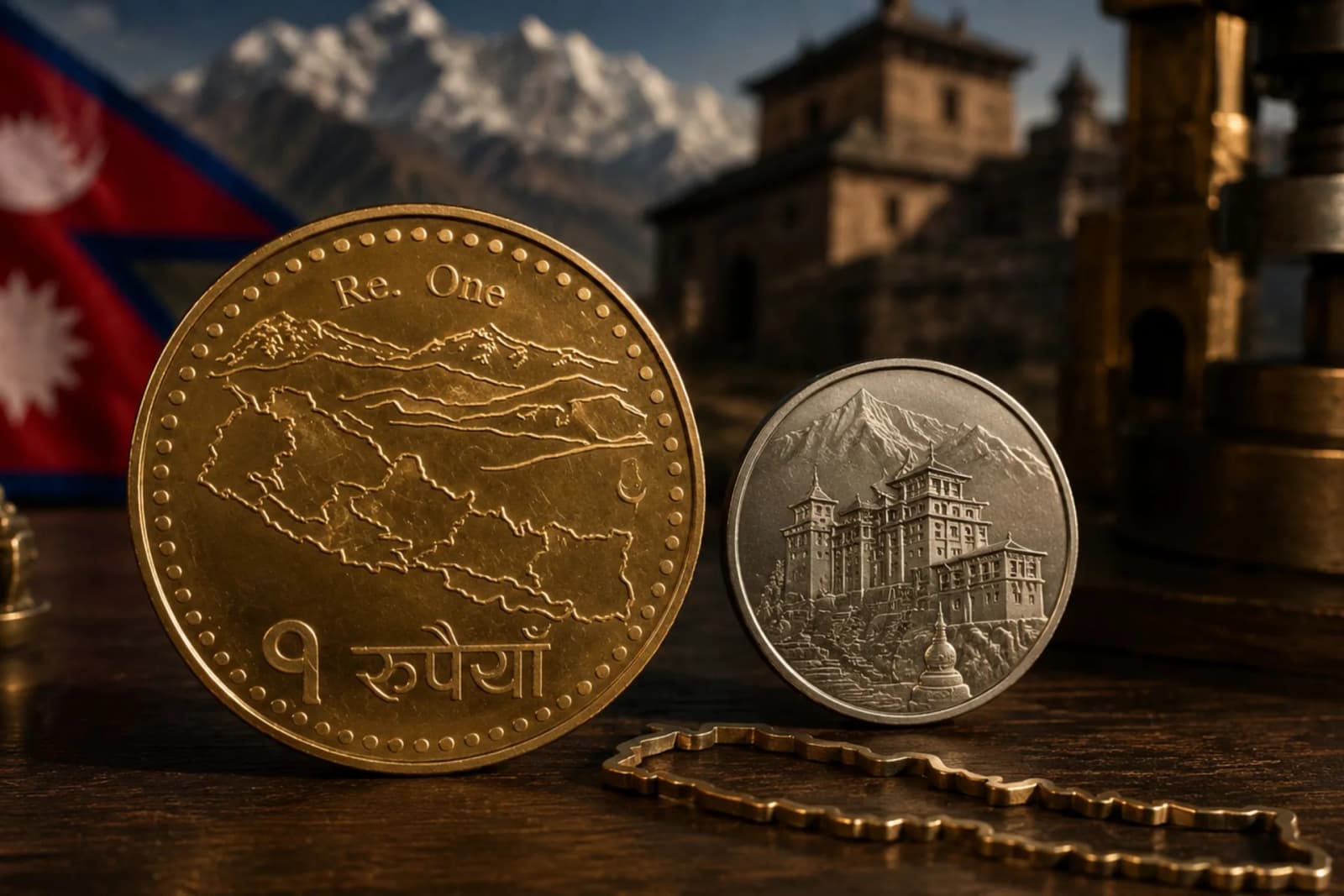
The Coin That Sparked a New Debate
The debate began after Nepal's Cabinet approved new designs for the country's Re. 1 and Rs. 2 coins, authorizing Nepal Rastra Bank to mint the updated versions. According to government officials, the redesign is intended to modernize Nepal's coins by making them smaller, lighter, and more cost-effective to produce. Reports also stated that the new Re. 1 coin would feature Lo Ghyakar Monastery in Mustang, replacing the map of Nepal that appeared on previous versions of the coin.
The proposed design quickly drew public and political attention. Some critics questioned the reported removal of Nepal's map, arguing that national symbols should continue to appear on the country's currency. Others pointed out that the redesign was presented by officials as a technical and production-related update rather than a change to Nepal's official territorial position. As a result, the discussion has grown beyond the coin itself, becoming a wider conversation about national identity, symbolism, and how Nepal's heritage is represented on its currency.
2. What Is the Chuchche Map?
The "Chuchche Map" (Nepali: चुच्चे नक्सा) is the popular nickname for Nepal's current official political map, which was adopted in 2020. The word chuchche means "pointed" or "sharp-tipped" in Nepali, referring to the map's distinctive pointed western edge that extends toward Limpiyadhura, making it visually different from Nepal's previous official map. This nickname has since become widely used in public and political discussions, according to an analysis by The Kathmandu Post.

The updated map includes Limpiyadhura, Lipulekh, and Kalapani territories that Nepal claims based on its interpretation of historical documents, including the 1816 Treaty of Sugauli. The map was unanimously approved by Nepal's Parliament in 2020 and incorporated into the country's official emblem and constitutional schedule. India, however, does not recognize the revised map and continues to maintain its own claim over the disputed areas, as explained by The Kathmandu Post.
Since then, the term "Chuchche Map" has become commonly used by the media, politicians, and the public when referring to Nepal's revised political map and the broader discussion surrounding the western border dispute.
3. How Nepal Adopted the New Map
The issue gained momentum in May 2020, after India opened a road through Lipulekh, an area claimed by both Nepal and India. Nepal then released a revised political map on May 20, 2020, including Limpiyadhura, Lipulekh, and Kalapani.
To place the map in Nepal’s national emblem, Parliament amended Article 9(2) and Schedule 3 of the Constitution. According to The Kathmandu Post, the amendment passed unanimously in the House of Representatives on June 13, 2020, and in the National Assembly on June 18, 2020.
4. From Constitution to Currency
After Nepal adopted the revised map in its Constitution, the new outline gradually began appearing on official materials. According to eKantipur, the Cabinet decided in May 2024 to include the updated map on the Rs. 100 banknote. The decision was announced by then government spokesperson Rekha Sharma, while Nepal Rastra Bank said the note would still need to complete the regular design and approval process before it could be issued.
The revised map had already appeared on a special Re. 1 commemorative coin issued in 2078 BS. A commemorative coin is created to mark an important national event or milestone, rather than mainly for everyday transactions. According to Ratopati English, the coin marked the constitutional change that added Nepal’s updated map to the national emblem.
5. Why the Coin Redesign Is Being Discussed
According to ICT Frame, Nepal Rastra Bank approved a redesign of the Re. 1 and Rs. 2 coins to reduce production costs and improve efficiency. The new coins will be made of stainless steel instead of stainless iron, making them smaller and lighter. The Re. 1 coin will be reduced from 4.0 grams to 3.2 grams, while the Rs. 2 coin will decrease from 5.0 grams to 3.8 grams. The coins will continue to be minted in Poland, with production expected to cost around Rs. 2.40 per coin.
According to ICT Frame, Nepal Rastra Bank said the updated size made it difficult to clearly reproduce the detailed outline of Nepal's revised map on the Re. 1 coin. As a result, reports indicate the design will instead feature Lo Ghyakar Monastery in Mustang. Ratopati English also reported that the monastery is expected to replace the map on the regular Re. 1 coin, although the redesign has sparked public discussion over the representation of national symbols on Nepal's currency.
6. The History of Lo Ghyaker Monastery
Lo Ghyaker Monastery, also known as Lo Gekar, is one of Nepal's oldest Buddhist monasteries. Located along the Marang River in Upper Mustang at an elevation of about 3,930 meters (12,894 feet), the monastery is believed to have been founded in the 8th century by Guru Padmasambhava (Guru Rinpoche), a revered figure credited with spreading Buddhism across the Himalayan region.
According to NORBUSUM, the monastery is closely associated with the Pema Katang, a sacred biography of Guru Padmasambhava discovered by the Tibetan treasure revealer Orgyen Lingpa in the 14th century. Although the monastery traces its origins to the 8th century, most of the structure seen today reflects a major restoration carried out during the 16th century, helping preserve its religious and historical significance.
7. Why Maps Become Political Symbols
Maps are more than geographic references they can also represent a country's identity, history, and territorial claims. Because of that, changes to official maps or the way they appear on government documents, currency, or national symbols often attract public and political attention.
As Lok Raj Baral writes in a Kathmandu Post opinion column, maps in South Asia frequently carry political significance because they reflect competing historical narratives and unresolved border disputes. The column argues that official maps are often viewed not only as geographic tools but also as expressions of national sovereignty and state identity. Since this is an opinion piece, these observations reflect the author's analysis rather than established fact.
8. Where Things Stand Today
Today, the Chuchche Map remains Nepal's official political map and continues to appear in the country's Constitution and national emblem. At the same time, the proposed redesign of the regular Re. 1 coin has sparked renewed public discussion about how national symbols should be represented on Nepal's currency.
Supporters and critics have expressed different views on the redesign, while government officials have said the changes are intended to make the coins smaller, lighter, and more cost-effective to produce. As the discussion continues, the debate reflects how a small change in a country's currency can raise broader conversations about history, identity, culture, and national symbols.
Ultimately, the redesign is still part of an ongoing public conversation. How Nepal balances practical design decisions with the symbolic importance of its national icons will continue to be closely watched.
Sources
MyRepublica. Bhim Rawal calls reported coin redesign another serious anti-national move.
The Kathmandu Post. Map politics in South Asia. September 16, 2023.
The Kathmandu Post, Constitution amendment bill to update Nepal map endorsed unanimously at the lower house, June 13, 2020.
eKantipur. Decision to keep Chuche map in Rs. 100 note. May 6, 2024.
Ratopati English. Is the Balen government planning to remove the map of Nepal from its coins?
Lok Raj Baral. Map politics in South Asia. The Kathmandu Post, September 16, 2023.
Published Jul 22 in Researched Article