
Why Nepal Has No Death Penalty
Nepal cannot simply introduce the death penalty because Article 16(2) of the Constitution prohibits capital punishment. Nepal is also bound by the Second Optional Protocol to the ICCPR, which commits the country to abolition. However, Nepal can still pursue stronger laws, better investigations, victim protection, prevention, and greater accountability within its legal framework.
· 10 min read
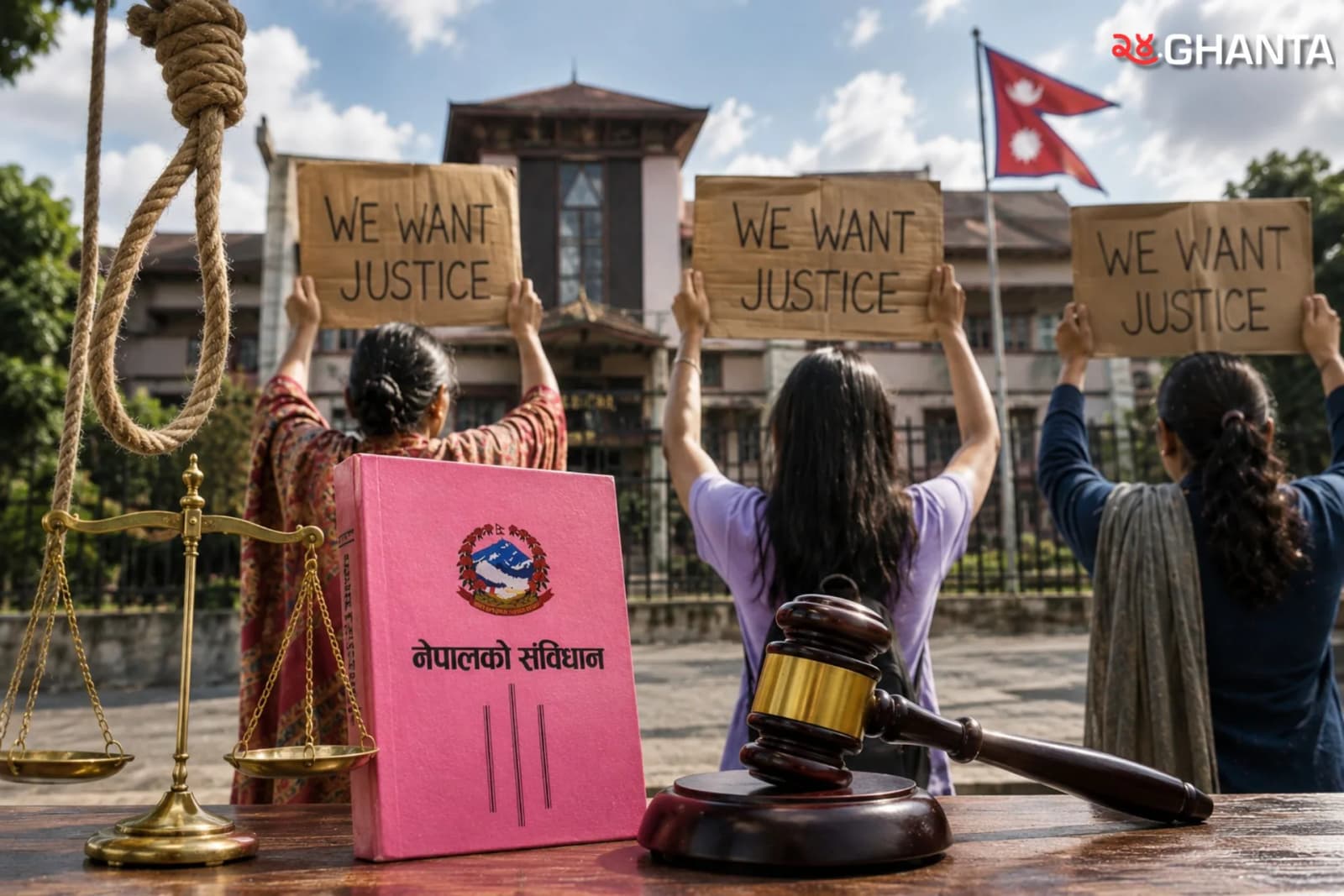
Nepal’s Constitution bans capital punishment, and the country has also made an international commitment to keep it abolished. But that does not mean Nepal cannot strengthen its laws against rape and improve the justice system.
Whenever a horrifying crime happens, especially one involving a child, people naturally ask why the offender should not receive the harshest possible punishment.
That is why the death penalty has again become part of Nepal’s public debate.
But legally, Nepal cannot simply decide today to execute people convicted of rape, murder, or other serious crimes.

There are two major legal barriers: Nepal’s Constitution and an international treaty Nepal voluntarily joined.
The Constitution Directly Bans the Death Penalty
The first and strongest domestic barrier is Article 16 of the Constitution of Nepal, which protects the right to live with dignity.
Article 16(2) says:
“No law shall be made providing for the death penalty to anyone.”
The wording is very clear.
Parliament cannot simply pass a new criminal law saying that a person convicted of rape, child rape, murder, or another serious crime should be executed.
Any ordinary law providing for capital punishment would conflict with the Constitution.
In simple terms:
Parliament can make laws, but those laws must follow the Constitution.
So the government cannot simply say, “From tomorrow, rape will be punishable by death.”
The Constitution itself would first have to be addressed.
Can Article 16 Be Changed?
Nepal’s Constitution does contain a constitutional amendment process under Article 274.
This is important because Article 16 is not expressly listed as a provision that can never be amended.
So it would be inaccurate to say:
“Article 16 can never be changed under any circumstances.”
A constitutional amendment could theoretically be proposed.
But changing the Constitution is much harder than passing an ordinary law. Article 274 requires the constitutional amendment process and, ultimately, support from at least a two-thirds majority of the total number of then members of both Houses of the Federal Parliament.
Even if Nepal successfully changed Article 16, however, the problem would not end there.
Nepal has another legal obligation at the international level.
Nepal Also Joined an International Treaty Against the Death Penalty
Nepal is a party to the International Covenant on Civil and Political Rights, or ICCPR.
The ICCPR protects basic human rights such as life, liberty, fair trial, privacy, freedom of expression, and protection from torture.
But the ICCPR itself is not the main reason Nepal cannot have capital punishment.
The more important treaty is the:
Second Optional Protocol to the International Covenant on Civil and Political Rights, aiming at the abolition of the death penalty.
Nepal acceded to this Protocol on March 4, 1998.
That means Nepal voluntarily accepted an international legal obligation specifically aimed at abolishing capital punishment.
What Does the Second Optional Protocol Say?
Article 1 of the Protocol says that no one within the jurisdiction of a State Party shall be executed.
It also requires every State Party to take the necessary measures to abolish the death penalty.
In simple terms, Nepal agreed:
We will not execute people, and we will keep capital punishment abolished.
This was not simply a political statement or recommendation.
It was an international treaty commitment.
Could Nepal Have Kept an Exception?
The Protocol allows only one very narrow reservation.
Under Article 2, a country may, when joining the treaty, keep the possibility of using the death penalty during wartime for a most serious military crime committed during wartime.
That exception does not cover rape, murder, or other ordinary criminal offenses.
And the reservation has to be made when the country joins the Protocol.
Nepal did not preserve such an exception.
So Nepal cannot simply create a new reservation today saying:
“We now want the death penalty for rape.”
Why Can’t Nepal Simply Leave the Treaty?
This is one of the biggest questions people ask.
If Nepal voluntarily joined the Protocol, why can’t it simply say:
“We changed our mind. We no longer want to follow it.”
The difficulty is that the Second Optional Protocol contains no ordinary withdrawal or denunciation clause.
The UN Human Rights Committee has interpreted the legal framework to mean that countries that have abolished capital punishment are barred from reintroducing it and that States Parties cannot simply denounce the Protocol.
So a new government cannot simply make a political announcement and erase the obligation.
Changing political opinion does not automatically end a binding treaty commitment.
Nepal’s Own Treaty Act Also Matters
Nepal’s domestic law gives international treaties an important legal role.
Section 9 of the Nepal Treaty Act, 2047 (1990) provides that when Nepal has joined a treaty through the required process, and a provision of ordinary Nepalese law conflicts with that treaty, the conflicting domestic provision becomes invalid to the extent of that conflict for purposes of the treaty, and the treaty provision applies as Nepalese law.
This makes the international commitment more than just a promise made abroad.
In simple terms:
Nepal’s own law recognizes the legal effect of its treaty obligations.
The Easiest Way to Understand It: Two Legal Locks
Think of Nepal’s death-penalty situation as a door with two locks.
Lock One: The Constitution
Article 16(2) says no law may provide for the death penalty.
So Parliament cannot simply introduce capital punishment through an ordinary law.
Lock Two: The International Treaty
The Second Optional Protocol to the ICCPR commits Nepal to abolition.
So even if Article 16 were changed, Nepal would still face its international obligation.
That is why saying:
“Just change the law”
is not enough.
And even saying:
“Just change the Constitution”
does not solve the whole legal problem.
But Does This Mean Nepal Cannot Strengthen Its Rape Laws?
No.
This is an important distinction.
The Constitution prevents Nepal from introducing the death penalty.
It does not prevent Parliament from reviewing or strengthening other laws relating to rape, sexual violence, investigation, victim protection, sentencing, and compensation.
Nepal’s current rape law is mainly found in Section 219 of the National Penal Code, 2017.
Section 219 defines rape to include sexual intercourse without a woman’s consent. It also provides that sexual intercourse with a girl under 18 is treated as rape even if she appears to consent.
The law also says consent obtained through coercion, fear, deception, kidnapping, or similar pressure is not valid consent.
Nepal’s Rape Punishments Already Differ by the Victim’s Age
Section 219 also provides different prison terms depending on the victim’s age and circumstances.
According to the current legal framework:
Rape of a girl under 10, or certain highly vulnerable victims, can result in life imprisonment.
Rape of a girl aged 10 to under 14 can carry 18 to 20 years in prison.
Rape of a girl aged 14 to under 16 can carry 12 to 14 years.
Rape of a girl aged 16 to under 18 can carry 10 to 12 years.
Rape of a woman aged 18 or older can carry 7 to 10 years.
The law therefore already treats the age and vulnerability of the victim as important sentencing factors.
There are legitimate reasons for giving children stronger legal protection.
But lawmakers can still ask whether the overall sentencing structure is strong enough, proportionate, and consistent.
That is a lawful debate.
The Bigger Problem Is Not Only the Maximum Punishment
Public anger often focuses on one question:
“How harsh should the punishment be?”
But there is another question that matters just as much:
“How likely is the offender to actually be caught, properly investigated, convicted, and punished?”
A severe punishment written in a law means little if investigations fail, evidence disappears, victims are afraid to report, or cases take too long.
That is why stronger justice cannot only mean stronger sentences.
It must also mean:
better investigation, stronger forensic systems, better evidence preservation, faster reporting, survivor protection, and effective prosecution.
Stronger Forensic Investigation Matters
DNA and other forensic evidence can play an important role in sexual assault cases.
Nepal Police has DNA-profiling capacity, including for rape and sexual-abuse investigations.
But the broader question is whether evidence can be collected quickly, preserved correctly, tested efficiently, and used effectively throughout Nepal.
A strong justice system should continuously examine:
Are medical examinations available quickly?
Is evidence preserved properly?
Can police outside major cities access forensic services?
Are enough trained experts available?
Do results reach investigators and courts on time?
These questions matter because harsher punishment requires stronger proof, not weaker safeguards.
The Law Is Only Part of the Problem
Sexual violence cannot be solved through punishment alone.
It is also connected to the way society teaches children about gender, boundaries, consent, and responsibility.
When the victim is a very young child, people usually recognize immediately that she deserves justice.
But when a survivor is older, victim-blaming can appear.
People may ask:
What was she wearing?
Did she have a boyfriend?
Why was she there?
Why did she go with him?
Those questions can shift attention away from the offender’s actions.
The real question should be:
Was there consent?
Having a boyfriend is not automatic consent.
Knowing someone is not consent.
Wearing particular clothes is not consent.
Going somewhere with someone is not consent.
A survivor’s age, clothes, relationships, or lifestyle do not remove her right to refuse sexual activity.
Everyone Should Be Taught Accountability
For years, prevention has often focused heavily on telling people what not to do:
Don’t go out late.
Don’t go there alone.
Be careful.
Protect yourself.
Safety education has value, but preventing sexual violence should not place the responsibility primarily on potential victims.
Everyone should learn from an early age about consent, boundaries, bodily autonomy, respect, healthy relationships, and accountability.
Sex education should not only explain reproduction. Age-appropriate education can also help children understand safe and unsafe touch, personal boundaries, consent, respect, and how to seek help.
Prevention should therefore be about more than teaching people how to avoid danger. It should also be about teaching everyone to recognize boundaries, respect them, and never violate another person’s autonomy.
Stronger Education Does Not Mean Weaker Punishment
This is not an argument for replacing punishment with education.
Both are necessary.
Education works on prevention.
Criminal law creates accountability.
Police investigate.
Forensic experts examine evidence.
Prosecutors build cases.
Courts determine guilt.
And punishment follows when guilt is lawfully proven.
A strong justice system needs all of these parts to work together.
The Government Can Still Reform the Law
Law Minister Sobita Gautam has said the government cannot introduce the death penalty because of Nepal’s constitutional framework, while also discussing the need to review existing laws relating to serious crimes.
A committee has been announced to examine existing legal provisions and recommend possible changes.
That means Nepal can still debate tougher and more effective legal responses.
But a proposed review is not the same thing as a law already being changed.
Until Parliament passes amendments through the required process, the existing law remains in force.
Nepal Has More Choices Than “Death Penalty or Nothing”
The debate should not be reduced to two options:
Execute offenders
or
do nothing.
Nepal can strengthen its response in many lawful ways.
It can review prison sentences.
It can improve police investigations.
It can strengthen forensic capacity.
It can improve evidence collection.
It can protect survivors and witnesses.
It can reduce unnecessary delays.
It can provide age-appropriate consent education.
It can challenge victim-blaming.
And it can make sure convicted offenders actually face meaningful punishment.
These are not weak alternatives.
They are essential parts of justice.
The Bottom Line
Nepal cannot simply make a death penalty law because Article 16(2) of the Constitution expressly prohibits it.
Even changing Article 16 would not automatically solve the issue because Nepal also acceded to the Second Optional Protocol to the ICCPR in 1998, making an international commitment to abolish capital punishment.
Nepal’s Treaty Act also gives important domestic legal effects to treaty obligations.
But none of this means Nepal is powerless to respond to sexual violence.
The country can still strengthen rape laws, review sentences, improve investigations, expand forensic capacity, protect survivors, improve education, and challenge the social attitudes that allow victim-blaming to continue.
The real question for Nepal is therefore bigger than:
“Why don’t we execute rapists?”
It is:
How can Nepal make sure sexual violence is prevented where possible, properly investigated when it happens, fairly prosecuted, and followed by meaningful punishment when guilt is proven?
The death penalty may be legally blocked.
Stronger justice is not.
Source: Constitution of Nepal; Second Optional Protocol to the ICCPR; UN Human Rights Committee; Nepal Treaty Act; National Penal Code.
Published Aug 24 in Researched Article