
Why Nepal’s Roads Fail Every Monsoon and What Could Make Them Safer
Every monsoon, Nepal’s roads are disrupted by landslides, floods, and unfinished infrastructure. Heavy rain may trigger the damage, but weak planning, delayed projects, poor oversight, and slow disaster response often make the situation worse. Safer roads will require more than clearing blockages it will take stronger accountability, better drainage, timely warnings, and long-term planning.
· 9 min read
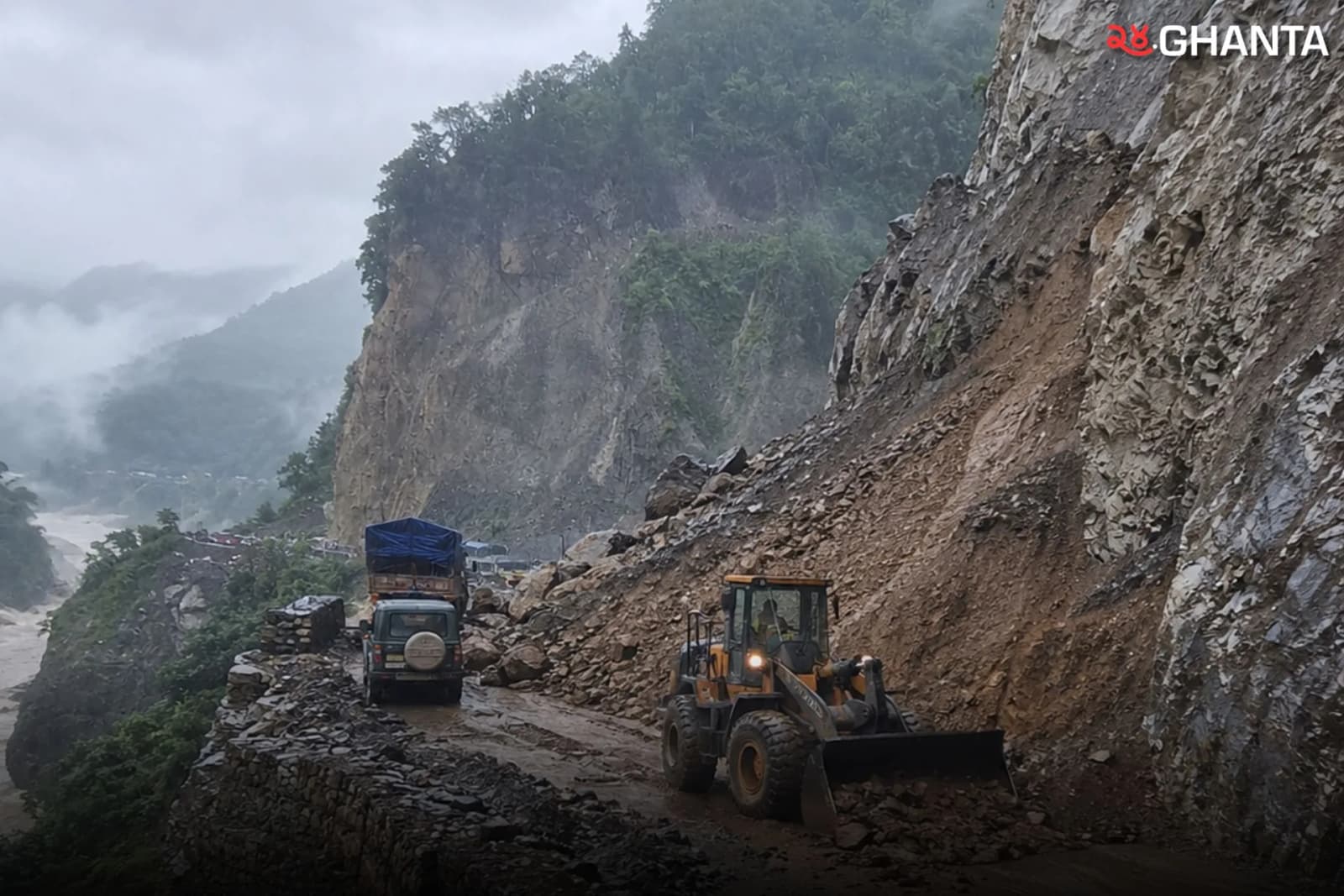
A journey that normally takes five hours can become an overnight wait during Nepal’s monsoon. Passengers sit inside buses without reliable information, ambulances are delayed, food supplies are interrupted, and families wait to hear whether the road ahead has reopened. Every year, the same question returns: must Nepal continue to face this disruption, or can its highways be made safer?
Built to Fail: Why Nepal's Roads Collapse Every Monsoon
The hillside above the Narayangadh-Muglin road at Jhyaple Khola gave way just after dark in September 2024. Two buses, parked for the night, never had a chance. Thirty-five people di*d, buried under tons of mud and rock on one of Nepal's busiest highways.

Two years later, the same corridor is still failing. At Tuin Khola, a few kilometers away, a fresh landslide zone now stretches some 165 meters, with debris falling from as high as 105 meters above the road.
Last year alone, that single stretch was blocked for a combined 184 hours, with the two worst incidents occurring on September 19 and 23, 2025. The road has still not been permanently fixed; mitigation work has typically resumed only after fresh incidents occur. Every monsoon, the cycle repeats: rain falls, the hillside slides, traffic stops, excavators arrive, and the road reopens until it happens again.
This isn't just bad weather. It's a pattern with a paper trail.
A Country That Floods on Schedule
Every June, Nepal's monsoon shows up right on cue and so do the landslides, the floods, and the blocked highways. This year was no exception. By July 20, landslides and flooding had shut down nine major highways at once, most of them clustered in Koshi and Bagmati provinces, according to The Kathmandu Post . To keep the roads passable, the Department of Roads had to rush 155 pieces of heavy equipment to vulnerable stretches nationwide, with another 122 machines held on standby in case things got worse essentially running an emergency operation just to keep the country moving during its wettest months.
Zoom out, and the scale gets hard to ignore. A study published in the Tribhuvan University journal BIBECHANA, drawing on twelve years of government disaster data from 2011 to 2022, counted 2,785 landslide incidents nationwide and 1,483 deaths more lives lost to landslides than to floods, fires, or lightning individually over the same stretch of time (Adhikari & Khanal). And the timing isn't random: 2,066 of those incidents, and 1,006 of those deaths, happened during the summer monsoon months alone, meaning roughly three out of every four landslide deaths in Nepal over those twelve years happened in these same few months, every single year.
The pattern holds up in the most current numbers, too. This week, opposition lawmakers brought a motion before the National Assembly citing a decade's worth of losses: 3,074 people dead, 502 still missing, 4,769 injured, and 33,198 families affected by floods, landslides, heavy rain, and lightning over the past ten years. In just the most recent year alone, mid 2025 through mid 2026, roughly 7,500 disaster incidents killed 140 people and disrupted 14,000 families
Even the government's own systems confirm it. The Department of Roads runs a live incident tracking dashboard, and its internal data on road closures from 2022 to 2024 shows landslides as the single biggest cause by a wide margin outpacing debris, heavy rainfall, flooding, and sludge combined.
The Roads That Were Never Really Finished
Nepal’s roads do not start failing only when the monsoon arrives. Many are already weakened by delayed contracts, poor supervision, questionable payments, and unfinished work.
The Auditor General’s 63rd Annual Report found that the Department of Roads had 2,106 ongoing contracts, but only 1,161 were considered regular. The remaining 945 contracts, nearly 45 percent, were listed as problematic or “sick.” Among them, 188 contracts worth Rs. 14 arba 67 crore 88 lakh remained unresolved.
The report also found several cases where contractors were paid more than approved designs allowed. On the Butwal Gorusinghe road, extra concrete and changes in construction materials added millions of rupees in unnecessary costs. Similar overpayments were found in road projects in Surkhet and Nepalgunj, where premix carpeting was laid thicker than approved without proper technical justification.
Financial controls were also weak. Fifteen offices overpaid contractors by Rs. 21 crore 44 lakh 65 thousand because advance payments were not properly deducted before price adjustments were calculated. Another Rs. 44 crore 71 lakh 63 thousand was paid in price adjustments that did not follow the rules.
The biggest concern came from projects that were terminated but never properly settled. Across 17 canceled contracts, the government failed to collect Rs. 5 crore 41 lakh in performance guarantees and did not recover around Rs. 2 arba 8 crore linked to unfinished work.
Design delays also pushed projects further behind. A bridge design at Tinkune remained unapproved even after 92 percent of the project timeline had passed. Two other bridge designs took nearly two years to receive approval.
The report also found that 45 percent of the department’s annual procurement contracts, worth Rs. 8 arba 96 crore, were signed in Asar, the final month of the fiscal year. This raised concerns about whether the contracts received enough technical and financial review.
These findings do not mean every landslide or road closure is caused by mismanagement. Nepal’s steep terrain, fragile slopes, and heavy rainfall create serious natural risks. But poor planning, unfinished contracts, delayed designs, and weak accountability make those risks worse.
The Department of Roads may be able to clear a landslide quickly, but clearing debris is not the same as fixing the road.
That is the real problem: Nepal often reopens roads without solving why they keep failing.
A Disaster System Without Permanent Leadership
As floods and landslides threaten communities and major highways across Nepal, opposition lawmakers are asking a simple question: Is the government prepared before disaster strikes, or only after people are already in danger?
On July 22, opposition parties filed an urgent public-interest motion in the National Assembly demanding that the home minister explain the government’s monsoon preparations. The motion highlighted several high-risk roads, including the Narayangadh–Muglin section, the Kavre–Sindhuli section of the BP Highway, Siddhababa, Daunne, and the Karnali Highway.
The concern is serious. The government’s own action plan estimates that monsoon disasters could affect 226,661 people from 51,868 households this year.
Lawmakers also questioned why the National Disaster Risk Reduction and Management Authority still lacks permanent, full-time leadership during the most dangerous season of the year. They warned that unclear leadership can weaken coordination between government agencies, local authorities, security forces, hospitals, and road offices.
Nepal already has weather forecasts, disaster plans, and SMS warning systems. But warnings do not save lives unless they quickly lead to evacuations, road closures, rescue preparations, and clear action on the ground.
The issue is not whether Nepal can predict every disaster. It is whether the government acts before another warning becomes another tragedy.
What Would Actually Make These Roads Safer
Nepal cannot stop the monsoon, but it can stop preventable failures from making every landslide worse.
The first step is enforcing road contracts. Nearly 45 percent of the Department of Roads’ ongoing contracts were listed as problematic or “sick.” When contractors leave projects unfinished, the government must collect performance guarantees and recover public money instead of allowing projects to remain abandoned.
Designs also need to be approved on time. Some bridge projects have lost months or even years waiting for paperwork, increasing both costs and delays.
The government should also stop rushing large numbers of contracts at the end of the fiscal year. The Auditor General found that contracts worth about Rs. 8 arba 96 crore were signed in Asar alone, leaving less time for proper review and planning.
Finally, Nepal’s central disaster-management authority needs permanent leadership and clearer coordination. Weather warnings matter only when they lead to timely road closures, evacuations, rescue preparations, and public alerts.
None of these steps will stop the rain. But they could prevent weak management, unfinished work, and delayed decisions from turning natural hazards into repeated disasters.
The hills are not the only thing failing every monsoon. The system is failing too.
The Warning Beneath the Water
The same problem can be seen in the heart of Kathmandu. After Maitighar flooded, Kathmandu Metropolitan City ordered officials to investigate the technical causes, including possible drainage problems and obstructions created by nearby construction.
The investigation is important, but it also reflects a familiar pattern: authorities often begin searching for the cause only after roads are underwater and daily life has already been disrupted.
Whether it is a landslide on a highway or flooding at a major city intersection, the lesson is the same. Nepal needs to identify risks, maintain drainage systems, review construction impacts, and assign responsibility before the next storm, not after the damage is done.
sources :
Bimal Khatiwada, “Roads Department Deploys Heavy Machinery as Monsoon Landslides Disrupt Highways,” The Kathmandu Post, July 19, 2026.
Ramesh Kumar Paudel, “Tuin Khola Landslide Threat Persists as Monsoon Nears,” The Kathmandu Post, May 11, 2026.
Republica, “Jhyaple Khola Landslides: All 35 Dead Identified (With List),” Republica, October 4, 2024.
Post Report, “Landslides and Floods Block Nine Highways,” The Kathmandu Post, July 20, 2026
Department of Roads, “NAVIGATE Road Closure Dashboard,” Ministry of Physical Infrastructure and Transport, Government of Nepal, accessed July 23, 2026.
Kalpana Ghimire, “Road Department and Ministry Face Scrutiny for Negligence and Financial Irregularities,” Ratopati, May 20, 2026.
Ratopati, July 22, 2026; Nepal Monsoon Preparedness and Response National Action Plan 2083.
Ratopati Correspondent, “Opposition Registers Urgent Public-Interest Motion in National Assembly,” Ratopati, July 22, 2026.
Ratopati reports on the Auditor General’s 63rd Annual Report and the National Assembly’s urgent public-interest motion.
Ratopati Correspondent, “Metropolitan Municipality Directs Officials to Submit Report on Causes of Maitighar Flooding,” Ratopati, July 22, 2026.
Adhikari, Pitri Bhakta, and Nabraj Khanal. “Seasonal Variations of Disasters in Nepal.” BIBECHANA, vol. 21, no. 1, 2024, pp. 1–11.
Published Jul 23 in Researched Article