
You May Already Have a Chance to Win Rs. 10 Lakh: How Nepal’s Taxpayer Incentive Prize Program Actually Works
Your recent digital purchase may have already given you a chance to win up to Rs. 10 lakh under Nepal’s Taxpayer Incentive Prize Program. Eligible transactions may be entered automatically, but winners have only five days to claim their prizes after the results are announced. Although the program is temporarily suspended due to Nepal’s current situation, the Inland Revenue Department has announced 33 winners for eligible transactions recorded up to Bhadra.
· 8 min read
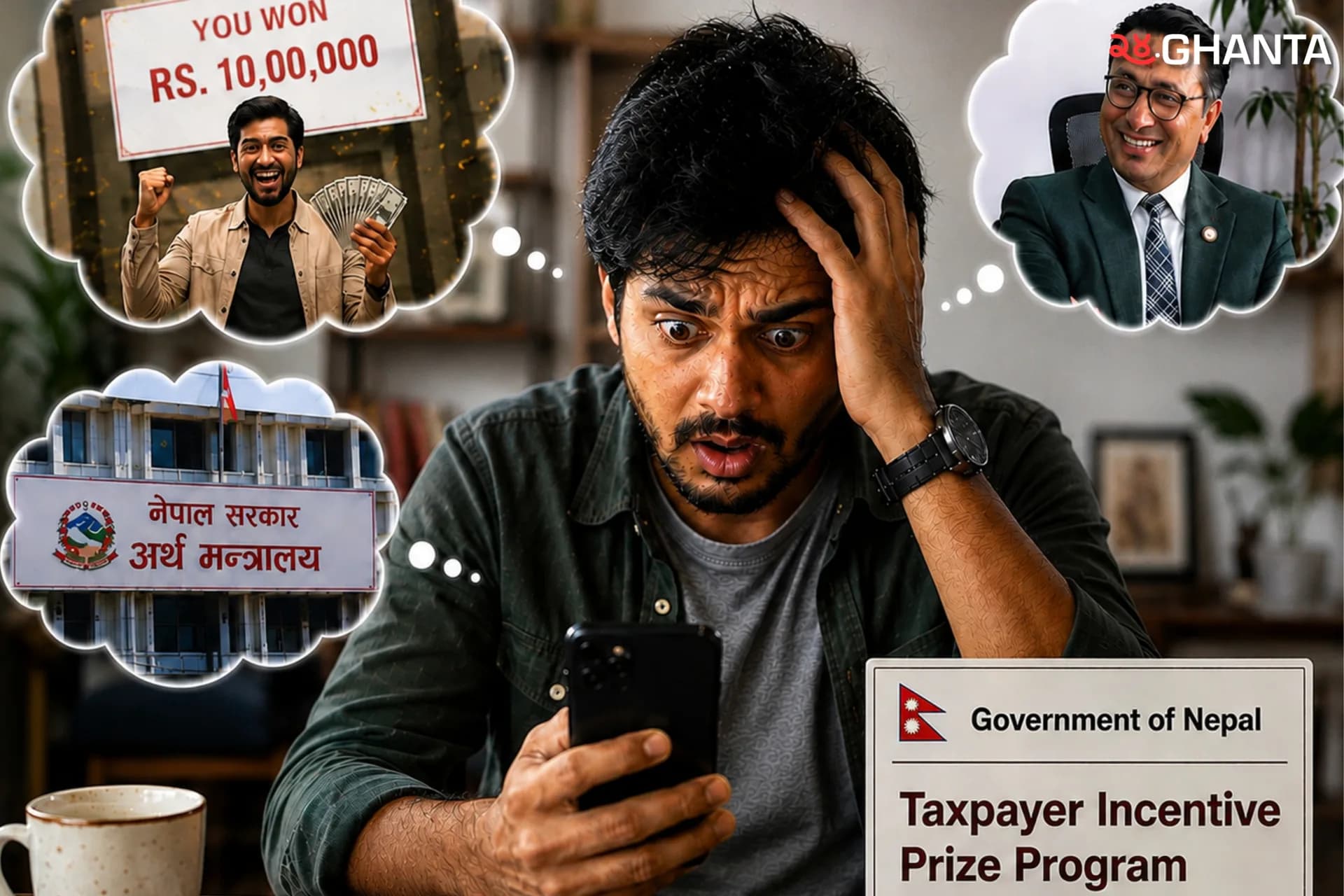
That QR payment you made while buying something at a local shop may be doing more than sitting unnoticed in your transaction history. If the purchase meets the government’s requirements, it may already be entered into Nepal’s Taxpayer Incentive Prize Program 2083, where consumers can win a daily prize or a Rs. 10 lakh bumper prize every 15 days.
But there is an important catch: not every payment, QR transaction, or bill qualifies.

The program is run by the Inland Revenue Department (IRD) under an operating procedure introduced by the Ministry of Finance. Its purpose is not simply to give away money. The government wants more consumers to ask for proper bills, encourage businesses to record their actual sales, and improve tax compliance.
The government is giving consumers another reason to do something many of us forget after shopping: take the bill and keep it.
Who Can Enter the Prize Program?
You do not need to make a huge purchase to have a chance.
An individual buying goods or services in Nepal for personal use can participate if a single eligible purchase is more than Rs. 100.
However, spending Rs. 100 or more alone does not guarantee an entry. The purchase must meet the program’s other requirements, including being made from an eligible seller with a Permanent Account Number (PAN).
The bill matters too. If you eventually win, your original invoice is one of the documents you may need to claim the money.
So before throwing that small receipt into the nearest trash can, it may be worth checking it.
Paid Digitally? You May Already Be Entered
This is perhaps the most interesting part of the program.
If you make an eligible electronic payment, the transaction can be entered into the prize program automatically. The IRD’s prize portal specifically states that QR and card payments are automatically registered, while its online registration form is provided for eligible cash transactions.
That means you may not have to fill out a separate form every time you make a qualifying QR or card payment.
But there is an important distinction.
Paying digitally does not automatically make an otherwise ineligible purchase eligible. The purchase itself still needs to satisfy the program’s rules.
Where Do You Find Your Coupon Number?
Your coupon number is important because it identifies your entry in the prize program.
Where you find it can depend on the payment service you used.
For example, eSewa says eligible QR transactions made through its platform automatically generate a coupon code. Users can check eligible payments and coupon codes through the Taxpayer Incentive Prize Program section of the eSewa app. According to eSewa, it can take up to 24 hours for the coupon code of an eligible transaction to appear.
For payments made through banks, how the information is displayed can vary. Consumers should check the relevant transaction details, statement, or IRD incentive section available through their banking service.
The key point is simple: if you have an eligible digital payment, check for your coupon number and keep it.
Paid in Cash? You Can Still Participate
Paying cash does not automatically leave you out of the program.
If you paid cash and received an eligible bill, you can register the invoice yourself through the IRD’s official prize portal.
The registration requires information such as the bill number, seller’s PAN, invoice date, purchase amount, payment method, purchaser’s name, and mobile number. The system then checks whether the invoice qualifies.
And you cannot keep entering the same bill to improve your chances.
One eligible purchase = one prize entry.
Before Paying, Check the Seller and Your Bill
There is another practical point consumers should pay attention to when making digital payments.
The important thing is that the transaction can be properly connected to the eligible business purchase. Consumers should therefore check the merchant/payment details and make sure they receive a proper invoice containing the seller’s PAN.
This matters because simply transferring money digitally does not, by itself, prove that the transaction qualifies for the incentive program.
A useful habit is therefore:
Pay correctly. Ask for the bill. Check the PAN. Keep the bill.
Not Every Bill Can Win
Seeing a PAN number or paying through QR does not mean every purchase qualifies.
The operating procedure excludes several types of transactions, including business purchases, purchases from sellers without PAN, telephone services, internet services, electricity services, vehicles and other means of transportation, air tickets, and invoices issued in the name of government bodies or public institutions.
So if you paid digitally for one of these excluded purchases, the payment method does not turn it into an eligible entry.
The purchase itself has to qualify.
When Are Winners Chosen?
You do not have to wait months for one large annual draw.
Winners are selected twice during each Nepali month on the 1st and the 16th.
Purchases made from the 1st through the 15th are considered for the selection on the 16th. Eligible purchases made from the 16th through the end of the month are considered for the selection on the 1st of the following month.
The procedure says winners are selected through an automated system.
For each applicable period, the program provides for daily winners as well as a bumper winner.
How Much Can You Win?
There are two main prize amounts:
Daily prize: Rs 1,33,334
15-day bumper prize: Rs 10,00,000
But the amount announced is before tax.
The procedure provides for a 25% tax deduction from the prize.
So a person announced as the Rs 10 lakh bumper winner would receive Rs 7.5 lakh after the stated 25% deduction.
Similarly, a Rs 1,33,334 daily prize works out to approximately Rs 1 lakh after the deduction.
So when you see “Rs 10 lakh prize,” remember that Rs 10 lakh is the gross amount, not the final amount the winner receives.
How Do You Know If You Won?
You should not have to discover your win by accident.
Under the procedure, selected winners are informed through the mobile number and email address connected to their entry.
Winner information is also published through the IRD’s website and social media channels.
This is especially important for people registering cash purchases themselves: make sure the contact information you enter is correct.
Won? Don't Throw Away That Original Bill
Getting selected is only the first step.
To receive the prize, the winner must submit a claim to a nearby Inland Revenue Office, either personally or through an authorized representative.
The required documents include the original invoice, an accepted identification document, PAN, and bank account details.
After the information and documents are verified, the procedure says the prize should be distributed within 10 days, with the payment deposited into the winner’s bank account.
That little bill you normally leave at the shop could therefore become very important.
Important: Winners Currently Have 15 Days to Claim
The current government-hosted version of the procedure referenced for this article states that winners have 15 days from the prize announcement to submit their claim.
What Happens If You Miss the Deadline?
Winning does not mean the prize remains yours forever.
If a winner does not submit the required documents and claim the prize within the prescribed period, the unclaimed money is deposited into the Prime Minister Natural Disaster Relief Fund, according to the procedure.
The rules also contain safeguards against misuse. Fake, altered, duplicate, forged, or otherwise invalid documents or invoices can result in an entry being rejected, a coupon or prize being canceled, recovery of money already paid, and possible legal action.
Why Is the Government Giving Away This Money?
The Rs. 10 lakh prize gets people's attention, but the bigger story is about tax compliance.
When customers ask for proper invoices, businesses have a stronger reason to record transactions formally. Those records can make it more difficult for sales to disappear from the tax system.
The incentive program is therefore designed to encourage a culture in which sellers issue proper invoices and customers actually ask for them.
For consumers, the message is much easier:
Buy from an eligible PAN-registered seller. Ask for a proper bill. Keep the original. Check your coupon number. And if you paid cash, register an eligible invoice through the IRD portal.
The receipt you normally forget about may just be your entry for a prize worth Rs 10 lakh before tax.
Why the Bill Still Matters Even When You Pay Digitally
Digital payments have made shopping faster and easier, but they do not replace the need for a proper bill. As IRD Director Keshav Raghuwanshi explained, a QR payment mainly records that money moved from one account to another; by itself, it does not guarantee that the seller has recorded the transaction as an official sale for tax purposes.
That is why the Taxpayer Incentive Prize Program still requires an official PAN or VAT invoice. Without a proper invoice, a seller could potentially receive the money digitally but fail to record the sale in its formal accounts. In that situation, the transaction trail exists, but the tax record may still be incomplete.
This explains why the government has tied the prize program to billing rather than digital payment alone. The goal is not simply to reward people for using QR codes. It is to encourage consumers to ask for bills, push businesses to record their actual sales, and reduce the possibility of tax leakage.
For shoppers, the takeaway is simple: pay however you want, but do not walk away without checking the bill. Make sure it comes from a PAN- or VAT-registered seller, keep the original invoice, and check whether your eligible transaction has generated a coupon entry.
A digital payment may show that money changed hands. The bill is what helps show that the sale was officially recorded.
Source: Taxpayer Incentive Gift Program Operating Procedure, 2083, Inland Revenue Department, Ministry of Finance, Government of Nepal
Tags
Published Yesterday in Researched Article